Department of Anesthesiology and Pain Medicine, Anesthesia and Pain Research Institute, Yonsei University College of Medicine, 50-1 Yonsei-ro, Seodaemun-gu, Seoul, 03722, Republic of Korea.
Biostatistics Collaboration Unit, Yonsei University College of Medicine, Seoul, Republic of Korea.
Sci Rep. 2021 Jul 16;11(1):14589. doi: 10.1038/s41598-021-93990-3.
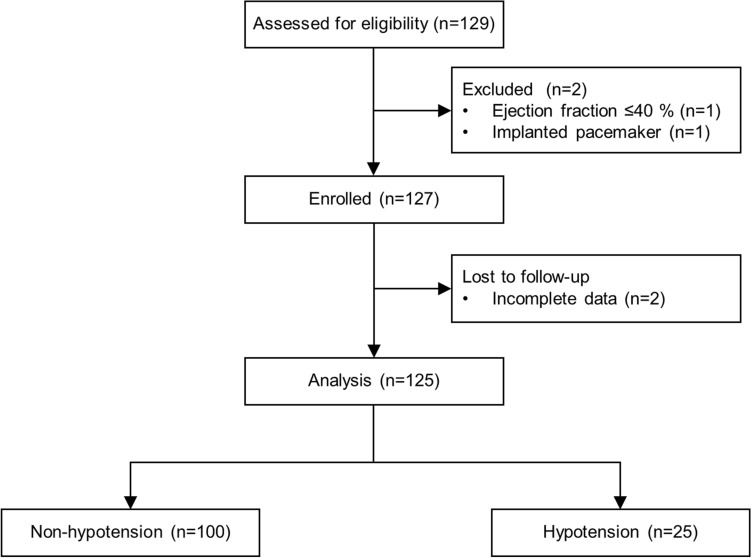
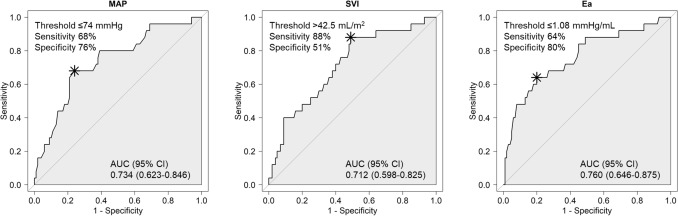
Postural change from a steep Trendelenburg position to a supine position (T-off) during robot-assisted laparoscopic prostatectomy (RALP) induces a considerable abrupt decrease in the mean arterial pressure (MAP). We investigated the variables for predicting postural hypotension induced by T-off using esophageal Doppler monitoring (EDM). One hundred and twenty-five patients undergoing RALP were enrolled. Data on the MAP, heart rate, stroke volume index (SVI), cardiac index, peak velocity, corrected flow time, stroke volume variation, pulse pressure variation, arterial elastance (Ea), and dynamic arterial elastance were collected before T-off and at 1, 3, 5, 7, and 10 min after T-off using EDM. MAP < 60 mmHg within 10 min after T-off was considered to indicate hypotension, and 25 patients developed hypotension. The areas under the curves of the MAP, SVI, and Ea were 0.734 (95% confidence interval [CI] 0.623-0.846; P < 0.001), 0.712 (95% CI 0.598-0.825; P < 0.001), and 0.760 (95% CI 0.646-0.875; P < 0.001), respectively, with threshold values of ≤ 74 mmHg, ≥ 42.5 mL/m, and ≤ 1.08 mmHg/mL, respectively. If patients have MAP < 75 mmHg with SVI ≥ 42.5 mL/m or Ea ≤ 1.08 mmHg/mL before postural change from T-off during RALP, prompt management for ensuing hypotension should be considered.Trial registration: NCT03882697 (ClinicalTrial.gov, March 20, 2019).
在机器人辅助腹腔镜前列腺切除术 (RALP) 中,从陡峭的Trendelenburg 体位转为仰卧位 (T 位) 会导致平均动脉压 (MAP) 急剧下降。我们使用食管多普勒监测 (EDM) 研究了预测 T 位后体位性低血压的变量。共纳入 125 例行 RALP 的患者。在 T 位前和 T 位后 1、3、5、7 和 10 分钟,使用 EDM 收集 MAP、心率、每搏量指数 (SVI)、心指数、峰值速度、校正流量时间、每搏量变异、脉压变异、动脉弹性 (Ea) 和动态动脉弹性的数据。T 位后 10 分钟内 MAP<60mmHg 被认为是低血压,有 25 例患者出现低血压。MAP、SVI 和 Ea 的曲线下面积分别为 0.734 (95%置信区间 [CI] 0.623-0.846; P<0.001)、0.712 (95% CI 0.598-0.825; P<0.001) 和 0.760 (95% CI 0.646-0.875; P<0.001),阈值分别为≤74mmHg、≥42.5mL/m 和≤1.08mmHg/mL。如果患者在 RALP 从 T 位转变体位期间 MAP<75mmHg 且 SVI≥42.5mL/m 或 Ea≤1.08mmHg/mL,则应考虑对随后的低血压进行及时处理。
NCT03882697(ClinicalTrials.gov,2019 年 3 月 20 日)。