Blecha Sebastian, Harth Marion, Schlachetzki Felix, Zeman Florian, Blecha Christiane, Flora Pierre, Burger Maximilian, Denzinger Stefan, Graf Bernhard M, Helbig Horst, Pawlik Michael T
Department of Anaesthesiology, University Medical Centre Regensburg, Franz-Josef-Strauss-Allee 11, 93053, Regensburg, Germany.
Department of Anaesthesiology, Caritas St. Josef Medical Center, University of Regensburg, Landshuter Str. 65, 93053, Regensburg, Germany.
BMC Anesthesiol. 2017 Mar 11;17(1):40. doi: 10.1186/s12871-017-0333-3.
To evaluate changes in intraocular pressure (IOP) and intracerebral pressure (ICP) reflected by the optic nerve sheath diameter (ONSD) in patients undergoing robotic-assisted laparoscopic prostatectomy (RALP) in permanent 45° steep Trendelenburg position (STP).
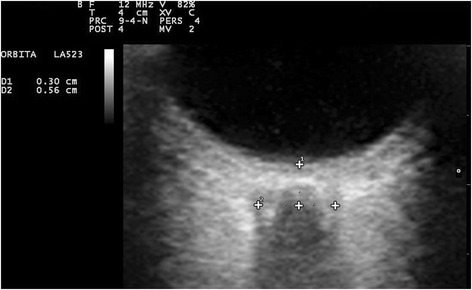
Fifty-one patients undergoing RALP under a standardised anaesthesia. IOP was perioperatively measured in awake patients (T0) and IOP and ONSD 20 min after induction of anaesthesia (T1), after insufflation of the abdomen in supine position (T2), after 30 min in STP (T3), when controlling Santorini's plexus in STP (T4) and before awakening while supine (T5). We investigated the influence of respiratory and circulatory parameters as well as patient-specific and time-dependent factors on IOP and ONSD.
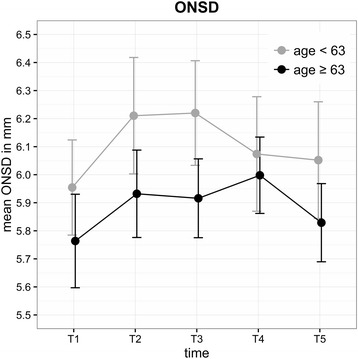
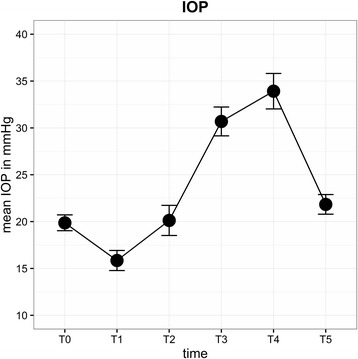
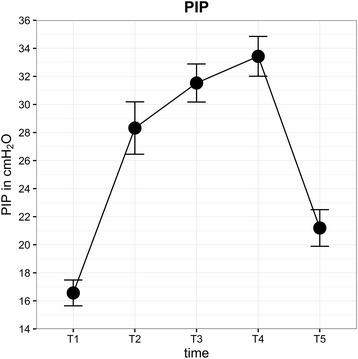
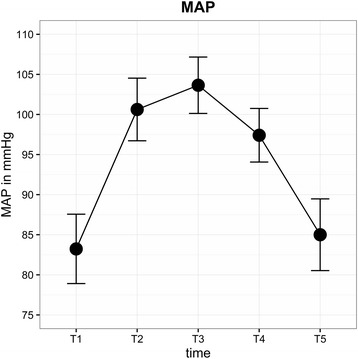
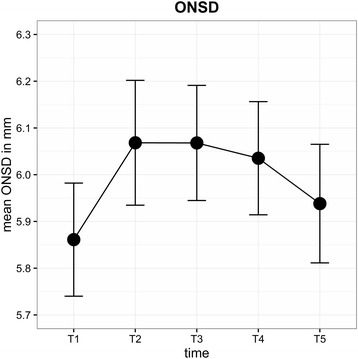
Average IOP values (mmHg) were T0 = 19.9, T1 = 15.9, T2 = 20.1, T3 = 30.7, T4 = 33.9 and T5 = 21.8. IOP was 14.0 ± 7.47 mmHg (mean ± SD) higher at T4 than T0 (p = 0.013). Univariate mixed effects models showed peak inspiratory pressure (PIP) and mean arterial blood pressure (MAP) to be significant predictors for IOP increase. Mean ONSD values (mm) were T1 = 5.88, T2 = 6.08, T3 = 6.07, T4 = 6.04 and T5 = 5.96. The ONSD remained permanently >6.0 mm during RALP. Patients aged <63 years showed a 0.21 mm wider ONSD on average (p = 0.017) and greater variations in diameter than older patients.
The combination of STP and capnoperitoneum during RALP has a pronounced influence on IOP and, to a lesser degree, on ICP. IOP is directly correlated with increasing PIP and MAP. IOP doubled and the ONSD rose to values indicating increased intracranial pressure. Differences in the ONSD were age-related, showing higher output values as well as better autoregulation and compliance in STP for patients aged <63 years. Despite several ocular changes during RALP, visual function was not significantly impaired postoperatively.
Z-2014-0387-6 . Registered 8 July 2014.
评估在永久性45°头低脚高位(STP)下接受机器人辅助腹腔镜前列腺切除术(RALP)的患者中,视神经鞘直径(ONSD)所反映的眼压(IOP)和颅内压(ICP)的变化。
51例患者在标准化麻醉下接受RALP手术。在清醒患者中围手术期测量眼压(T0),麻醉诱导后20分钟(T1)、仰卧位腹部充气后(T2)、STP体位30分钟后(T3)、STP体位下控制Santorini丛时(T4)以及仰卧位苏醒前(T5)测量眼压和ONSD。我们研究了呼吸和循环参数以及患者特异性和时间依赖性因素对眼压和ONSD的影响。
平均眼压值(mmHg)分别为:T0 = 19.9,T1 = 15.9,T2 = 20.1,T3 = 30.7,T4 = 33.9,T5 = 21.8。T4时的眼压比T0时高14.0±7.47 mmHg(均值±标准差)(p = 0.013)。单变量混合效应模型显示,吸气峰压(PIP)和平均动脉血压(MAP)是眼压升高的显著预测因素。平均ONSD值(mm)分别为:T1 = 5.88,T2 = 6.08,T3 = 6.07,T4 = 6.04,T5 = 5.96。在RALP手术期间,ONSD始终>6.0 mm。年龄<63岁的患者平均ONSD宽0.21 mm(p = 0.017),且直径变化比老年患者更大。
RALP手术期间STP和二氧化碳气腹的联合对眼压有显著影响,对颅内压的影响较小。眼压与PIP和MAP的升高直接相关。眼压翻倍,ONSD升至表明颅内压升高的值。ONSD的差异与年龄有关,年龄<63岁的患者在STP体位下显示出更高的输出值以及更好的自动调节和顺应性。尽管RALP手术期间有多种眼部变化,但术后视觉功能未受到显著损害。
Z-2014-0387-6。2014年7月8日注册。