Key Laboratory of Buffalo Genetics, Breeding and Reproduction Technology, Ministry of Agriculture and Guangxi Buffalo Research Institute, Chinese Academy of Agricultural Sciences, Nanning, China.
Institute of Animal and Dairy Sciences, University of Agriculture, Faisalabad, Pakistan.
Vet Med Sci. 2021 Sep;7(5):1696-1706. doi: 10.1002/vms3.570. Epub 2021 Jul 17.
Heat stress in tropics is generally associated with significant economic losses resulting from reduced performance, morbidity, and mortality of livestock. To avoid serious consequences of heat stress, it is imperative to better understand the physiological responses and biochemical changes under the state of altered body homeostasis during different seasons of the year.
This study aimed to evaluate the seasonal dynamics of physiological, oxidative and metabolic responses of lactating Nili-Ravi buffaloes to the tropical climate of South China.
Physiological responses including rectal temperature (RT), body surface temperature (BST) and respiratory rate (RR) along with serum biochemical and antioxidant parameters of 20 lactating Nili-Ravi buffaloes were evaluated during different seasons of the year.
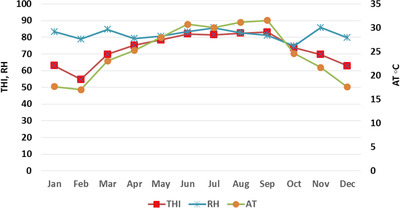
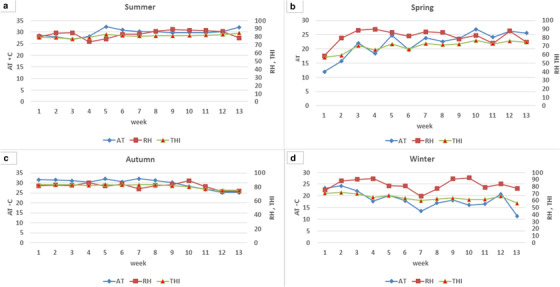
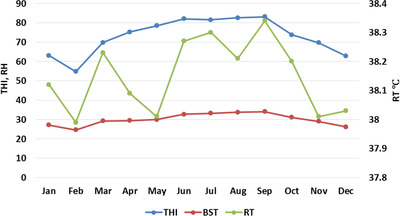
Higher temperature-humidity Index (THI) during the summer season (>80) resulted in a significant increases in RR and BST as compared to the winter season. Higher oxidative stress was observed in the summer season as revealed by significantly higher MDA while lower serum antioxidant enzyme (TAC, GSH-Px, SOD and CAT) contents. Moreover, serum cortisol was also significantly higher in summer and autumn. The levels of growth hormone and ACTH were also significantly (P < 0.05) lower in summer and autumn as compared to other seasons. The negative association of THI with physiological and antioxidant parameters was observed while it was positively associated with serum MDA and cortisol levels.
Our study revealed moderate heat stress in lactating buffaloes in the summer season which calls for attention to avoid economic losses and animal welfare issues.
热带地区的热应激通常与牲畜生产性能下降、发病率和死亡率增加导致的重大经济损失有关。为了避免热应激的严重后果,必须更好地了解在一年不同季节中身体内环境稳态改变时的生理反应和生化变化。
本研究旨在评估泌乳期尼里-拉菲水牛对华南热带气候的生理、氧化和代谢反应的季节性动态。
在一年的不同季节,评估了 20 头泌乳期尼里-拉菲水牛的生理反应(直肠温度[RT]、体表面温度[BST]和呼吸率[RR])以及血清生化和抗氧化参数。
夏季的高温高湿指数(THI)较高(>80),与冬季相比,RR 和 BST 显著升高。夏季的氧化应激更高,表现为 MDA 显著升高,而血清抗氧化酶(TAC、GSH-Px、SOD 和 CAT)含量较低。此外,夏季和秋季的血清皮质醇也显著升高。与其他季节相比,夏季和秋季的生长激素和 ACTH 水平也显著(P<0.05)较低。THI 与生理和抗氧化参数呈负相关,而与血清 MDA 和皮质醇水平呈正相关。
我们的研究表明,夏季泌乳水牛存在中度热应激,需要引起重视,以避免经济损失和动物福利问题。