Inkster Amy M, Fernández-Boyano Icíar, Robinson Wendy P
BC Children's Hospital Research Institute, Vancouver, BC V5Z 4H4, Canada.
Department of Medical Genetics, University of British Columbia, Vancouver, BC V6H 3N1, Canada.
J Clin Med. 2021 Jul 5;10(13):3000. doi: 10.3390/jcm10133000.
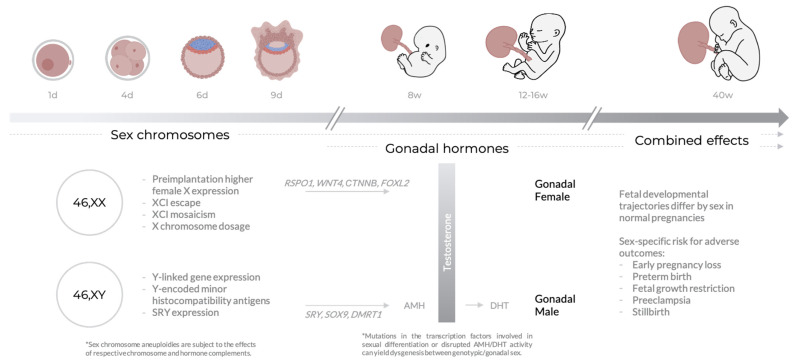
Sex differences exist in the incidence and presentation of many pregnancy complications, including but not limited to pregnancy loss, spontaneous preterm birth, and fetal growth restriction. Sex differences arise very early in development due to differential gene expression from the X and Y chromosomes, and later may also be influenced by the action of gonadal steroid hormones. Though offspring sex is not considered in most prenatal diagnostic or therapeutic strategies currently in use, it may be beneficial to consider sex differences and the associated mechanisms underlying pregnancy complications. This review will cover (i) the prevalence and presentation of sex differences that occur in perinatal complications, particularly with a focus on the placenta; (ii) possible mechanisms underlying the development of sex differences in placental function and pregnancy phenotypes; and (iii) knowledge gaps that should be addressed in the development of diagnostic or risk prediction tools for such complications, with an emphasis on those for which it would be important to consider sex.
许多妊娠并发症的发生率和表现存在性别差异,包括但不限于妊娠丢失、自发性早产和胎儿生长受限。由于X和Y染色体的基因表达差异,性别差异在发育早期就会出现,后期也可能受到性腺甾体激素作用的影响。尽管目前大多数产前诊断或治疗策略中并未考虑子代性别,但考虑性别差异以及妊娠并发症背后的相关机制可能是有益的。本综述将涵盖:(i)围产期并发症中出现的性别差异的患病率和表现,尤其关注胎盘;(ii)胎盘功能和妊娠表型中性别差异发展的潜在机制;以及(iii)在开发此类并发症的诊断或风险预测工具时应解决的知识空白,重点关注那些考虑性别因素很重要的情况。