Cox Christina P W, van Assema Daniëlle M E, Verburg Frederik A, Brabander Tessa, Konijnenberg Mark, Segbers Marcel
Department of Radiology & Nuclear Medicine, Erasmus Medical Center, Postbus, 2040 3000 CA, Rotterdam, The Netherlands.
EJNMMI Res. 2021 Jul 19;11(1):65. doi: 10.1186/s13550-021-00812-8.
The role of 2-[F]fluoro-2-deoxy-D-glucose ([F]FDG) positron emission tomography/computed tomography (PET/CT) in children is still expanding. Dedicated paediatric dosage regimens are needed to keep the radiation dose as low as reasonably achievable and reduce the risk of radiation-induced carcinogenesis. The aim of this study is to investigate the relation between patient-dependent parameters and [F]FDG PET image quality in order to propose a dedicated paediatric dose regimen.
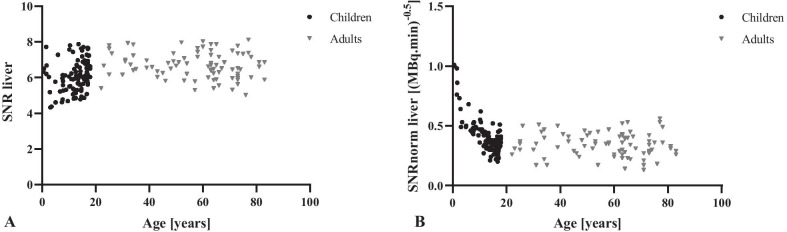
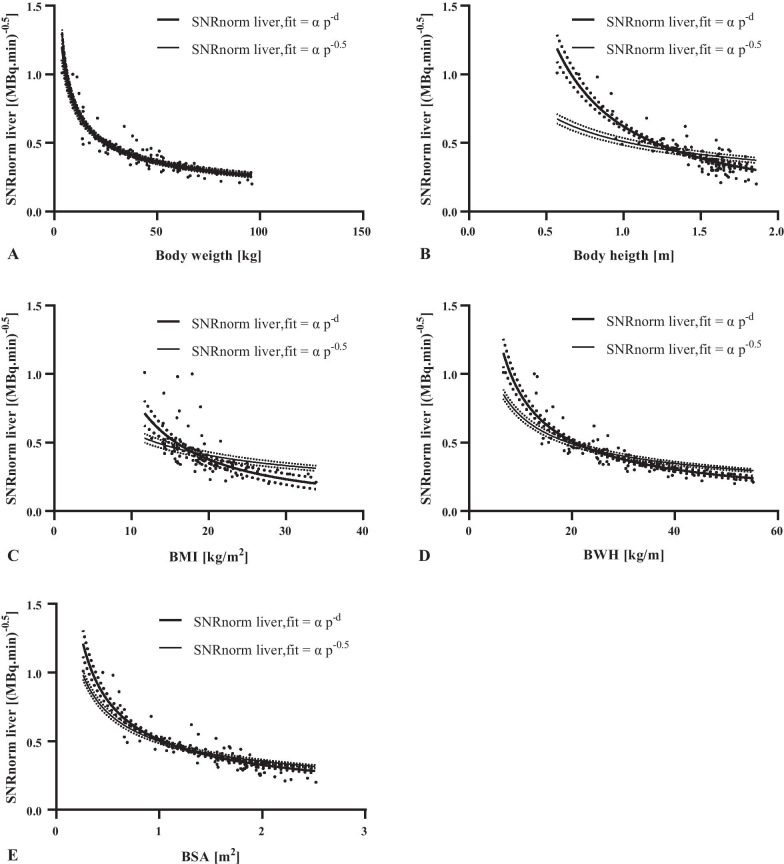
In this retrospective analysis, 102 children and 85 adults were included that underwent a diagnostic [F]FDG PET/CT scan. The image quality of the PET scans was measured by the signal-to-noise ratio (SNR) in the liver. The SNR liver was normalized (SNRnorm) for administered activity and acquisition time to apply curve fitting with body weight, body length, body mass index, body weight/body length and body surface area. Curve fitting was performed with two power fits, a nonlinear two-parameter model α p and a linear single-parameter model α p. The fit parameters of the preferred model were combined with a user preferred SNR to obtain at least moderate or good image quality for the dosage regimen proposal.
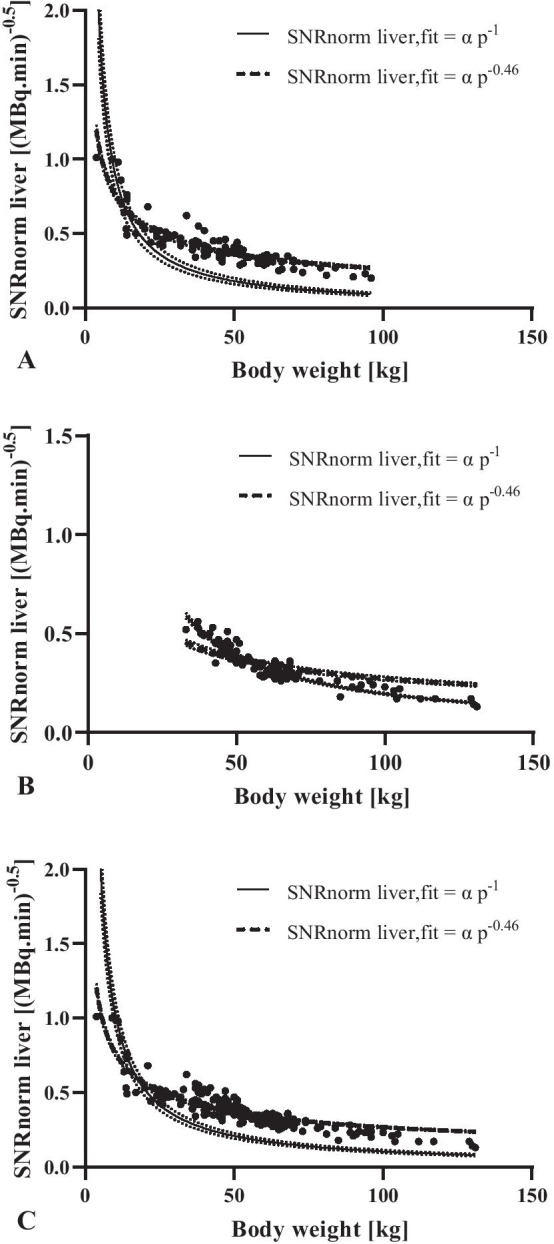
Body weight demonstrated the highest coefficient of determination for the nonlinear (R = 0.81) and linear (R = 0.80) models. The nonlinear model was preferred by the Akaike's corrected information criterion. We decided to use a SNR of 6.5, based on the expert opinion of three nuclear medicine physicians. Comparison with the quadratic adult protocol confirmed the need for different dosage regimens for both patient groups. In this study, the amount of administered activity can be considerably reduced in comparison with the current paediatric guidelines.
Body weight has the strongest relation with [F]FDG PET image quality in children. The proposed nonlinear dosage regimen based on body mass will provide a constant and clinical sufficient image quality with a significant reduction of the effective dose compared to the current guidelines. A dedicated paediatric dosage regimen is necessary, as a universal dosing regimen for paediatric and adult is not feasible.
2-[F]氟-2-脱氧-D-葡萄糖([F]FDG)正电子发射断层扫描/计算机断层扫描(PET/CT)在儿童中的应用仍在不断拓展。需要专门的儿科剂量方案,以使辐射剂量尽可能低,并降低辐射诱发癌症的风险。本研究的目的是调查患者相关参数与[F]FDG PET图像质量之间的关系,以便提出专门的儿科剂量方案。
在这项回顾性分析中,纳入了102名儿童和85名成人,他们均接受了诊断性[F]FDG PET/CT扫描。PET扫描的图像质量通过肝脏中的信噪比(SNR)来衡量。将肝脏的SNR进行归一化处理(SNRnorm),以考虑给药活度和采集时间,从而对体重、身长、体重指数、体重/身长以及体表面积进行曲线拟合。曲线拟合采用两种幂函数拟合,即非线性双参数模型αp和线性单参数模型αp。将首选模型的拟合参数与用户偏好的SNR相结合,以获得至少中等或良好的图像质量,用于剂量方案建议。
体重在非线性(R = 0.81)和线性(R = 0.80)模型中显示出最高的决定系数。根据赤池信息准则校正后,非线性模型更受青睐。基于三位核医学医师的专家意见,我们决定使用6.5的SNR。与成人二次方案的比较证实了两组患者需要不同的剂量方案。在本研究中,与当前儿科指南相比,给药活度可大幅降低。
体重与儿童[F]FDG PET图像质量的关系最为密切。基于体重提出的非线性剂量方案将提供恒定且临床足够的图像质量,与当前指南相比,有效剂量显著降低。由于通用的儿科和成人给药方案不可行,因此需要专门的儿科剂量方案。