Hematology and Oncology, Medical Faculty, University of Augsburg, Augsburg, Germany.
General Pathology and Molecular Diagnostics, Medical Faculty, University of Augsburg, Augsburg, Germany.
PLoS One. 2021 Jul 19;16(7):e0254872. doi: 10.1371/journal.pone.0254872. eCollection 2021.
COVID-19 is only partly understood, and the level of evidence available in terms of pathophysiology, epidemiology, therapy, and long-term outcome remains limited. During the early phase of the pandemic, it was necessary to effectively investigate all aspects of this new disease. Autopsy can be a valuable procedure to investigate the internal organs with special techniques to obtain information on the disease, especially the distribution and type of organ involvement.
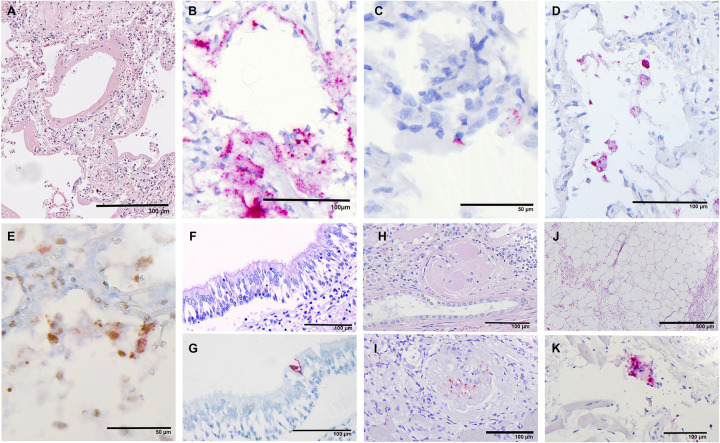
During the first wave of COVID-19 in Germany, autopsies of 19 deceased patients were performed. Besides gross examination, the organs were analyzed with standard histology and polymerase-chain-reaction for SARS-CoV-2. Polymerase chain reaction positive localizations were further analyzed with immunohistochemistry and RNA-in situ hybridization for SARS-CoV-2.
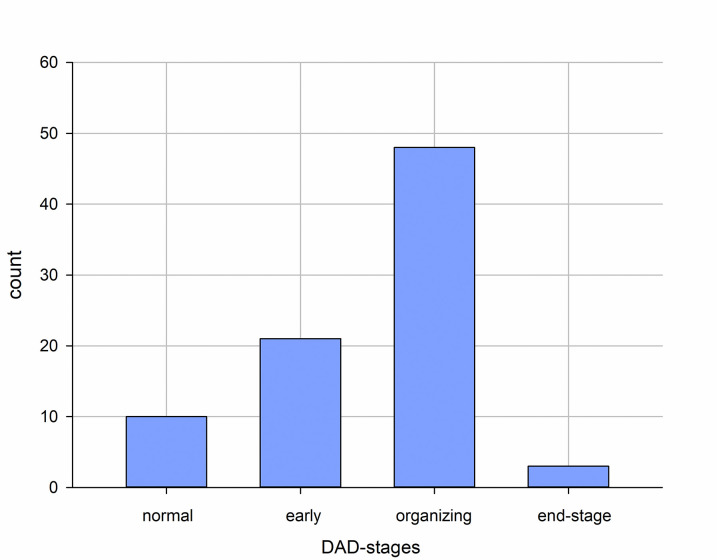
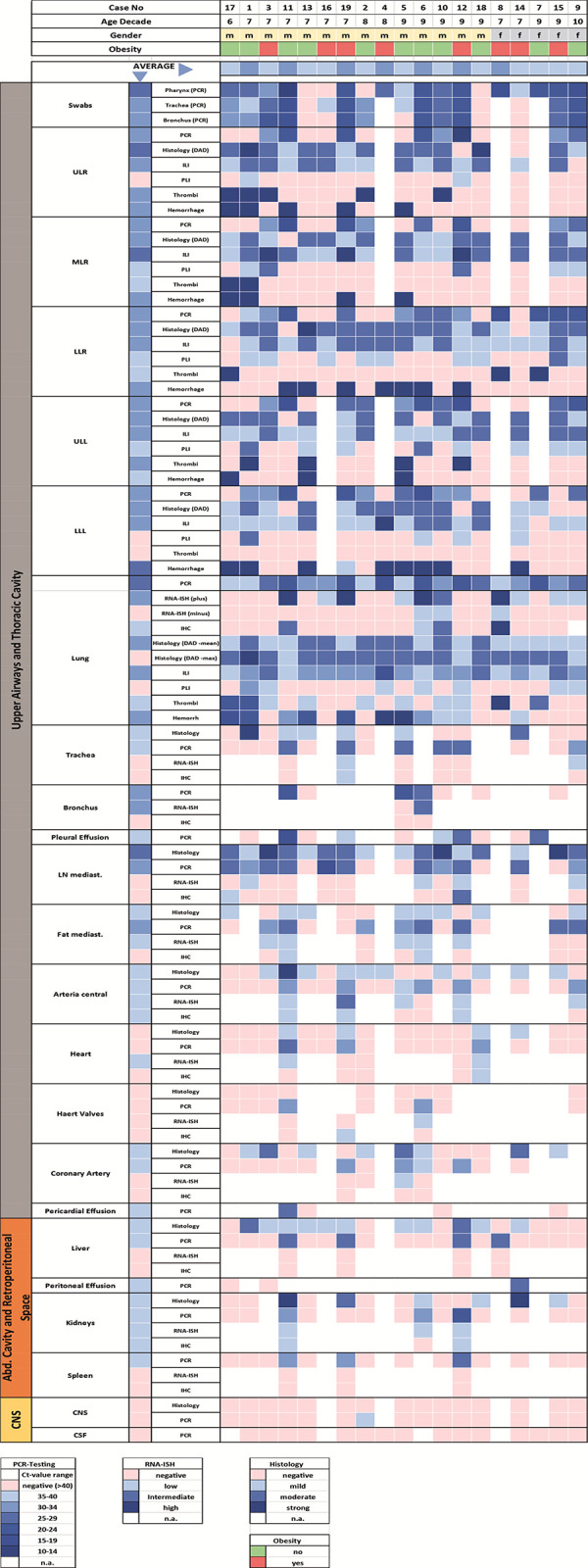
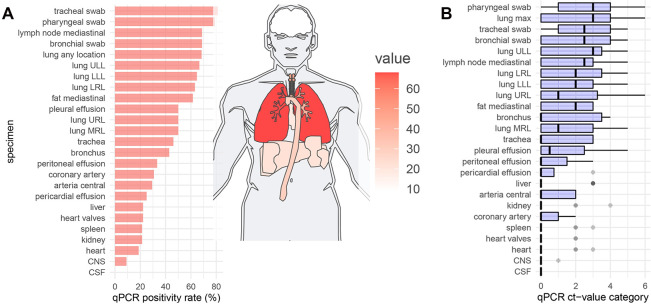
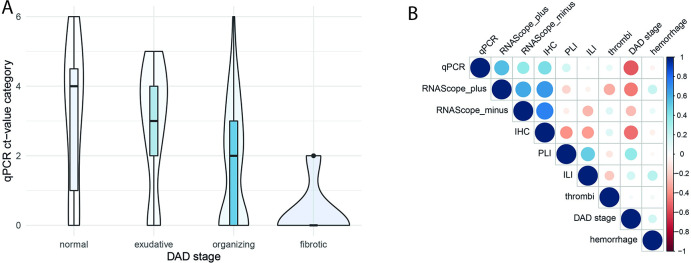
Eighteen of 19 patients were found to have died due to COVID-19. Clinically relevant histological changes were only observed in the lungs. Diffuse alveolar damage in considerably different degrees was noted in 18 cases. Other organs, including the central nervous system, did not show specific micromorphological alterations. In terms of SARS-CoV-2 detection, the focus remains on the upper airways and lungs. This is true for both the number of positive samples and the viral load. A highly significant inverse correlation between the stage of diffuse alveolar damage and viral load was found on a case and a sample basis. Mediastinal lymph nodes and fat were also affected by the virus at high frequencies. By contrast, other organs rarely exhibited a viral infection. Moderate to strong correlations between the methods for detecting SARS-CoV-2 were observed for the lungs and for other organs.
The lung is the most affected organ in gross examination, histology and polymerase chain reaction. SARS-CoV-2 detection in other organs did not reveal relevant or specific histological changes. Moreover, we did not find CNS involvement.
COVID-19 的认识还很不全面,其病理生理学、流行病学、治疗和长期预后方面的证据水平仍然有限。在大流行的早期阶段,有必要有效地研究这种新疾病的各个方面。尸检可以作为一种有价值的程序,用特殊技术研究内脏器官,以获取有关疾病的信息,尤其是器官受累的分布和类型。
在德国 COVID-19 的第一波疫情期间,对 19 名死者进行了尸检。除了肉眼检查外,还使用标准组织学和聚合酶链反应(PCR)分析了 SARS-CoV-2。用免疫组织化学和 RNA 原位杂交进一步分析了聚合酶链反应阳性的定位。
19 例患者中有 18 例被认为死于 COVID-19。临床上仅观察到肺部有相关的组织学改变。18 例均有不同程度的弥漫性肺泡损伤。其他器官,包括中枢神经系统,均未出现特异性的微观形态改变。就 SARS-CoV-2 的检测而言,重点仍在上呼吸道和肺部。无论是阳性样本的数量还是病毒载量,都是如此。在病例和样本的基础上,均发现弥漫性肺泡损伤的严重程度与病毒载量呈高度负相关。纵隔淋巴结和脂肪也经常受到病毒的影响。相比之下,其他器官很少出现病毒感染。肺部和其他器官的 SARS-CoV-2 检测方法之间存在中度至强相关性。
肉眼检查、组织学和聚合酶链反应显示,肺部是受影响最严重的器官。其他器官中 SARS-CoV-2 的检测未发现相关或特定的组织学改变。此外,我们未发现中枢神经系统受累。