Department of Stomatognathic Function and Occlusal Reconstruction, Graduate School of Biomedical Sciences, Tokushima University, 3-18-15 Tokushima, Tokushima 770-8504, Japan.
Kawahara Dental Clinic, 1-128 Muneshige, Mima, Tokushima 771-2104, Japan.
Int J Environ Res Public Health. 2021 Jul 5;18(13):7174. doi: 10.3390/ijerph18137174.
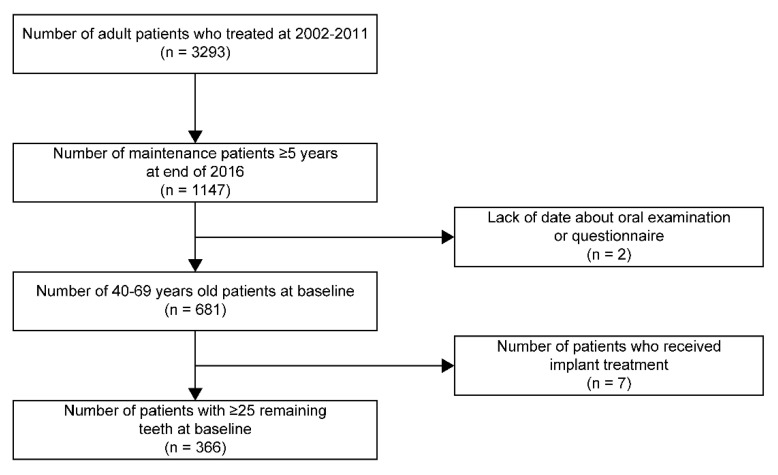
Tooth loss represents a diffused pathologic condition affecting the worldwide population. Risk factors have been identified in both general features (smoking, diabetes, economic status) and local tooth-related factors (caries, periodontitis). In this retrospective study, we examined the data of 366 patients with a large number of remaining teeth (≥25) undergoing maintenance therapy in order to identify specific risk factors for tooth loss. The number of remaining teeth, number of non-vital teeth, and number of occlusal units were investigated for their correlation with tooth loss. The mean follow-up of patients was 9.2 years (range 5 to 14). Statistically significant risk factors for tooth loss were identified as number of remaining teeth at baseline ( = 0.05), number of occlusal units ( = 0.03), and number of non-vital teeth in posterior regions ( < 0.001). Multiple logistic regression showed that the number of occlusal units and number of non-vital teeth in the posterior regions were significantly associated with a greater risk of tooth loss (odds ratio 1.88 and 3.17, respectively). These results confirm that not only the number of remaining teeth, but also their vital or non-vital status and the distribution between the anterior and posterior regions influence the long-term survival.
牙齿缺失代表了一种影响全球人群的弥漫性病理状况。在一般特征(吸烟、糖尿病、经济状况)和局部与牙齿相关的因素(龋齿、牙周炎)中都已经确定了风险因素。在这项回顾性研究中,我们检查了 366 名接受维持治疗的大量剩余牙齿(≥25 颗)患者的数据,以确定牙齿缺失的特定风险因素。我们研究了剩余牙齿的数量、非活髓牙的数量和咬合单位的数量,以探讨它们与牙齿缺失的相关性。患者的平均随访时间为 9.2 年(范围为 5 至 14 年)。结果发现,牙齿缺失的统计学显著风险因素包括基线时的剩余牙齿数量(=0.05)、咬合单位数量(=0.03)和后牙区的非活髓牙数量(<0.001)。多因素逻辑回归显示,咬合单位数量和后牙区的非活髓牙数量与牙齿缺失的风险增加显著相关(比值比分别为 1.88 和 3.17)。这些结果证实,不仅剩余牙齿的数量,而且它们的活力或非活力状态以及前牙区和后牙区之间的分布都会影响长期的生存。