Bioengineering Science Research Group, Faculty of Engineering and Physical Sciences, University of Southampton, Southampton, UK.
School of Clinical and Experimental Sciences, Faculty of Medicine, University of Southampton, Southampton, UK.
Sci Rep. 2021 Jul 19;11(1):14672. doi: 10.1038/s41598-021-93184-x.
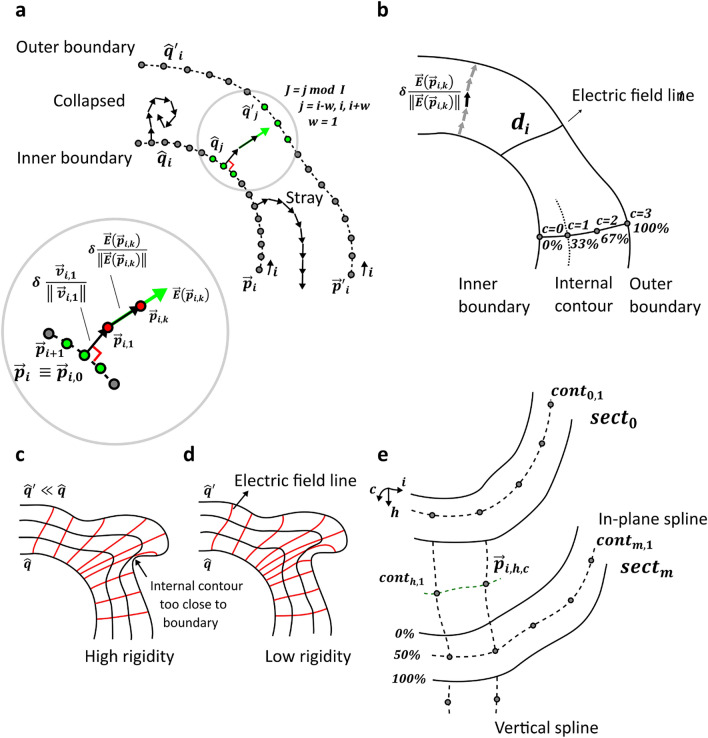
Colonic crypts are tubular glands that multiply through a symmetric branching process called crypt fission. During the early stages of colorectal cancer, the normal fission process is disturbed, leading to asymmetrical branching or budding. The challenging shapes of the budding crypts make it difficult to prepare paraffin sections for conventional histology, resulting in colonic cross sections with crypts that are only partially visible. To study crypt budding in situ and in three dimensions (3D), we employ X-ray micro-computed tomography to image intact colons, and a new method we developed (3D cyclorama) to digitally unroll them. Here, we present, verify and validate our '3D cyclorama' method that digitally unrolls deformed tubes of non-uniform thickness. It employs principles from electrostatics to reform the tube into a series of onion-like surfaces, which are mapped onto planar panoramic views. This enables the study of features extending over several layers of the tube's depth, demonstrated here by two case studies: (i) microvilli in the human placenta and (ii) 3D-printed adhesive films for drug delivery. Our 3D cyclorama method can provide novel insights into a wide spectrum of applications where digital unrolling or flattening is necessary, including long bones, teeth roots and ancient scrolls.
结肠隐窝是管状腺体,通过称为隐窝裂变的对称分支过程进行繁殖。在结直肠癌的早期阶段,正常的裂变过程被打乱,导致不对称的分支或出芽。出芽隐窝的形状具有挑战性,使得难以为常规组织学制备石蜡切片,导致结肠横截面上仅部分可见隐窝。为了原位和三维(3D)研究隐窝出芽,我们使用 X 射线微计算机断层扫描对完整的结肠进行成像,并采用我们开发的新方法(3D 全景图)对其进行数字展开。在这里,我们介绍、验证和验证了我们的“3D 全景图”方法,该方法可对变形的非均匀厚度管进行数字展开。它采用静电学原理将管重新形成一系列洋葱状表面,并将其映射到平面全景视图上。这使得能够研究延伸到管深度的几个层的特征,这里通过两个案例研究来证明:(i)人胎盘的微绒毛和(ii)用于药物输送的 3D 打印粘合膜。我们的 3D 全景图方法可以为数字展开或扁平化必要的广泛应用领域提供新的见解,包括长骨、牙根和古代卷轴。