Biomarkers and Research, Nordic Bioscience, Herlev Hovedgade 205-207, 2730, Herlev, Denmark.
Department of Medical Gastroenterology, University of Southern Denmark and Odense University Hospital, Odense, Denmark.
Sci Rep. 2021 Jul 19;11(1):14713. doi: 10.1038/s41598-021-94321-2.
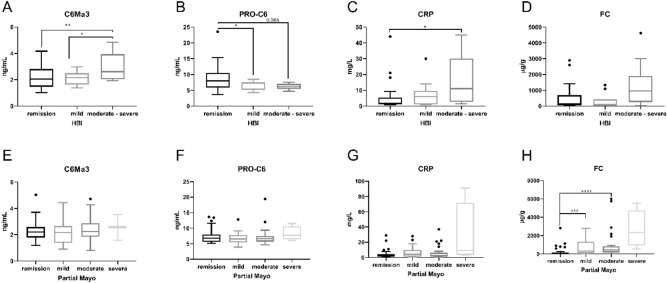
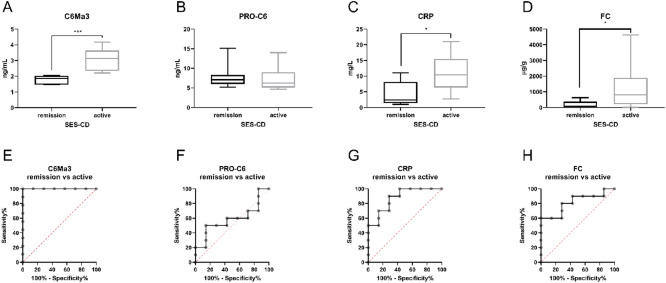
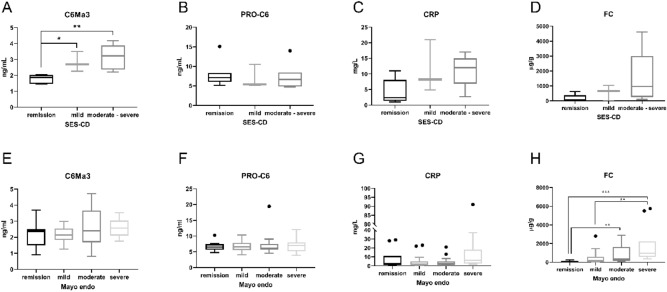
In inflammatory bowel disease (IBD), the chronic inflammation deeply affects the intestinal extracellular matrix. The aim of this study was to investigate if remodeling of the intestinal basement membrane type VI collagen was associated with pathophysiological changes in Crohn's disease (CD) and ulcerative colitis (UC). Serum from IBD patients (CD: n = 65; UC: n = 107; irritable bowel syndrome: n = 18; healthy subjects: n = 20) was investigated in this study. The serological biomarkers C6Ma3 (a matrix metalloproteinase (MMP) generated fragment of the type VI collagen α3 chain) and PRO-C6, also called endotrophin (the C-terminus of the released C5 domain of the type VI collagen α3 chain) were measured by ELISAs. Serum C6Ma3 was increased in CD patients with moderate to severe and mild endoscopically active disease compared to endoscopic remission (p = 0.002, p = 0.0048), respectively, and could distinguish endoscopically active disease from remission with an AUC of 1.0 (sensitivity: 100%, specificity: 100%) (p < 0.0001), which was superior to CRP. C6Ma3 was increased in CD patients with moderate to severe clinical disease compared to mild and remission (p = 0.04; p = 0.009). Serum PRO-C6, endotrophin, was increased in CD patients in clinically remission compared to mild disease (p = 0.04) and moderate to severe disease (p = 0.065). In UC, fecal calprotectin was the only marker that alone could distinguish both clinical and endoscopic active and inactive disease. Type VI collagen degradation of the α3 chain mediated by MMPs was increased in CD patients with endoscopically active disease, measured by the serological biomarker C6Ma3, which was able to distinguish endoscopically active from inactive CD.
在炎症性肠病 (IBD) 中,慢性炎症会深度影响肠道细胞外基质。本研究旨在探究克罗恩病 (CD) 和溃疡性结肠炎 (UC) 中,肠道基底膜 VI 型胶原的重塑是否与病理生理变化相关。本研究检测了 IBD 患者(CD:n=65;UC:n=107;肠易激综合征:n=18;健康对照:n=20)的血清。采用 ELISA 法检测血清标志物 C6Ma3(VI 型胶原 α3 链基质金属蛋白酶 (MMP) 生成片段)和 PRO-C6(VI 型胶原 α3 链释放的 C5 结构域 C 端)。与内镜缓解期相比,中重度和轻度内镜活动期 CD 患者的血清 C6Ma3 均升高(p=0.002,p=0.0048),且能以 AUC 为 1.0(灵敏度:100%,特异性:100%)(p<0.0001)区分内镜活动期和缓解期,优于 CRP。与轻度和缓解期相比,中重度 CD 患者的 C6Ma3 更高(p=0.04;p=0.009)。与轻度疾病相比,缓解期 CD 患者的血清 PRO-C6(内毒素)更高(p=0.04);与中重度疾病相比,缓解期 CD 患者的血清 PRO-C6 更高(p=0.065)。在 UC 中,粪便钙卫蛋白是唯一能够单独区分临床和内镜活动期和非活动期疾病的标志物。通过血清标志物 C6Ma3 检测到 MMP 介导的 VI 型胶原 α3 链降解在内镜活动期 CD 患者中增加,C6Ma3 能区分内镜活动期和非活动期 CD。