Todeschini Paola, Salviato Elisa, Romani Chiara, Raimondi Vittoria, Ciccarese Francesco, Ferrari Federico, Tognon Germana, Marchini Sergio, D'Incalci Maurizio, Zanotti Laura, Ravaggi Antonella, Odicino Franco, Sartori Enrico, D'Agostino Donna M, Samaja Michele, Romualdi Chiara, Bignotti Eliana
Angelo Nocivelli' Institute of Molecular Medicine, ASST Spedali Civili di Brescia, University of Brescia, 25121 Brescia, Italy.
Division of Obstetrics and Gynecology, ASST Spedali Civili di Brescia, 25123 Brescia, Italy.
Cancers (Basel). 2021 Jul 4;13(13):3358. doi: 10.3390/cancers13133358.
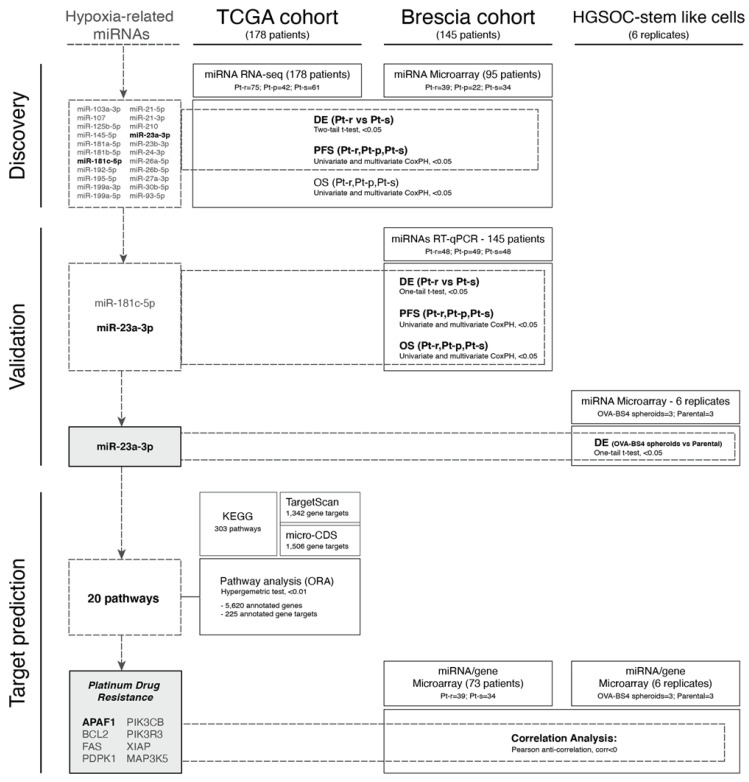
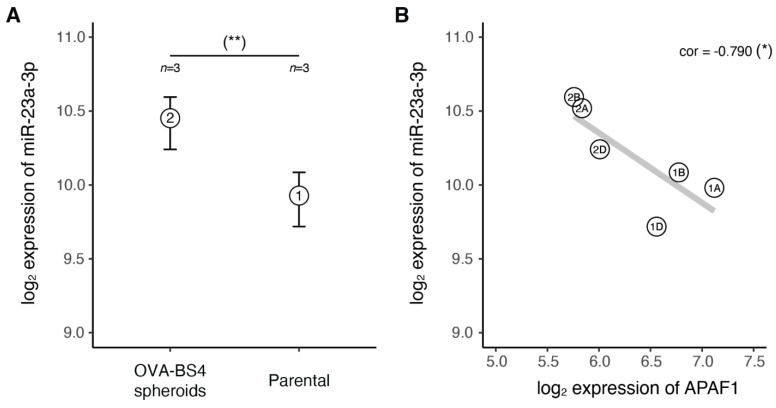
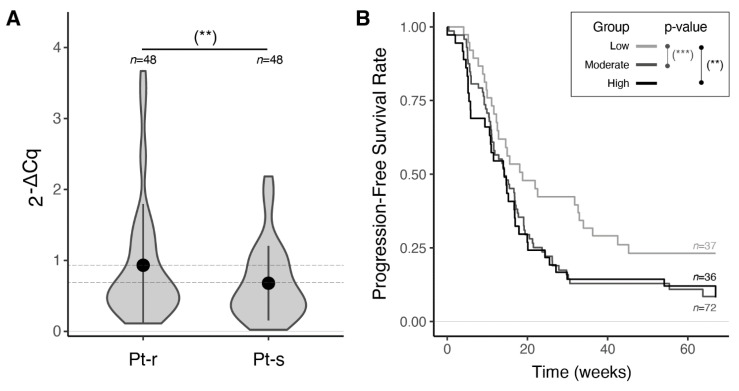
The onset of chemo-resistant recurrence represents the principal cause of high-grade serous ovarian carcinoma (HGSOC) death. HGSOC masses are characterized by a hypoxic microenvironment, which contributes to the development of this chemo-resistant phenotype. Hypoxia regulated-miRNAs (HRMs) represent a molecular response of cancer cells to hypoxia and are involved in tumor progression. We investigated the expression of HRMs using miRNA expression data from a total of 273 advanced-stage HGSOC samples. The miRNAs associated with chemoresistance and survival were validated by RT-qPCR and target prediction, and comparative pathway analysis was conducted for target gene identification. Analysis of miRNA expression profiles indicated miR-23a-3p and miR-181c-5p over-expression as associated with chemoresistance and poor PFS. RT-qPCR data confirmed upregulation of miR-23a-3p in tumors from chemoresistant HGSOC patients and its significant association with shorter PFS. In silico miR-23a-3p target prediction and comparative pathway analysis identified platinum drug resistance as the pathway with the highest number of miR-23a-3p target genes. Among them, APAF-1 emerged as the most promising, being downregulated in platinum-resistant patients and in HGSOC chemo-resistant cells. These results highlight miR-23a-3p as a potential biomarker for HGSOC platinum response and prognosis and the miR23a-3p/APAF1 axis as a possible target to overcome platinum-resistance.
化疗耐药性复发的发生是高级别浆液性卵巢癌(HGSOC)死亡的主要原因。HGSOC肿块的特征是缺氧微环境,这有助于这种化疗耐药表型的发展。缺氧调节的微小RNA(HRM)代表癌细胞对缺氧的分子反应,并参与肿瘤进展。我们使用总共273个晚期HGSOC样本的微小RNA表达数据研究了HRM的表达。通过RT-qPCR和靶标预测验证了与化疗耐药性和生存率相关的微小RNA,并进行了比较通路分析以鉴定靶基因。微小RNA表达谱分析表明,miR-23a-3p和miR-181c-5p的过表达与化疗耐药性和不良无进展生存期相关。RT-qPCR数据证实了化疗耐药性HGSOC患者肿瘤中miR-23a-3p的上调及其与较短无进展生存期的显著相关性。计算机模拟的miR-23a-3p靶标预测和比较通路分析确定铂类药物耐药性是miR-23a-3p靶标基因数量最多的通路。其中,APAF-1成为最有前景的基因,在铂耐药患者和HGSOC化疗耐药细胞中表达下调。这些结果突出了miR-23a-3p作为HGSOC铂反应和预后的潜在生物标志物,以及miR23a-3p/APAF1轴作为克服铂耐药性的可能靶点。