Faculty of Pharmacy, Université Laval, Quebec, QC, Canada.
Quebec National Institute of Public Health, Quebec, QC, Canada.
BMC Med Inform Decis Mak. 2021 Jul 20;21(1):219. doi: 10.1186/s12911-021-01583-x.
Polypharmacy is common among older adults and it represents a public health concern, due to the negative health impacts potentially associated with the use of several medications. However, the large number of medication combinations and sequences of use makes it complicated for traditional statistical methods to predict which therapy is genuinely associated with health outcomes. The project aims to use artificial intelligence (AI) to determine the quality of polypharmacy among older adults with chronic diseases in the province of Québec, Canada.
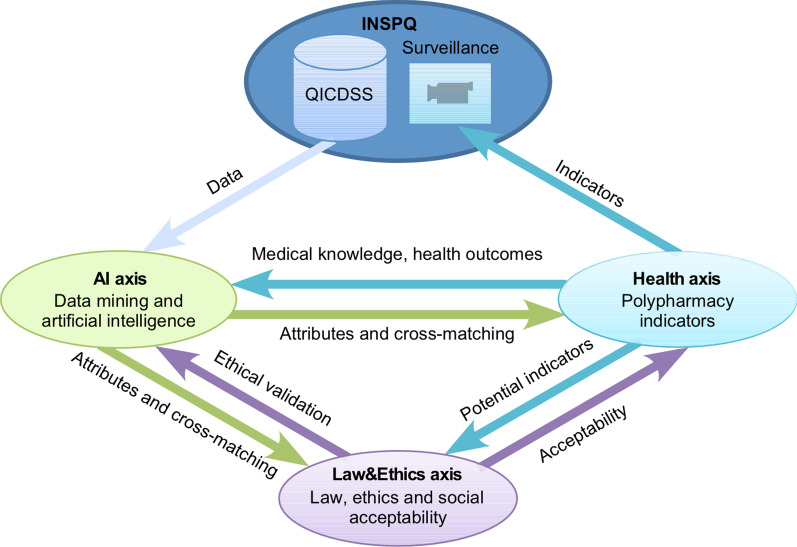
We will use data from the Quebec Integrated Chronic Disease Surveillance System (QICDSS). QICDSS contains information about prescribed medications in older adults in Quebec collected over 20 years. It also includes diagnostic codes and procedures, and sociodemographic data linked through a unique identification number for each individual. Our research will be structured around three interconnected research axes: AI, Health, and Law&Ethics. The AI research axis will develop algorithms for finding frequent patterns of medication use that correlate with health events, considering data locality and temporality (explainable AI or XAI). The Health research axis will translate these patterns into polypharmacy indicators relevant to public health surveillance and clinicians. The Law&Ethics axis will assess the social acceptability of the algorithms developed using AI tools and the indicators developed by the Heath axis and will ensure that the developed indicators neither discriminate against any population group nor increase the disparities already present in the use of medications.
The multi-disciplinary research team consists of specialists in AI, health data, statistics, pharmacy, public health, law, and ethics, which will allow investigation of polypharmacy from different points of view and will contribute to a deeper understanding of the clinical, social, and ethical issues surrounding polypharmacy and its surveillance, as well as the use of AI for health record data. The project results will be disseminated to the scientific community, healthcare professionals, and public health decision-makers in peer-reviewed publications, scientific meetings, and reports. The diffusion of the results will ensure the confidentiality of individual data.
老年人普遍存在多种药物治疗(polypharmacy)的情况,这是一个公共卫生关注点,因为使用多种药物可能会对健康产生负面影响。然而,大量的药物组合和使用顺序使得传统的统计方法难以预测哪种治疗方案真正与健康结果相关。本项目旨在使用人工智能(AI)来确定加拿大魁北克省患有慢性病的老年人中多种药物治疗的质量。
我们将使用魁北克综合慢性病监测系统(QICDSS)的数据。QICDSS 包含了魁北克省老年人的处方药信息,这些信息是在 20 多年的时间里收集的。它还包括诊断代码和程序以及通过每个个体的唯一识别号链接的社会人口统计学数据。我们的研究将围绕三个相互关联的研究轴展开:人工智能、健康和法律与伦理。人工智能研究轴将开发用于发现与健康事件相关的药物使用频繁模式的算法,同时考虑数据的局部性和时间性(可解释的人工智能或 XAI)。健康研究轴将把这些模式转化为与公共卫生监测和临床医生相关的多种药物治疗指标。法律与伦理轴将使用 AI 工具评估开发的算法和健康轴开发的指标的社会可接受性,并确保开发的指标既不会歧视任何人群,也不会增加药物使用中已经存在的差异。
多学科研究团队由 AI、健康数据、统计学、药学、公共卫生、法律和伦理方面的专家组成,这将允许从不同角度研究多种药物治疗,并有助于更深入地了解围绕多种药物治疗及其监测以及 AI 在健康记录数据中的使用的临床、社会和伦理问题。项目结果将通过同行评议的出版物、科学会议和报告向科学界、医疗保健专业人员和公共卫生决策者传播。结果的传播将确保个人数据的机密性。