Department of Science, University of Basilicata, Via Ateneo Lucano, 85100, Potenza, Italy.
Humanitas Clinical and Research Center-IRCCS, Via Alessandro Manzoni 56, 20089, Rozzano, Italy.
Sci Rep. 2021 Jul 20;11(1):14811. doi: 10.1038/s41598-021-94228-y.
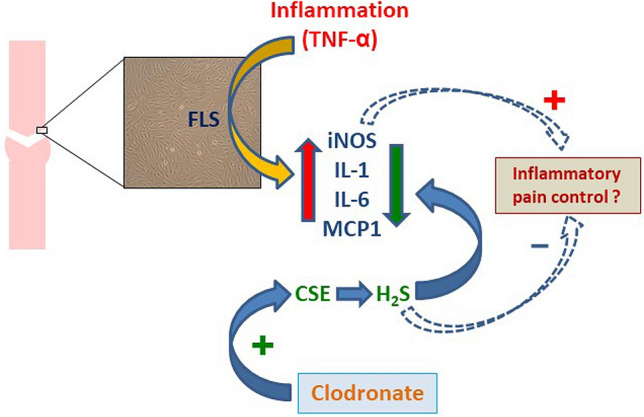
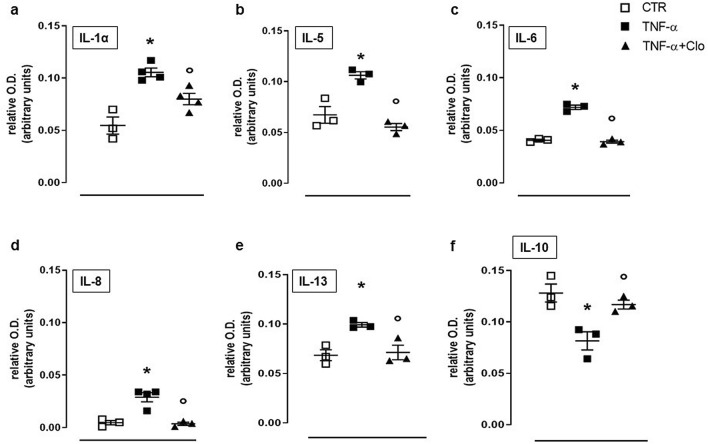
Clodronate is a bisphosphonate agent commonly used as anti-osteoporotic drug. Throughout its use, additional anti-inflammatory and analgesic properties have been reported, although the benefits described in the literature could not solely relate to their inhibition of bone resorption. Thus, the purpose of our in vitro study is to investigate whether there are underlying mechanisms explaining the anti-inflammatory effect of clodronate and possibly involving hydrogen sulphide (HS). Immortalised fibroblast-like synoviocyte cells (K4IM) were cultured and treated with clodronate in presence of TNF-α. Clodronate significantly modulated iNOS expression elicited by TNF-α. Inflammatory markers induced by TNF-α, including IL-1, IL-6, MCP-1 and RANTES, were also suppressed following administration of clodronate. Furthermore, the reduction in enzymatic biosynthesis of CSE-derived HS, together with the reduction in CSE expression associated with TNF-α treatment, was reverted by clodronate, thus rescuing endogenous HS pathway activity. Clodronate displays antinflammatory properties through the modulation of HS pathway and cytokines levels, thus assuring the control of the inflammatory state. Although further investigation is needed to stress out how clodronate exerts its control on HS pathway, here we showed for the first the involvement of HS in the additive beneficial effects observed following clodronate therapy.
氯膦酸二钠是一种常用的双膦酸盐类抗骨质疏松药物。在其应用过程中,除了抗吸收作用外,还报道了其具有抗炎和镇痛作用,尽管文献中描述的益处不能仅归因于其对骨吸收的抑制。因此,我们的体外研究旨在探讨氯膦酸二钠是否存在潜在的作用机制来解释其抗炎作用,并且可能涉及硫化氢(HS)。我们培养了永生化的成纤维样滑膜细胞(K4IM),并在 TNF-α存在的情况下用氯膦酸二钠处理这些细胞。氯膦酸二钠显著调节了 TNF-α引起的诱导型一氧化氮合酶(iNOS)的表达。此外,氯膦酸二钠还抑制了 TNF-α诱导的炎症标志物的产生,包括白细胞介素-1(IL-1)、白细胞介素-6(IL-6)、单核细胞趋化蛋白-1(MCP-1)和调节激活正常 T 细胞表达和分泌因子(RANTES)。此外,氯膦酸二钠还逆转了 TNF-α处理导致的 CSE 衍生的 HS 酶生物合成减少和 CSE 表达减少,从而恢复了内源性 HS 途径的活性。氯膦酸二钠通过调节 HS 途径和细胞因子水平发挥抗炎作用,从而确保对炎症状态的控制。尽管需要进一步的研究来强调氯膦酸二钠如何对 HS 途径发挥其控制作用,但我们首次表明 HS 参与了氯膦酸二钠治疗后观察到的附加有益作用。