Gaster Natascha, Hallas Jesper, Pottegård Anton, Friis Søren, Schmidt Morten
Department of Clinical Epidemiology, Aarhus University Hospital, Aarhus, Denmark.
Clinical Pharmacology, Pharmacy, and Environmental Medicine, Department of Public Health, University of Southern Denmark, Odense, Denmark.
Clin Epidemiol. 2021 Jul 13;13:569-579. doi: 10.2147/CLEP.S311450. eCollection 2021.
To evaluate the potential of Danish prescription registries to capture aspirin and non-aspirin non-steroidal anti-inflammatory drug (NSAID) use and to quantitatively evaluate the magnitude of bias from misclassification of true NSAID and aspirin use as apparent non-use in drug outcome studies.
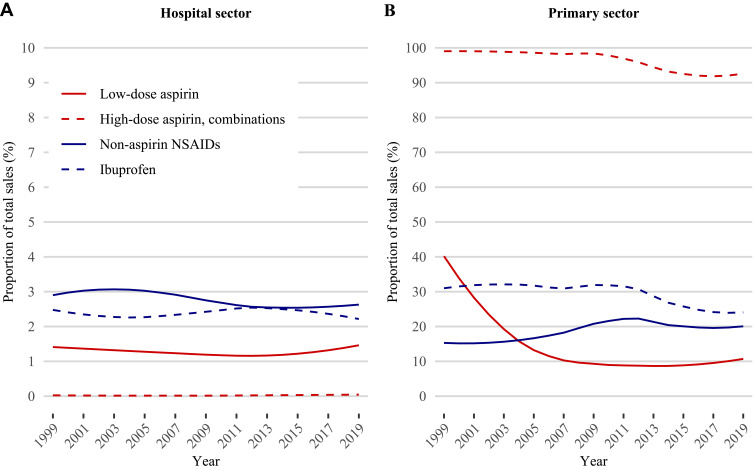
In a population-based cohort study, we retrieved sales statistics for NSAIDs and aspirins based on nationwide data from the Danish Health Data Authority and the Danish National Prescription Registry. We estimated prevalence of recorded and non-recorded NSAID use in the prescription registry and resulting proportions of true NSAID and aspirin use misclassified as apparent non-use from 1999 to 2019 at population and patient levels.
The prevalence of true use misclassified as non-use (mainly due to over-the-counter use) peaked at 4.7% in 2012 for NSAIDs overall, 5.5% in 2012 for ibuprofen, and at 5.9% in 2002 for high-dose aspirin. Misclassification of other individual NSAIDs was near null. Misclassification of true low-dose aspirin use as non-use declined during the study period but remained around 1% since 2005. In subgroups of cardiac patients, the highest prevalence of true NSAID use misclassified as non-use was 5.0% in 2002 and 4.3% in 2017. Quantitative bias analyses showed how such misclassification of true NSAID and aspirin use as non-use remained minimal both at population and patient levels. In hypothetical examples simulating real study populations with differing exposure prevalence and prevalence of true NSAID and aspirin use misclassified as apparent non-use, the approximate percentage change due to misclassification of use as non-use did not exceed 5% and in most scenarios stayed around 1%.
The Danish prescription registries are valid data sources for assessing the effects of aspirin and NSAID use. The influence of non-recorded NSAID and aspirin use on estimates of association is virtually negligible.
评估丹麦处方登记系统获取阿司匹林及非阿司匹林非甾体抗炎药(NSAID)使用情况的潜力,并定量评估在药物疗效研究中,将真实的NSAID和阿司匹林使用误分类为未使用所导致的偏倚程度。
在一项基于人群的队列研究中,我们根据丹麦卫生数据管理局和丹麦国家处方登记处的全国性数据,检索了NSAID和阿司匹林的销售统计数据。我们估计了处方登记系统中记录和未记录的NSAID使用情况,以及1999年至2019年在人群和患者层面将真实的NSAID和阿司匹林使用误分类为未使用的比例。
总体NSAID真实使用被误分类为未使用的比例(主要由于非处方使用)在2012年达到峰值,为4.7%;布洛芬在2012年为5.5%;高剂量阿司匹林在2002年为5.9%。其他个别NSAID的误分类几乎为零。真实低剂量阿司匹林使用被误分类为未使用的情况在研究期间有所下降,但自2005年以来仍保持在1%左右。在心脏病患者亚组中,真实NSAID使用被误分类为未使用的最高比例在2002年为5.0%,在2017年为4.3%。定量偏倚分析表明,这种将真实的NSAID和阿司匹林使用误分类为未使用的情况在人群和患者层面均保持在最低水平。在模拟具有不同暴露患病率以及真实NSAID和阿司匹林使用被误分类为未使用患病率的实际研究人群的假设示例中,因使用被误分类为未使用导致的近似百分比变化不超过5%,在大多数情况下约为1%。
丹麦处方登记系统是评估阿司匹林和NSAID使用效果的有效数据源。未记录的NSAID和阿司匹林使用对关联估计的影响几乎可以忽略不计。