Alahmri Fayez, Alsaadi Saad, Ahsan Mohammed
Department of Medical Rehabilitation, Ministry of Health, Riyadh, Saudi Arabia.
Department of Physical Therapy, College of Applied Medical Sciences, Imam Abdulrahman Bin Faisal University, Dammam, Saudi Arabia.
Malays J Med Sci. 2021 Jun;28(3):77-85. doi: 10.21315/mjms2021.28.3.7. Epub 2021 Jun 30.
The impact of asymptomatic pronation on proximal joints during motion has not been well understood, and research on it remains limited. Therefore, the current study determines the effect of asymptomatic pronation of the foot on hip joint kinematics during gait.
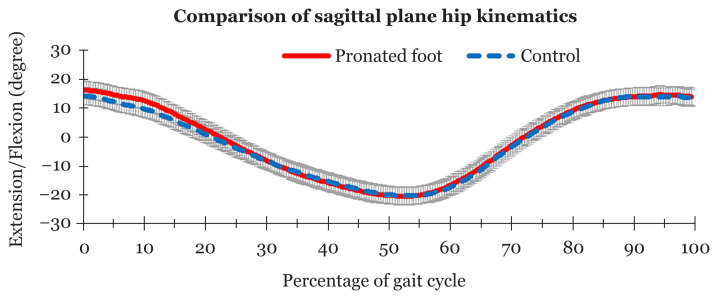
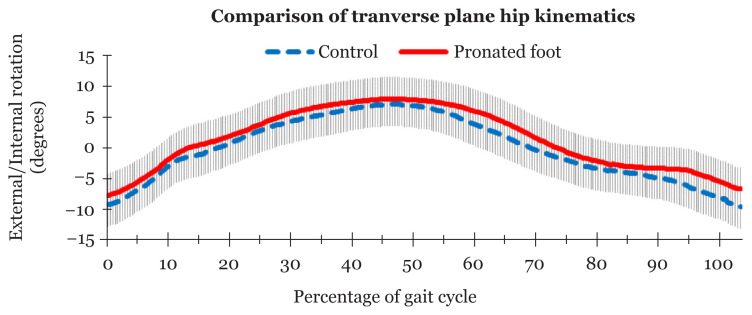
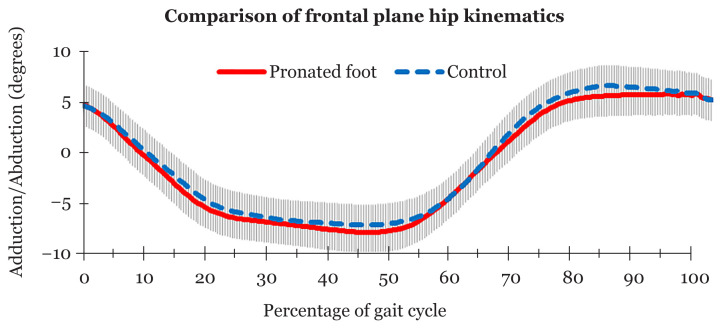
Forty participants were recruited for the study (20 with asymptomatic pronated feet and 20 with non-pronated feet). Foot assessment was conducted by navicular drop and rear-foot angle tests. Hip joint kinematics were measured via MVN Xsens system 3D-motion capture from sagittal, frontal and transverse planes during gait. An independent -test was used to identify differences in kinematic variables.
Both groups were similar in characteristics, and there were no significant differences between the groups in age ( = 0.674) and BMI ( = 0.459). However, there was a significant difference in arch height ( = 0.001) and rear-foot angle ( = 0.001). Our findings showed there were insignificant differences between the asymptomatic pronated foot and non-pronated foot control groups in hip joint kinematics of sagittal ( = 0.618), frontal ( = 0.276), and transverse ( = 0.337) planes during a full gait cycle.
Patients with asymptomatic pronation of the foot and non-pronation of the foot showed similar movement patterns of hip kinematics in all three planes. The findings of the present study highlight the need for clinicians to consider foot alignment when examining patients with asymptomatic pronation of the foot and non-pronation of the foot.
无症状内旋在运动过程中对近端关节的影响尚未得到充分理解,对此的研究仍然有限。因此,本研究旨在确定足部无症状内旋在步态期间对髋关节运动学的影响。
招募了40名参与者进行研究(20名足部无症状内旋者和20名足部无内旋者)。通过舟骨下垂试验和后足角度试验进行足部评估。在步态期间,通过MVN Xsens系统从矢状面、额状面和横断面进行三维运动捕捉来测量髋关节运动学。采用独立样本t检验来确定运动学变量的差异。
两组在特征方面相似,两组在年龄(P = 0.674)和体重指数(P = 0.459)上无显著差异。然而,在足弓高度(P = 0.001)和后足角度(P = 0.001)上存在显著差异。我们的研究结果表明,在整个步态周期中,无症状内旋足组和无内旋足对照组在矢状面(P = 0.618)、额状面(P = 0.276)和横断面(P = 0.337)的髋关节运动学上无显著差异。
足部无症状内旋患者和无内旋患者在所有三个平面上的髋关节运动模式相似。本研究结果强调临床医生在检查足部无症状内旋患者和无内旋患者时需要考虑足部对线情况。