Grimm Fiona, Hodgson Karen, Brine Richard, Deeny Sarah R
The Health Foundation, 8 Salisbury Square, London EC4Y 8AP, UK.
Int J Popul Data Sci. 2021 Jul 8;5(4):1663. doi: 10.23889/ijpds.v5i4.1663. eCollection 2020.
Care home residents have complex healthcare needs but may have faced barriers to accessing hospital treatment during the first wave of the COVID-19 pandemic.
To examine trends in the number of hospital admissions for care home residents during the first months of the COVID-19 outbreak.
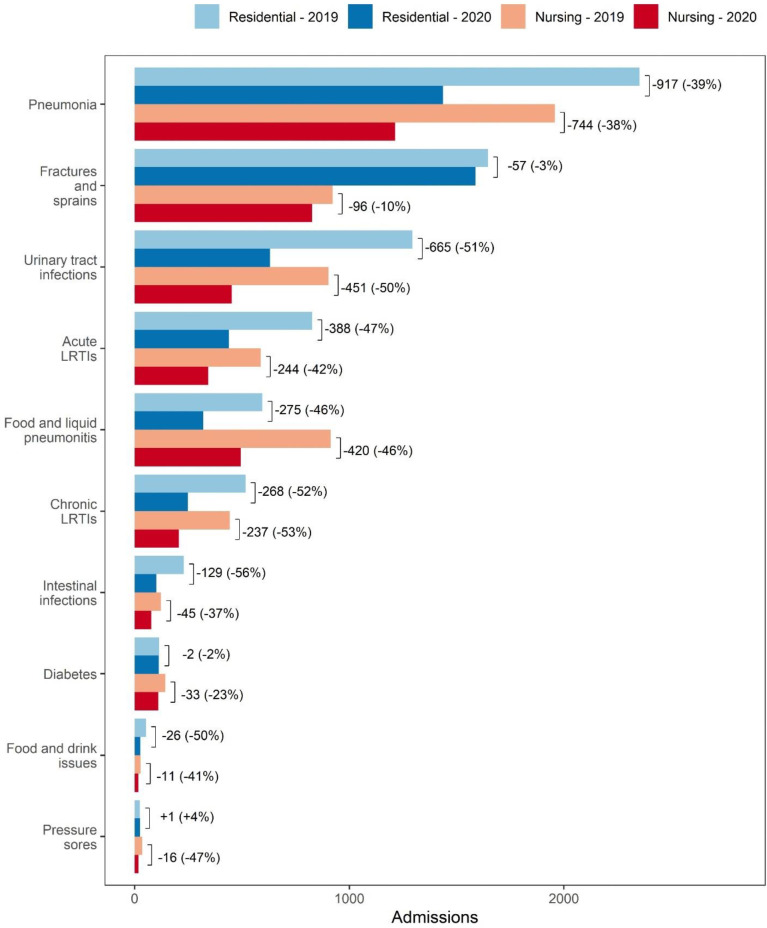
Retrospective analysis of a national linked dataset on hospital admissions for residential and nursing home residents in England (257,843 residents, 45% in nursing homes) between 20 January 2020 and 28 June 2020, compared to admissions during the corresponding period in 2019 (252,432 residents, 45% in nursing homes). Elective and emergency admission rates, normalised to the time spent in care homes across all residents, were derived across the first three months of the pandemic between 1 March and 31 May 2020 and primary admission reasons for this period were compared across years.
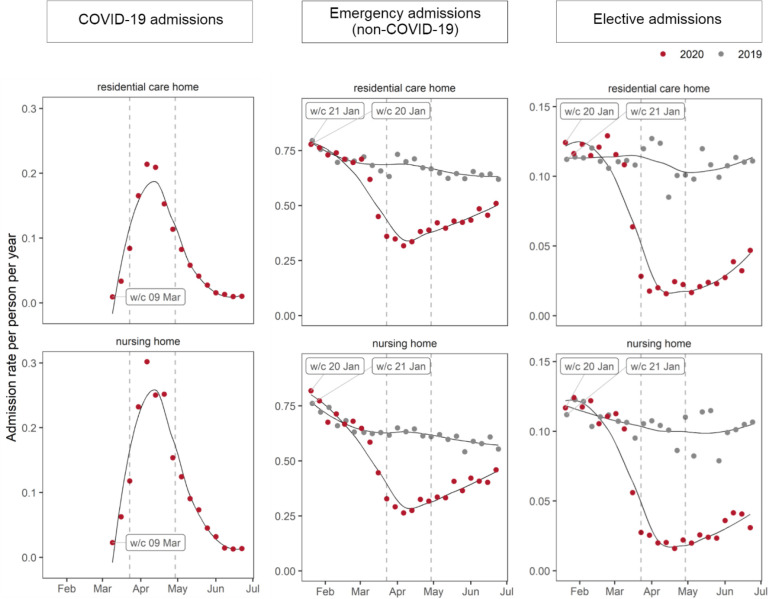
Hospital admission rates rapidly declined during early March 2020 and remained substantially lower than in 2019 until the end of June. Between March and May, 2,960 admissions from residential homes (16.2%) and 3,295 admissions from nursing homes (23.7%) were for suspected or confirmed COVID-19. Rates of other emergency admissions decreased by 36% for residential and by 38% for nursing home residents (13,191 fewer admissions in total). Emergency admissions for acute coronary syndromes fell by 43% and 29% (105 fewer admission) and emergency admissions for stroke fell by 17% and 25% (128 fewer admissions) for residential and nursing home residents, respectively. Elective admission rates declined by 64% for residential and by 61% for nursing home residents (3,762 fewer admissions).
This is the first study showing that care home residents' hospital use declined during the first wave of COVID-19, potentially resulting in substantial unmet health need that will need to be addressed alongside ongoing pressures from COVID-19.
养老院居民有复杂的医疗保健需求,但在新冠疫情第一波期间,他们在获得医院治疗方面可能面临障碍。
研究新冠疫情爆发头几个月养老院居民的住院人数趋势。
对2020年1月20日至2020年6月28日期间英格兰养老院和疗养院居民住院情况的全国关联数据集进行回顾性分析(257,843名居民,45%在疗养院),并与2019年同期(252,432名居民,45%在疗养院)的住院情况进行比较。在2020年3月1日至5月31日这一疫情的前三个月中,计算了所有居民在养老院的居住时间标准化后的择期和急诊住院率,并比较了不同年份这一时期的主要入院原因。
2020年3月初,住院率迅速下降,直到6月底仍大幅低于2019年。3月至5月期间,来自养老院的2960例入院(16.2%)和来自疗养院的3295例入院(23.7%)是疑似或确诊的新冠病例。其他急诊住院率,养老院居民下降了36%,疗养院居民下降了38%(总共减少了13,191例入院)。养老院居民急性冠状动脉综合征的急诊住院率分别下降了43%和29%(减少了105例入院),中风的急诊住院率分别下降了17%和25%(减少了128例入院)。养老院居民的择期住院率下降了64%,疗养院居民下降了6l%(减少了3,762例入院)。
这是第一项表明在新冠疫情第一波期间养老院居民住院率下降的研究,这可能导致大量未得到满足的健康需求,需要在应对新冠疫情持续压力的同时加以解决。