Santoso Jeffrey W, Li Xiling, Gupta Divya, Suh Gio C, Hendricks Eric, Lin Shaoyu, Perry Sarah, Ichida Justin K, Dickman Dion, McCain Megan L
Laboratory for Living Systems Engineering, Department of Biomedical Engineering, USC Viterbi School of Engineering, University of Southern California, Los Angeles, California 90089, USA.
Department of Biological Sciences, Dornsife College of Arts and Letters, University of Southern California, Los Angeles, California 90089, USA.
APL Bioeng. 2021 Jul 13;5(3):036101. doi: 10.1063/5.0054984. eCollection 2021 Sep.
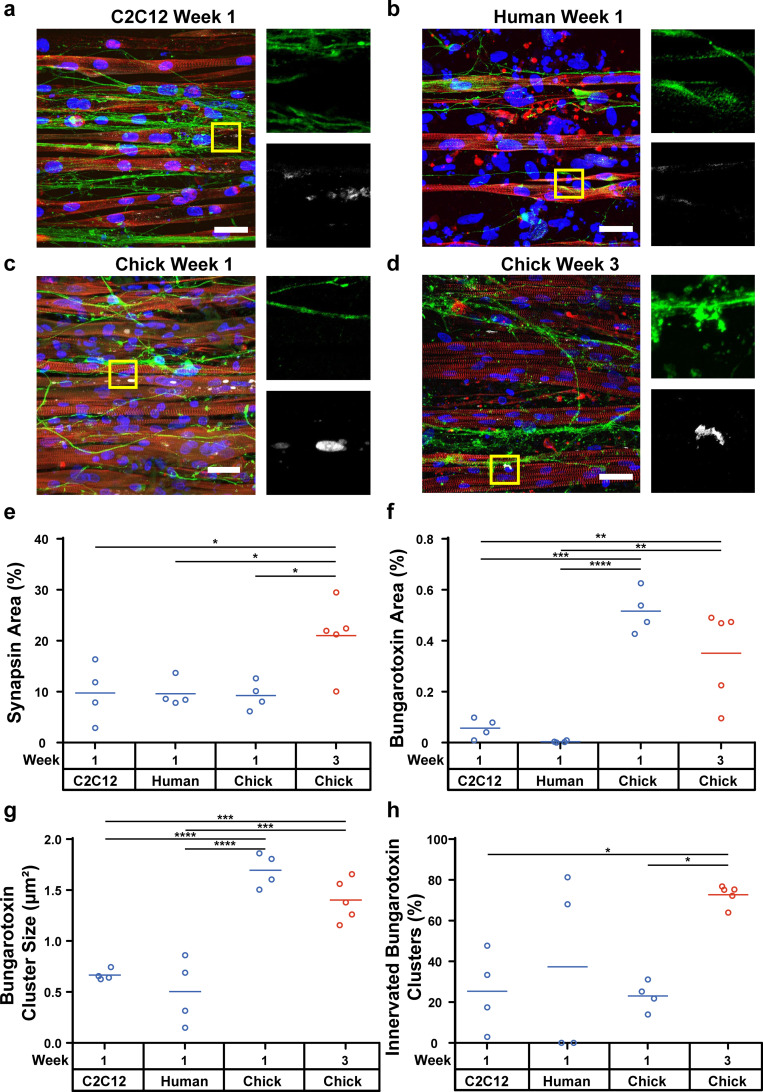
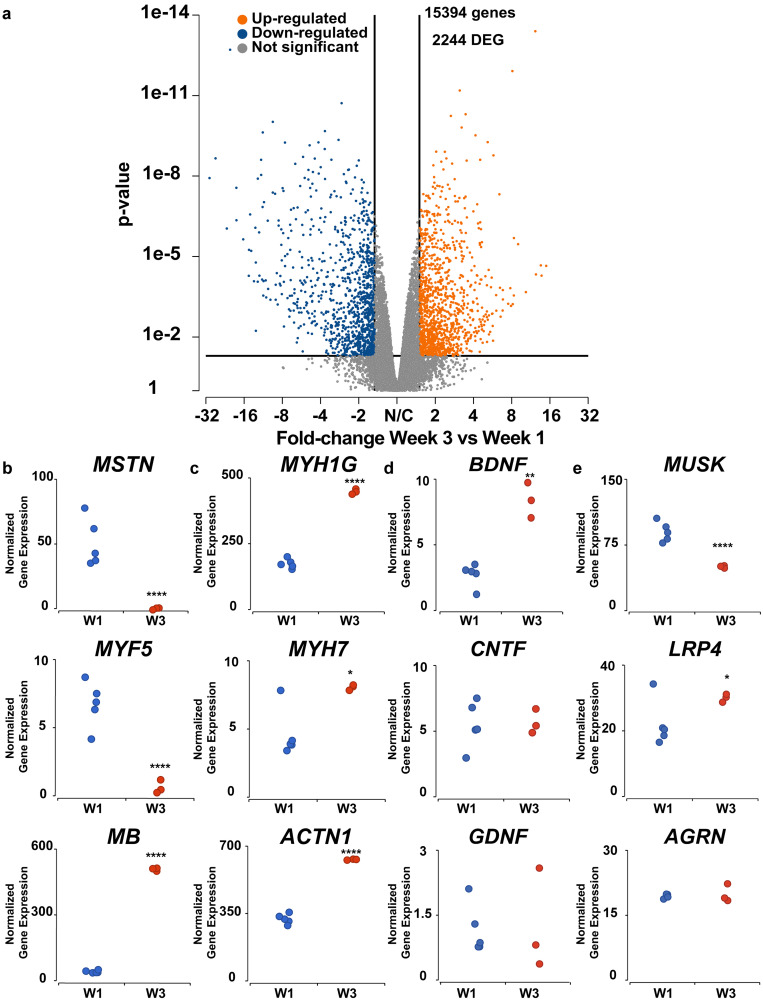
To develop effective cures for neuromuscular diseases, human-relevant models of neuromuscular tissues are critically needed to probe disease mechanisms on a cellular and molecular level. However, previous attempts to co-culture motor neurons and skeletal muscle have resulted in relatively immature neuromuscular junctions (NMJs). In this study, NMJs formed by human induced pluripotent stem cell (hiPSC)-derived motor neurons were improved by optimizing the maturity of the co-cultured muscle tissue. First, muscle tissues engineered from the C2C12 mouse myoblast cell line, cryopreserved primary human myoblasts, and freshly isolated primary chick myoblasts on micromolded gelatin hydrogels were compared. After three weeks, only chick muscle tissues remained stably adhered to hydrogels and exhibited progressive increases in myogenic index and stress generation, approaching values generated by native muscle tissue. After three weeks of co-culture with hiPSC-derived motor neurons, engineered chick muscle tissues formed NMJs with increasing co-localization of pre- and postsynaptic markers as well as increased frequency and magnitude of synaptic activity, surpassing structural and functional maturity of previous models. Engineered chick muscle tissues also demonstrated increased expression of genes related to sarcomere maturation and innervation over time, revealing new insights into the molecular pathways that likely contribute to enhanced NMJ formation. These approaches for engineering advanced neuromuscular tissues with relatively mature NMJs and interrogating their structure and function have many applications in neuromuscular disease modeling and drug development.
为了开发治疗神经肌肉疾病的有效疗法,亟需与人类相关的神经肌肉组织模型,以便在细胞和分子水平上探究疾病机制。然而,此前将运动神经元和骨骼肌进行共培养的尝试,导致形成的神经肌肉接头(NMJ)相对不成熟。在本研究中,通过优化共培养肌肉组织的成熟度,改善了由人诱导多能干细胞(hiPSC)衍生的运动神经元形成的NMJ。首先,对在微模塑明胶水凝胶上由C2C12小鼠成肌细胞系、冷冻保存的原代人成肌细胞和新鲜分离的原代鸡成肌细胞构建的肌肉组织进行了比较。三周后,只有鸡的肌肉组织稳定地附着在水凝胶上,并且肌源性指数和应力产生逐渐增加,接近天然肌肉组织产生的值。在与hiPSC衍生的运动神经元共培养三周后,构建的鸡肌肉组织形成了NMJ,突触前和突触后标记物的共定位增加,突触活动的频率和幅度也增加,超过了先前模型的结构和功能成熟度。随着时间的推移,构建的鸡肌肉组织还显示出与肌节成熟和神经支配相关基因的表达增加,揭示了可能有助于增强NMJ形成的分子途径的新见解。这些构建具有相对成熟NMJ的先进神经肌肉组织并探究其结构和功能的方法,在神经肌肉疾病建模和药物开发中有许多应用。