Guenthner Scott, McFalda Wendy, Kwong Pearl, Eads Kimberly, McCafferty Morgan, Rieger Jayson, Glover David K, Willson Cynthia, Burnett Patrick, Olivadoti Melissa
The Indiana Clinical Trials Center, Plainfield, IN, USA.
Clarkston Skin Research, Clarkston, MI, USA.
Dermatol Ther (Heidelb). 2021 Oct;11(5):1623-1634. doi: 10.1007/s13555-021-00576-y. Epub 2021 Jul 21.
Verrucae vulgaris, or common warts, is a common skin condition for which there is no US Food and Drug Administration-approved treatment. Compounded cantharidin has been used to treat warts for years but lacks a controlled formulation, consistent application schedule and methods, and robust safety and efficacy studies. VP-102 is a proprietary drug-device combination product containing a topical formulation of 0.7% (w/v) cantharidin in a single-use delivery device. This objective of the phase 2 study was to evaluate the efficacy, safety, tolerability, and optimal regimen of VP-102 in the treatment of common warts.
In this open-label trial, participants aged ≥ 2 years with one to six common warts were administered VP-102 topically to treatable common warts once every 14 days (Cohort 1) or once every 21 days in conjunction with paring (Cohort 2), for up to four treatments. Participants were evaluated through to day 84 (Cohort 1) or day 147 (Cohort 2). The primary endpoint was the percentage of participants with complete clearance of all treatable common warts (baseline and new) at day 84. Secondary endpoints included percentage of participants achieving complete clearance of all treatable common warts at other visits. Safety assessments included treatment-emergent adverse events (TEAEs), including local skin reactions (LSRs).
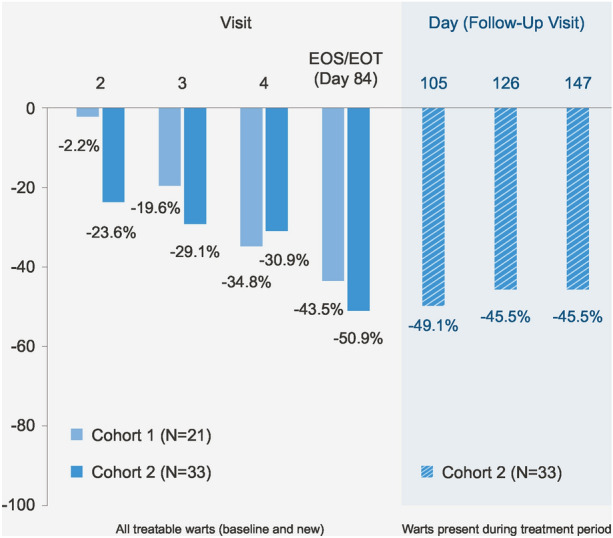
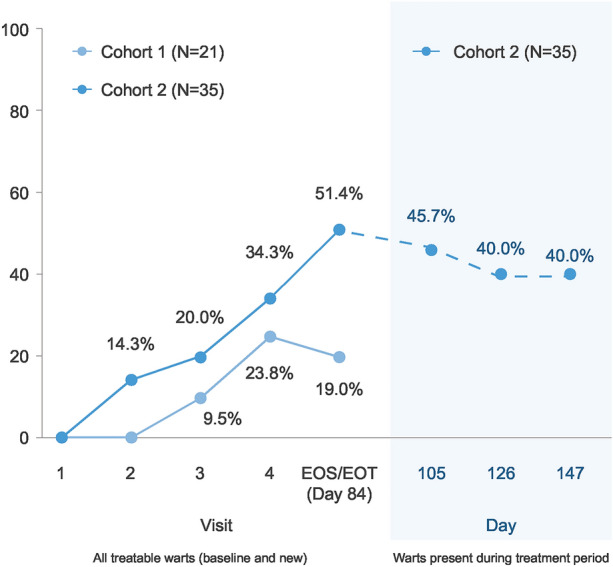
A total of 21 and 35 participants were enrolled in Cohort 1 and Cohort 2, respectively. Complete clearance at day 84 was seen in 19.0% of participants in Cohort 1 and 51.4% of those in Cohort 2. The most common TEAEs were expected LSRs and included application site vesicles, pain, pruritus, erythema, and scab. Most LSRs were mild or moderate in severity.
VP-102 showed efficacy in complete clearance of common warts from baseline to day 84, as well as at follow-up visits. Due to the higher percentage of patients exhibiting complete clearance in Cohort 2, the treatment regimen of Cohort 2 will be pursued in future studies. TEAEs were expected due to the pharmacodynamic action of cantharidin, a vesicant. Clinical Trials ID: NCT03487549.
寻常疣,即普通疣,是一种常见的皮肤疾病,美国食品药品监督管理局未批准针对其的治疗方法。复方斑蝥素多年来一直用于治疗疣,但缺乏标准化配方、一致的应用方案和方法,以及有力的安全性和有效性研究。VP-102是一种专利药物-器械组合产品,在一次性给药装置中含有0.7%(w/v)斑蝥素的局部用制剂。这项2期研究的目的是评估VP-102治疗寻常疣的疗效、安全性、耐受性和最佳治疗方案。
在这项开放标签试验中,年龄≥2岁、患有1至6个寻常疣的参与者,将VP-102局部应用于可治疗的寻常疣,队列1每14天给药一次,队列2每21天给药一次并配合修削,最多进行4次治疗。对参与者随访至第84天(队列1)或第147天(队列2)。主要终点是在第84天所有可治疗的寻常疣(基线和新发)完全清除的参与者百分比。次要终点包括在其他访视时所有可治疗的寻常疣完全清除的参与者百分比。安全性评估包括治疗中出现的不良事件(TEAE),包括局部皮肤反应(LSR)。
队列1和队列2分别共有21名和35名参与者入组。队列1中19.0%的参与者和队列2中51.4%的参与者在第84天实现了完全清除。最常见的TEAE是预期的LSR,包括用药部位水疱、疼痛、瘙痒、红斑和结痂。大多数LSR的严重程度为轻度或中度。
从基线到第84天以及随访期间,VP-102在完全清除寻常疣方面显示出疗效。由于队列2中表现出完全清除的患者百分比更高,未来研究将采用队列2的治疗方案。由于斑蝥素(一种发泡剂)的药效学作用,TEAE是预期的。临床试验识别号:NCT03487549。