Department of Pediatric Pulmonology and Allergology, Wilhelmina Children's Hospital, University Medical Center Utrecht, University of Utrecht, Utrecht, The Netherlands.
Department of Dermatology/Allergology, University Medical Center Utrecht, University of Utrecht, Utrecht, The Netherlands.
Clin Exp Allergy. 2021 Aug;51(8):1069-1079. doi: 10.1111/cea.13987. Epub 2021 Jul 29.
Specific IgE to Ara h 2 is a diagnostic test for peanut allergy which may reduce the need for double-blind placebo-controlled food challenges (DBPCFC); however, guidance for using Ara h 2 in place of DBPCFCs has not been validated.
To prospectively evaluate 1) diagnostic accuracy of previously published Ara h 2 cut-off levels to diagnose peanut allergy in children and 2) costs.
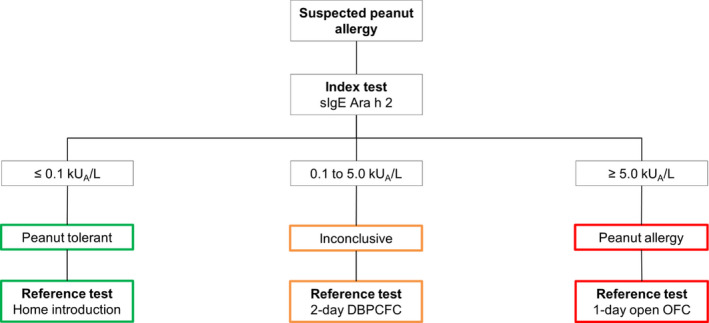
A consecutive series of 150 children age 3.5 to 18 years was evaluated in secondary and tertiary settings in the Netherlands. sIgE to Ara h 2 was the index test, and oral peanut ingestion was the reference test. Oral peanut ingestion was home or supervised introduction for Ara h 2 ≤ 0.1, DBPCFC for 0.1-5.0 and open food challenge for ≥5.0. Costs were calculated using financial healthcare data.
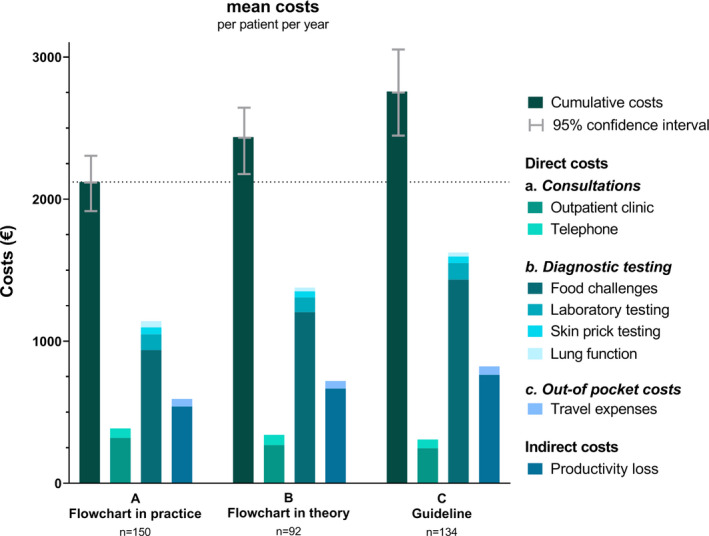
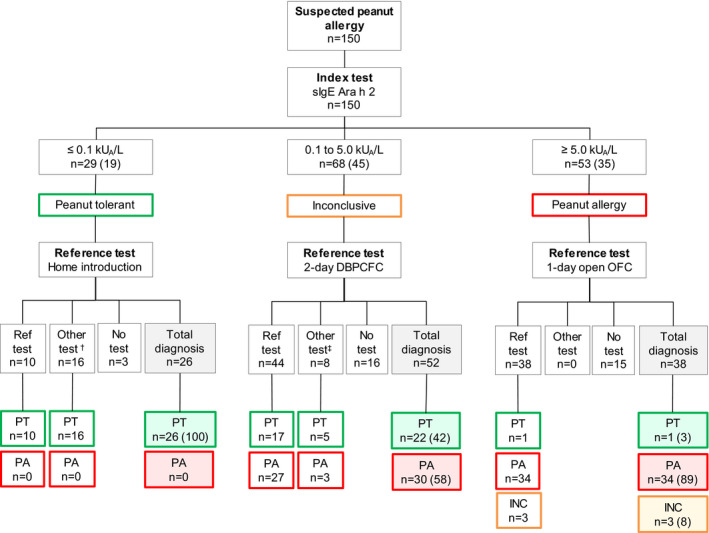
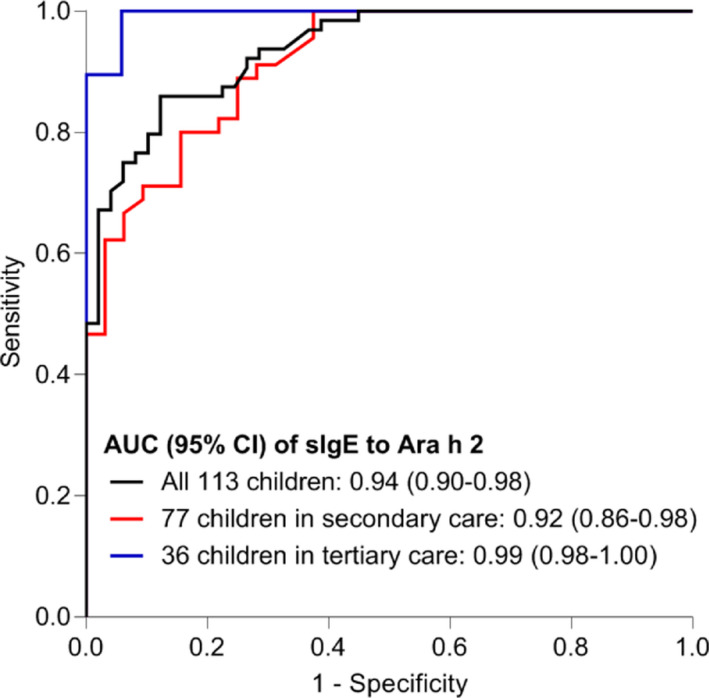
A conclusive reference test was performed in 113 children (75%). Sixty-four children (57%) had peanut allergy, as confirmed by a DBPCFC (27/47) or an open challenge (37/50). Forty-nine children (43%) were considered peanut-tolerant after peanut introduction (19/19), a DBPCFC (20/47) or an open challenge (10/50). Area under the curve for Ara h 2 was 0.94 (95% CI 0.90-0.98). The diagnostic flow chart correctly classified 26/26 (100%; 84-100) of children with Ara h 2 ≤ 0.1 as peanut-tolerant and 34/35 (97%; 83-100) of children with Ara h 2 ≥ 5.0 as peanut-allergic. At a cut-off of ≤0.1 and ≥5.0, a sensitivity of respectively 100% (93-100) and 53% (38-67) was observed and a specificity of 53% (38-67) and 98% (87-100). Mean annual costs of the flow chart were estimated as €320-€636 per patient lower than following national allergy guidelines.
In this diagnostic accuracy study, which did not take into account pretest probability, we have validated previously published Ara h 2 cut-off levels which are associated with peanut tolerance and allergy.
特异性 IgE 对 Ara h 2 是花生过敏的诊断测试,它可能减少对双盲安慰剂对照食物挑战(DBPCFC)的需求;然而,用 Ara h 2 代替 DBPCFC 的指导尚未得到验证。
前瞻性评估 1)先前发表的 Ara h 2 截止值诊断儿童花生过敏的诊断准确性,2)成本。
在荷兰的二级和三级医疗机构中连续评估了 150 名 3.5 至 18 岁的儿童。sIgE 对 Ara h 2 是指标检测,口服花生摄入是参考检测。口服花生摄入是 Ara h 2≤0.1 的家庭或监督引入,0.1-5.0 的 DBPCFC 和≥5.0 的开放食物挑战。使用财务医疗保健数据计算成本。
113 名儿童(75%)进行了结论性参考测试。64 名儿童(57%)患有花生过敏,这是通过 DBPCFC(27/47)或开放挑战(37/50)证实的。49 名儿童(43%)在进行花生引入(19/19)、DBPCFC(20/47)或开放挑战(10/50)后被认为对花生耐受。Ara h 2 的曲线下面积为 0.94(95%CI 0.90-0.98)。Ara h 2 诊断流程图正确分类了 26/26(100%;84-100)Ara h 2≤0.1 的儿童为花生耐受,34/35(97%;83-100)Ara h 2≥5.0 的儿童为花生过敏。在 Ara h 2≤0.1 和≥5.0 的截止值下,观察到分别为 100%(93-100)和 53%(38-67)的敏感性和分别为 53%(38-67)和 98%(87-100)的特异性。与遵循国家过敏指南相比,流程图的平均年度成本估计为每位患者降低 320-636 欧元。
在这项未考虑预测前概率的诊断准确性研究中,我们验证了先前发表的与花生耐受和过敏相关的 Ara h 2 截止值。