Kovacevic Bojan, Antonelli Giulio, Klausen Pia, Hassan Cesare, Larghi Alberto, Vilmann Peter, Karstensen John Gásdal
Gastro Unit, Division of Endoscopy, Herlev Hospital, Herlev, Denmark.
Digestive Endoscopy Unit, Nuovo Regina Margherita Hospital, Rome, Italy.
Endosc Ultrasound. 2021 Jul-Aug;10(4):270-279. doi: 10.4103/EUS-D-20-00172.
Pancreatic cystic lesions (PCLs) are frequent incidental findings on cross-sectional imaging and represent a diagnostic challenge as different kinds of PCLs harbor a dissimilar risk of malignancy. Two diagnostic tools have recently been developed and introduced: through-the-needle biopsy (TTNB) and needle-based confocal laser endomicroscopy (nCLE). The aim of this meta-analysis was to compare the diagnostic yield and performance, as well as the safety profile of the two methods.
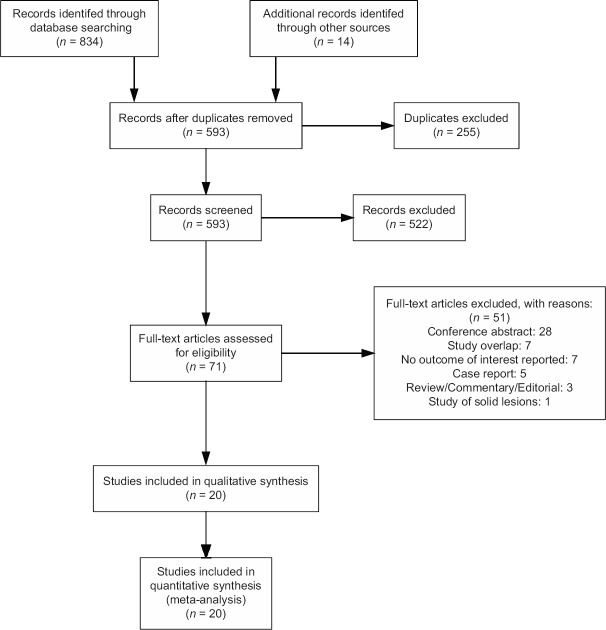
This meta-analysis was performed in accordance with the PRISMA statement. Medline, Embase, Web of Science, and Cochrane Library databases were searched for studies with five or more patients undergoing either endoscopic ultrasound (EUS)-TTNB or EUS-nCLE for a PCL. Reviews, case reports, editorials, conference abstracts, and studies on exclusively solid pancreatic lesions were excluded. Outcomes of interest were diagnostic yield and performance, safety, and technical success.
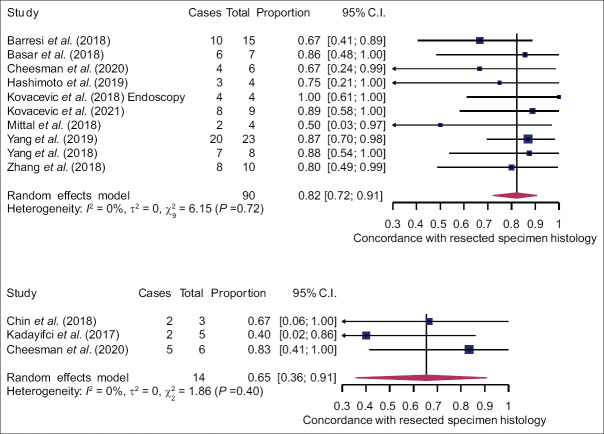
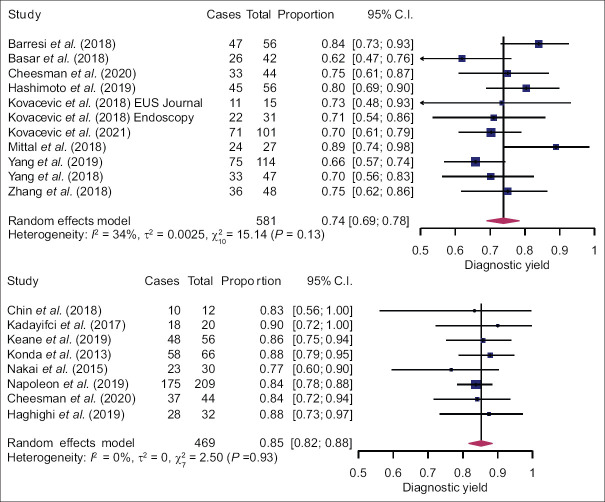
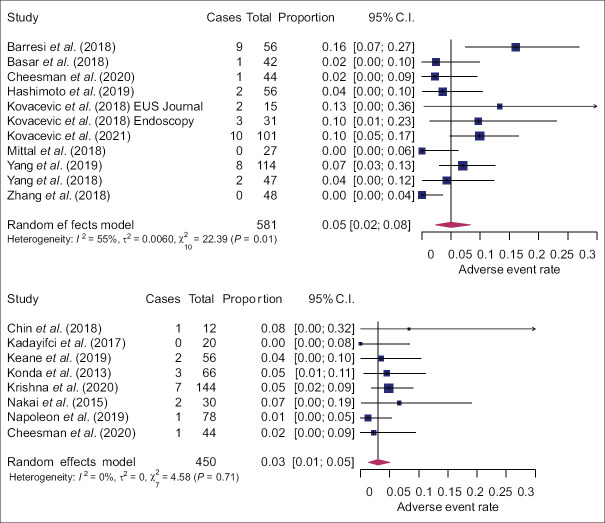
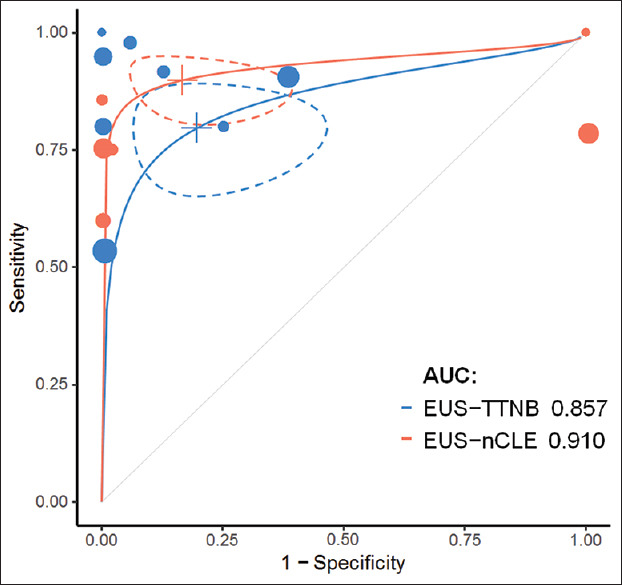
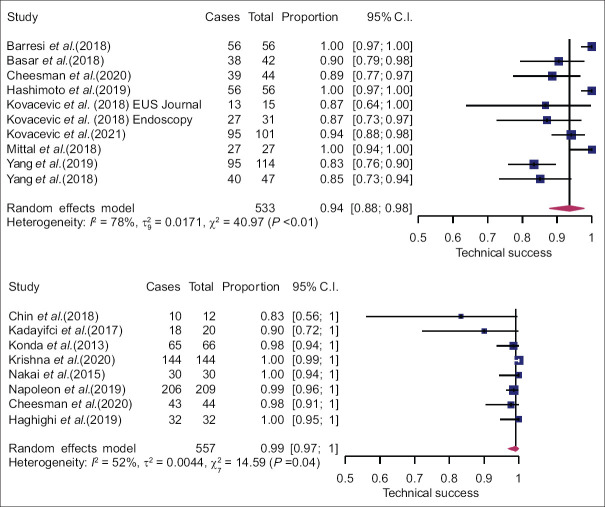
Twenty studies with 1023 patients were included in the meta-analysis. Pooled diagnostic yield of EUS-nCLE was higher compared to EUS-TTNB (85% vs. 74%, P < 0.0001), while diagnostic performance was high and comparable for both methods (pooled sensitivity: 80% vs. 86% and pooled specificity: 80% vs. 83% for TTNB and nCLE, respectively, P > 0.05). Pooled estimate of total adverse event (AE) rate was 5% in the TTNB group and 3% in the nCLE group, P = 0.302. Technical success rates were high and comparable (94% and 99% for EUS-TTNB and nCLE, respectively; P = 0.07).
EUS-TTNB and EUS-nCLE have a similar safety profile with a relatively low number of AEs. Technical success, sensitivity, and specificity are comparable; however, EUS-nCLE seems to have a slightly higher diagnostic yield.
胰腺囊性病变(PCLs)是横断面成像中常见的偶然发现,由于不同类型的PCLs具有不同的恶性风险,因此构成了诊断挑战。最近开发并引入了两种诊断工具:经针活检(TTNB)和基于针的共聚焦激光内镜检查(nCLE)。本荟萃分析的目的是比较这两种方法的诊断率和性能以及安全性。
本荟萃分析按照PRISMA声明进行。在Medline、Embase、Web of Science和Cochrane图书馆数据库中检索了对5例或更多例接受内镜超声(EUS)-TTNB或EUS-nCLE检查PCL患者的研究。排除综述、病例报告、社论、会议摘要以及仅关于实性胰腺病变的研究。感兴趣的结果是诊断率和性能、安全性和技术成功率。
荟萃分析纳入了20项研究,共1023例患者。与EUS-TTNB相比,EUS-nCLE的汇总诊断率更高(85%对74%,P<0.0001),而两种方法的诊断性能都很高且相当(TTNB和nCLE的汇总敏感性分别为80%对86%,汇总特异性分别为80%对83%,P>0.05)。TTNB组总不良事件(AE)率的汇总估计为5%,nCLE组为3%,P = 0.302。技术成功率很高且相当(EUS-TTNB和nCLE分别为94%和99%;P = 0.07)。
EUS-TTNB和EUS-nCLE具有相似的安全性,不良事件数量相对较少。技术成功率、敏感性和特异性相当;然而,EUS-nCLE的诊断率似乎略高。