Department of Psychology, University of Pennsylvania, Philadelphia, PA, USA.
Department of Neurosurgery, University of Texas Southwestern, Dallas, TX, USA.
Nat Commun. 2021 Jul 21;12(1):4444. doi: 10.1038/s41467-021-24393-1.
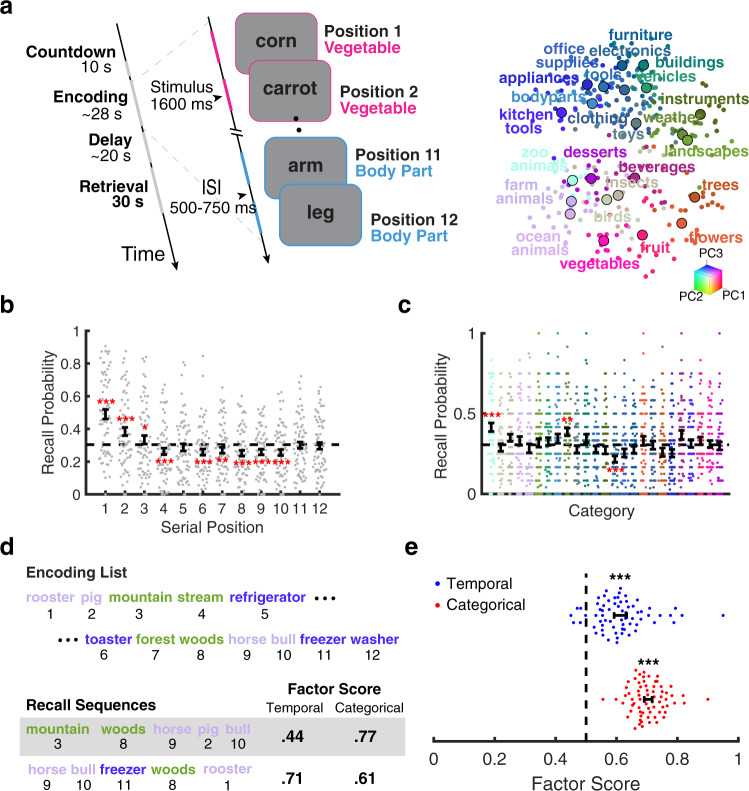
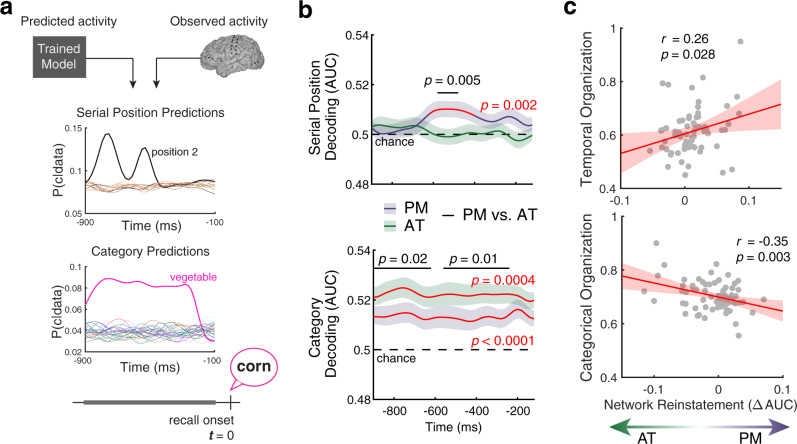
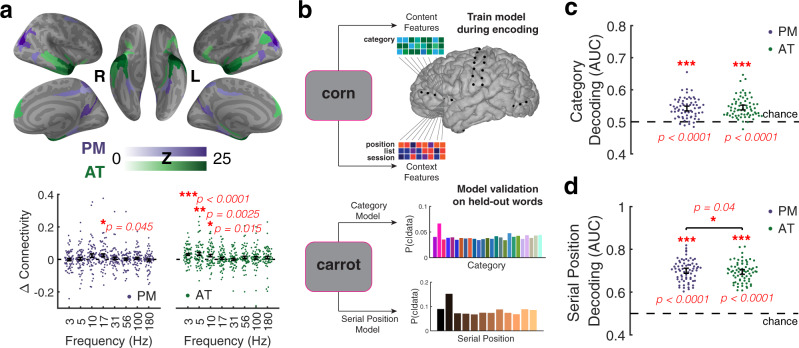
Episodic recall depends upon the reinstatement of cortical activity present during the formation of a memory. Evidence from functional neuroimaging and invasive recordings in humans suggest that reinstatement organizes our memories by time or content, yet the neural systems involved in reinstating these unique types of information remain unclear. Here, combining computational modeling and intracranial recordings from 69 epilepsy patients, we show that two cortical systems uniquely reinstate the semantic content and temporal context of previously studied items during free recall. Examining either the posterior medial or anterior temporal networks, we find that forward encoding models trained on the brain's response to the temporal and semantic attributes of items can predict the serial position and semantic category of unseen items. During memory recall, these models uniquely link reinstatement of temporal context and semantic content to these posterior and anterior networks, respectively. These findings demonstrate how specialized cortical systems enable the human brain to target specific memories.
情景记忆依赖于在记忆形成过程中重现的皮质活动。来自人类功能神经影像学和侵入性记录的证据表明,重现通过时间或内容组织我们的记忆,但涉及重现这些独特类型信息的神经系统仍不清楚。在这里,我们结合计算建模和 69 名癫痫患者的颅内记录,表明两个皮质系统在自由回忆期间独特地重现先前研究项目的语义内容和时间背景。检查后内侧或前颞网络,我们发现基于大脑对项目时间和语义属性的反应进行训练的前向编码模型可以预测未见过项目的序列位置和语义类别。在记忆回忆期间,这些模型分别将时间背景和语义内容的重现独特地与这些后和前网络联系起来。这些发现表明了特定的皮质系统如何使人类大脑能够针对特定的记忆。