Manchón Javier, Quiles María José, Quiles Yolanda, López-Roig Sofía
Miguel Hernández University of Elche, Alicante, Spain.
Front Psychol. 2021 Jul 5;12:709570. doi: 10.3389/fpsyg.2021.709570. eCollection 2021.
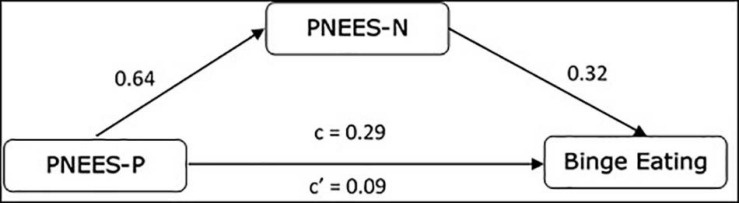
The literature points to the importance of distinguishing between positive and negative emotional eating in relation to overeating and binge eating. The aim of this study was to evaluate the Spanish version of the Positive-Negative Emotional Eating Scale (PNEES) in a Spanish community sample. The sample consisted of 628 participants. The mean age was 27.5 ( = 12.7) and 70.1% of them were women. The participants completed the PNEES, and measures of anxiety and depression (HADS), and eating disorder-related scales (TFEQ-R18, BULIT-R, and EAT-26) that were selected to examine convergent validity. A confirmatory factor analysis was conducted, replicating the original two-factor solution, consisting of Negative Emotional Eating (PNEES-N) and Positive Emotional Eating (PNEES-P). The results showed an acceptable fit of the model (CFI = 0.986; TLI = 0.984, RMSEA = 0.055). Internal consistency ranged from ω = 0.92 to ω = 0.96 for both subscales and the total score. PNEES-P correlations with other variables were lower with respect to the PNEES-N, showing that they are different constructs. A mediation analysis was conducted, in which PNEES-P significantly predicted binge eating and PNEES-N was a partially mediator variable. The results showed that the adaptation process was successful.
文献指出,区分与暴饮暴食和过度饮食相关的积极情绪性进食和消极情绪性进食非常重要。本研究的目的是在西班牙社区样本中评估西班牙语版的正负性情绪性进食量表(PNEES)。样本包括628名参与者。平均年龄为27.5岁(标准差=12.7),其中70.1%为女性。参与者完成了PNEES、焦虑和抑郁测量量表(HADS)以及为检验聚合效度而选择的饮食失调相关量表(TFEQ-R18、BULIT-R和EAT-26)。进行了验证性因素分析,复制了最初的双因素解决方案,包括消极情绪性进食(PNEES-N)和积极情绪性进食(PNEES-P)。结果显示模型拟合度可接受(CFI = 0.986;TLI = 0.984,RMSEA = 0.055)。两个子量表和总分的内部一致性范围为ω = 0.92至ω = 0.96。与PNEES-N相比,PNEES-P与其他变量的相关性较低,表明它们是不同的结构。进行了中介分析,其中PNEES-P显著预测暴饮暴食,PNEES-N是一个部分中介变量。结果表明改编过程是成功的。