Hromadová Dominika, Elewaut Dirk, Inman Robert D, Strobl Birgit, Gracey Eric
Institute of Animal Breeding and Genetics, University of Veterinary Medicine Vienna, Vienna, Austria.
Molecular Immunology and Inflammation Unit, VIB Centre for Inflammation Research, Ghent University, Ghent, Belgium.
Front Genet. 2021 Jul 5;12:685280. doi: 10.3389/fgene.2021.685280. eCollection 2021.
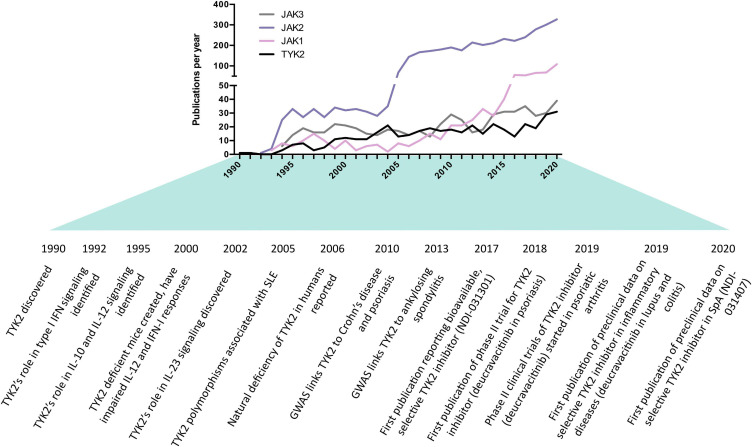
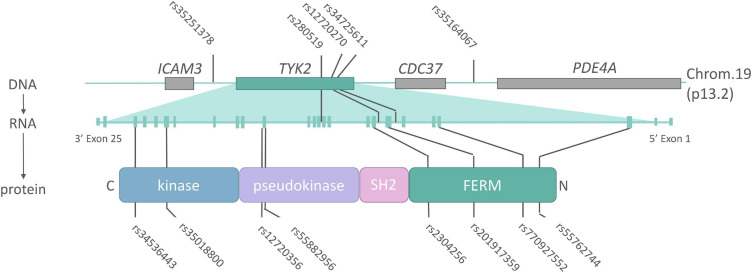
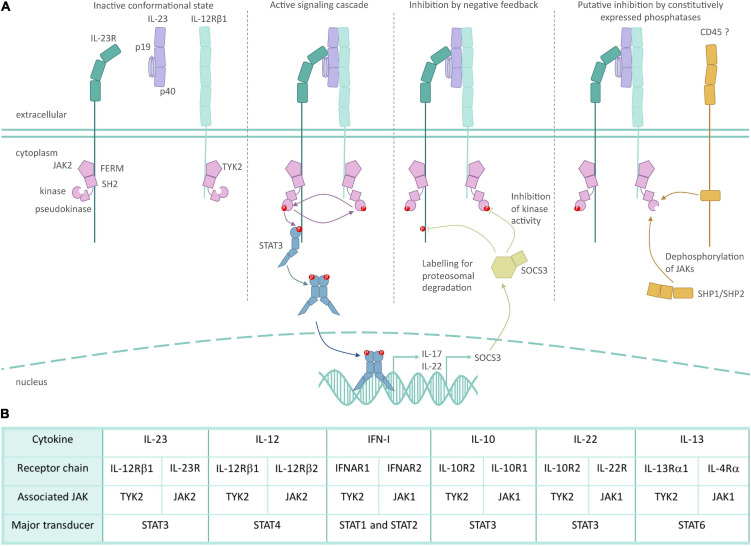
Spondyloarthritis (SpA) is a family of inflammatory arthritic diseases, which includes the prototypes of psoriatic arthritis and ankylosing spondylitis. SpA is commonly associated with systemic inflammatory diseases, such as psoriasis and inflammatory bowel disease. Immunological studies, murine models and the genetics of SpA all indicate a pathogenic role for the IL-23/IL-17 axis. Therapeutics targeting the IL-23/IL-17 pathway are successful at providing symptomatic relief, but may not provide complete protection against progression of arthritis. Thus there is still tremendous interest in the discovery of novel therapeutic targets for SpA. Tyrosine kinase 2 (TYK2) is a member of the Janus kinases, which mediate intracellular signaling of cytokines via signal transducer and activator of transcription (STAT) activation. TYK2 plays a crucial role in mediating IL-23 receptor signaling and STAT3 activation. A plethora of natural mutations in and around TYK2 have provided a wealth of data to associate this kinase with autoimmune/autoinflammatory diseases in humans. Induced and natural mutations in murine Tyk2 largely support human data; however, key inter-species differences exist, which means extrapolation of data from murine models to humans needs to be done with caution. Despite these reservations, novel selective TYK2 inhibitors are now proving successful in advanced clinical trials of inflammatory diseases. In this review, we will discuss TYK2 from basic biology to therapeutic targeting, with an emphasis on studies in SpA. Seminal studies uncovering the basic science of TYK2 have provided sound foundations for targeting it in SpA and related inflammatory diseases. TYK2 inhibitors may well be the next blockbuster therapeutic for SpA.
脊柱关节炎(SpA)是一类炎症性关节炎疾病,其中包括银屑病关节炎和强直性脊柱炎的典型病例。SpA通常与全身性炎症性疾病相关,如银屑病和炎症性肠病。免疫研究、小鼠模型以及SpA的遗传学研究均表明白细胞介素-23/白细胞介素-17轴具有致病作用。针对白细胞介素-23/白细胞介素-17途径的疗法在缓解症状方面取得了成功,但可能无法完全防止关节炎的进展。因此,人们仍然对发现SpA的新型治疗靶点有着浓厚的兴趣。酪氨酸激酶2(TYK2)是Janus激酶家族的成员,它通过信号转导和转录激活因子(STAT)激活来介导细胞因子的细胞内信号传导。TYK2在介导白细胞介素-23受体信号传导和STAT3激活中起着关键作用。TYK2及其周围大量的自然突变提供了丰富的数据,将这种激酶与人类自身免疫性/自身炎症性疾病联系起来。小鼠Tyk2中的诱导性和自然突变在很大程度上支持了人类的数据;然而,存在关键的种间差异,这意味着从小鼠模型向人类外推数据时需要谨慎。尽管有这些保留意见,但新型选择性TYK2抑制剂目前在炎症性疾病的晚期临床试验中已被证明是成功的。在这篇综述中,我们将讨论从TYK2的基础生物学到治疗靶点,重点是在SpA中的研究。揭示TYK2基础科学的开创性研究为在SpA和相关炎症性疾病中靶向它提供了坚实的基础。TYK2抑制剂很可能成为SpA的下一个重磅治疗药物。