de Jesus-Silva Seleno Glauber, Oliveira Jennifer Dos Santos, Ramos Karine Tobias França, Morais Luciene Azevedo, Silva Melissa Andreia de Moraes, Krupa Arturo Eduardo, Cardoso Rodolfo Souza
Associação de Integração Social de Itajubá - AISI, Hospital de Clínicas de Itajubá - HCI, Departamento de Cirurgia Vascular e Endovascular, Itajubá, MG, Brasil.
Faculdade de Medicina de Itajubá - FMIt, Itajubá, MG, Brasil.
J Vasc Bras. 2020 Sep 14;19:e20190142. doi: 10.1590/1677-5449.190142. eCollection 2020.
Short-term (ST) and long-term tunneled (LTT) central venous catheters for hemodialysis (CVCH) are critical for hemodialysis therapy. However, few studies have been conducted in Brazil to investigate the incidence of complications with these two types of catheters.
To analyze complications and duration of CVCH in a hemodialysis center at a teaching hospital.
Single-center, longitudinal, and retrospective study of 115 consecutive patients undergoing hemodialysis catheter placement (67 ST and 48 LTT) over a 2-year period, analyzing overall survival, patency, loss of access, and incidence of complications.
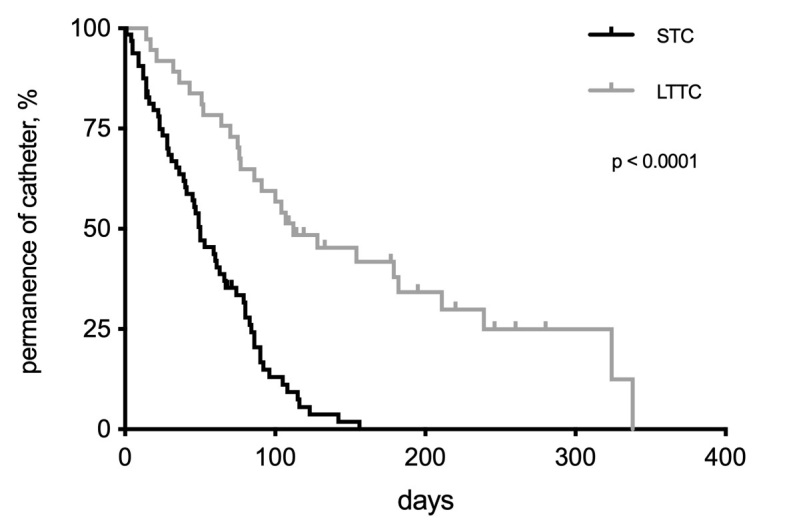
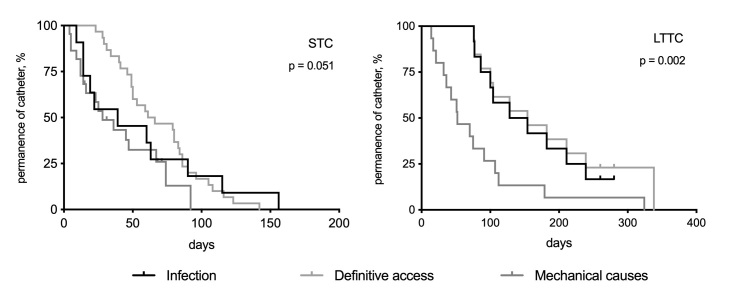
Sixty percent of the patients were male and mean age was 62 years. The most common puncture site was the right internal jugular vein. Systemic arterial hypertension was present in 95% of cases. Median catheter in-place duration was 50 days (ST) vs. 112 days (LTT; p < 0.0001). There was no difference in overall survival. Incidence of catheter-related infection was higher in ST CVCH, with sp. the microorganism most often found. The infection rate per 1000 days was higher in ST than in LTT catheters (16.7 events/1000 days vs. 7.0 events/1000 days). Low income was the only factor related to higher incidence of infection.
The in-place duration of long-term catheters was significantly longer compared to short-term CVCH, but still below the values reported in the literature and without impact on overall survival. Low income was a factor associated with catheter infection.
用于血液透析的短期(ST)和长期带隧道式(LTT)中心静脉导管对血液透析治疗至关重要。然而,巴西针对这两种类型导管并发症发生率的研究较少。
分析一家教学医院血液透析中心中心静脉导管用于血液透析(CVCH)的并发症及使用时长。
对一家中心在两年期间连续接受血液透析导管置入的115例患者(67例短期导管和48例长期带隧道式导管)进行单中心、纵向、回顾性研究,分析总体生存率、通畅率、通路丧失及并发症发生率。
60%的患者为男性,平均年龄62岁。最常见的穿刺部位是右颈内静脉。95%的病例存在系统性动脉高血压。导管中位在位时长短期导管为50天,长期带隧道式导管为112天(p<0.0001)。总体生存率无差异。短期CVCH导管相关感染发生率更高,其中[具体菌种]是最常发现的微生物。短期导管每1000天的感染率高于长期带隧道式导管(16.7次事件/1000天对7.0次事件/1000天)。低收入是与感染发生率较高相关的唯一因素。
与短期CVCH相比,长期导管的在位时长显著更长,但仍低于文献报道的值,且对总体生存率无影响。低收入是与导管感染相关的一个因素。