Robin Maxime, Mhanna Laurent, Chaltiel Leonor, Plat Gavin, Héluain Valentin, Basset Céline, Meilleroux Julie, Filleron Thomas, Mazières Julien, Hermant Christophe, Guibert Nicolas
Pulmonology Dept, Larrey University Hospital, Toulouse, France.
Biostatistics Dept, Institut Claudius Regaud, Toulouse University Cancer Institute (IUCT-O), Toulouse, France.
ERJ Open Res. 2021 Jul 19;7(3). doi: 10.1183/23120541.00942-2020. eCollection 2021 Jul.
Mini-invasive bronchoscopic techniques (such as radial endobronchial ultrasonography (rEBUS) and electromagnetic navigation (EMN)) have been developed to reach the peripheral lung but result in small samples. The feasibility of an adequate molecular testing from these specimens has been very little studied.
We retrospectively reviewed EMN and rEBUS procedures performed in patients diagnosed with lung cancer in our institution in 2017 and 2018. We analysed the sensitivity for rEBUS and EMN and each sampling method, and the feasibility of a comprehensive molecular testing.
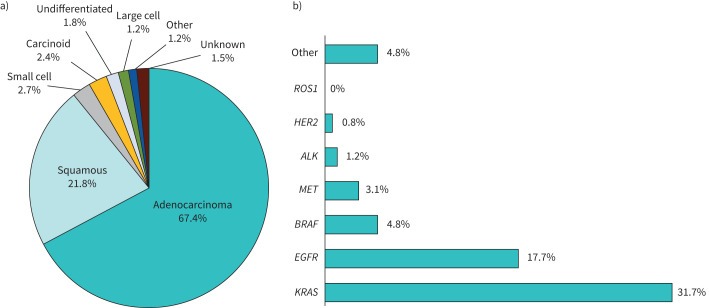
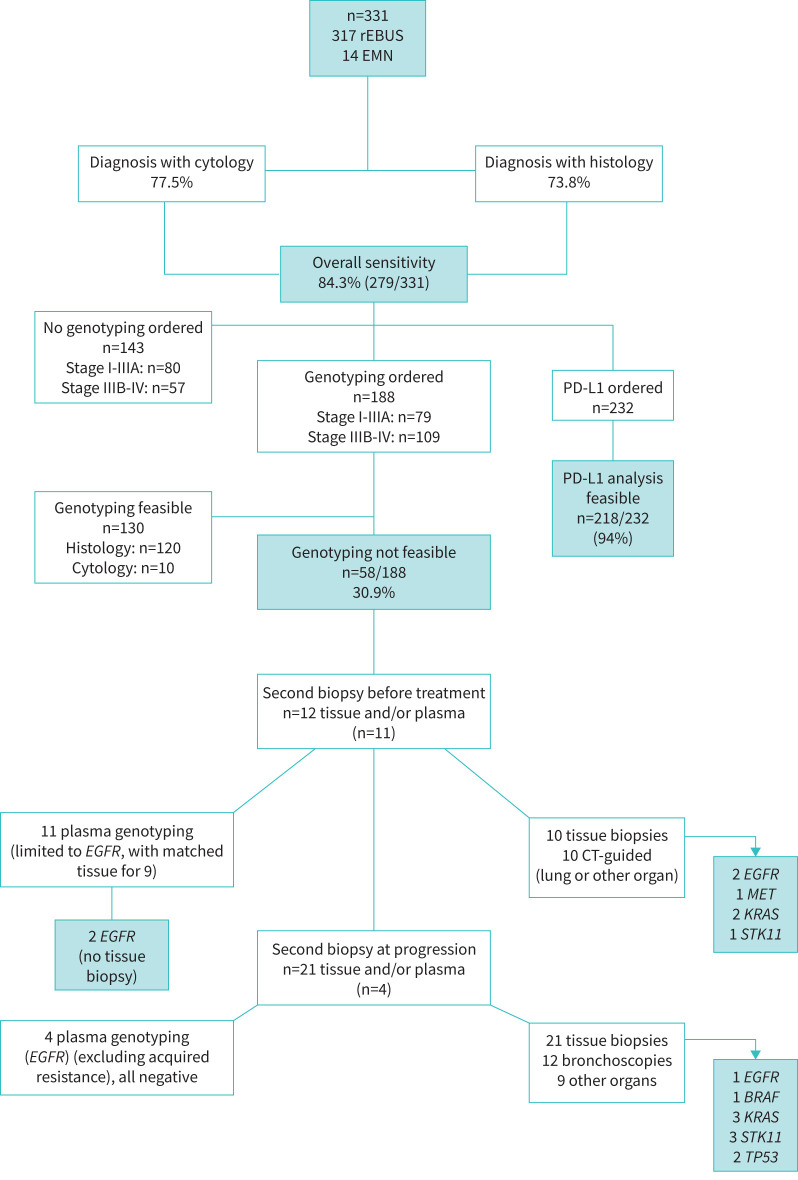
In total, 317 rEBUS and 14 EMN were performed. Median sizes of tumours were 16 and 32 mm for EMN and rEBUS, respectively. Overall sensitivity for rEBUS and EMN was 84.3%. Cytology was found to be complementary with biopsies, with 13.3% of cancer diagnosed on cytology while biopsies were negative. Complication rate was 2.4% (pneumothorax 1.5%, mild haemoptysis 0.9%). Genotyping (immunohistochemistry for and followed by fluorescence hybridisation if positive and hybrid capture next-generation sequencing covering 48 genes), when ordered (n=188), was feasible in 69.1% ( 17.7%, 31.7%, 4.8%, 1.2%, 3.1%, 0.8%). PD-L1 (programmed death-ligand 1) expression, when ordered (n=232), could be analysed in 94% of cases. Overall, 56.9% (33 out of 58) of patients for whom genotyping was not feasible underwent a second sampling (12 pretreatment, 21 at progression), allowing for the detection of six actionable genotypes (five , one ).
rEBUS and EMN are sensitive and safe procedures that result in limited samples, often not suitable for genotyping, highlighting the importance of integrating liquid biopsy in routine testing.
微创支气管镜技术(如径向支气管内超声检查(rEBUS)和电磁导航(EMN))已被开发用于到达外周肺,但获取的样本较小。对这些样本进行充分分子检测的可行性研究很少。
我们回顾性分析了2017年和2018年在我院诊断为肺癌的患者所接受的EMN和rEBUS检查。我们分析了rEBUS和EMN以及每种采样方法的敏感性,以及进行全面分子检测的可行性。
共进行了317例rEBUS和14例EMN检查。EMN和rEBUS检查的肿瘤中位大小分别为16毫米和32毫米。rEBUS和EMN的总体敏感性为84.3%。发现细胞学检查与活检具有互补性,13.3%的癌症在细胞学检查中被诊断出来,而活检结果为阴性。并发症发生率为2.4%(气胸1.5%,轻度咯血0.9%)。基因分型(先进行 和 的免疫组织化学检测,若为阳性则进行荧光原位杂交,然后进行覆盖48个基因的杂交捕获下一代测序),在有医嘱时(n = 188),可行率为69.1%( 17.7%, 31.7%, 4.8%، 1.2%, 3.1%, 0.8%)。当有医嘱时(n = 232),94%的病例可分析程序性死亡配体1(PD-L1)表达。总体而言,基因分型不可行的患者中有56.9%(58例中的33例)进行了二次采样(12例在治疗前,21例在病情进展时),从而检测到6种可采取行动的基因型(5种 ,1种 )。
rEBUS和EMN是敏感且安全的检查方法,但获取的样本有限,通常不适合进行基因分型,这凸显了在常规检测中整合液体活检的重要性。