College of Sports and Health, Shandong Sport University, Jinan 250102, China.
Department of Statistics and Analytical Sciences, Kennesaw State University, Kennesaw, GA 30144, USA.
J Sport Health Sci. 2021 Sep;10(5):585-593. doi: 10.1016/j.jshs.2021.07.005. Epub 2021 Jul 20.
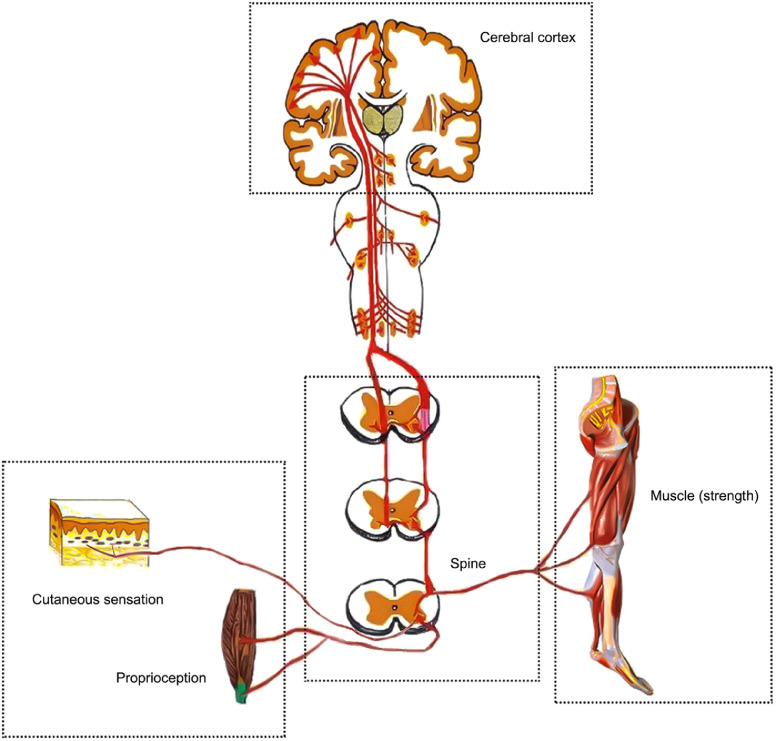
Balance impairment is one of the strongest risk factors for falls. Proprioception, cutaneous sensitivity, and muscle strength are 3 important contributors to balance control in older adults. The relationship that dynamic and static balance control has to proprioception, cutaneous sensitivity, and muscle strength is still unclear. This study was performed to investigate the relationship these contributors have to dynamic and static balance control.
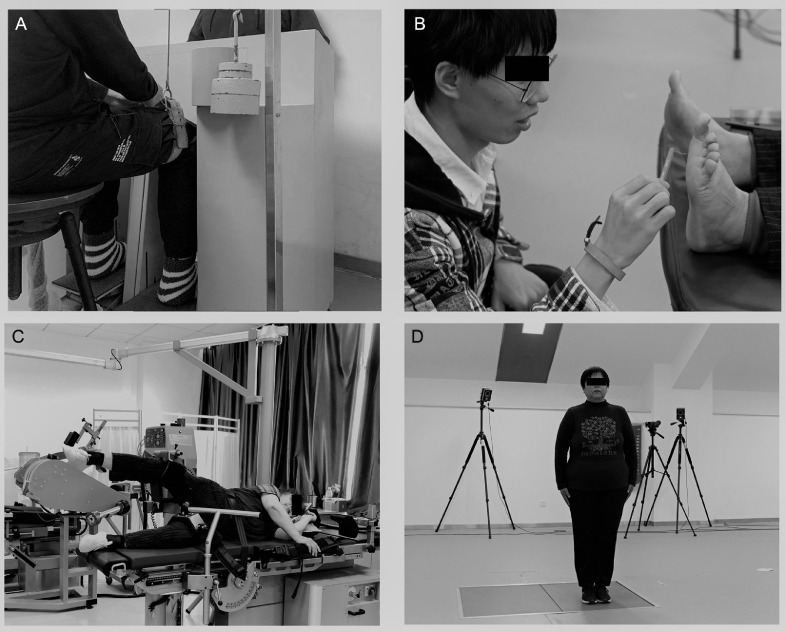
A total of 164 older adults (female = 89, left dominant = 15, age: 73.5 ± 7.8 years, height: 161.6 ± 7.1 cm, weight: 63.7 ± 8.9 kg, mean ± SD) participated in this study. It tested the proprioception of their knee flexion/extension and ankle dorsi/plantarflexion, along with cutaneous sensitivity at the great toe, first and fifth metatarsals, arch, and heel, and the muscle strength of their ankle dorsi/plantarflexion and hip abduction. The Berg Balance Scale (BBS) and the root mean square (RMS) of the center of pressure (CoP) were collected as indications of dynamic and static balance control. A partial correlation was used to determine the relationship between the measured outcomes variables (BBS and CoP-RMS) and the proprioception, cutaneous sensitivity, and muscle strength variables.
Proprioception of ankle plantarflexion (r = -0.306, p = 0.002) and dorsiflexion (r = -0.217, p = 0.030), and muscle strength of ankle plantarflexion (r = 0.275, p = 0.004), dorsiflexion (r = 0.369, p < 0.001), and hip abduction (r = 0.342, p < 0.001) were weakly to moderately correlated with BBS. Proprioception of ankle dorsiflexion (r = 0.218, p = 0.020) and cutaneous sensitivity at the great toe (r = 0.231, p = 0.041) and arch (r = 0.285, p = 0.002) were weakly correlated with CoP-RMS in the anteroposterior direction. Proprioception of ankle dorsiflexion (r = 0.220, p = 0.035), knee flexion (r = 0.308, p = 0.001) and extension (r = 0.193, p = 0.040), and cutaneous sensitivity at the arch (r = 0.206, p = 0.028) were weakly to moderately correlated with CoP-RMS in the mediolateral direction.
There is a weak-to-moderate relationship between proprioception and dynamic and static balance control, a weak relationship between cutaneous sensitivity and static balance control, and a weak-to-moderate relationship between muscle strength and dynamic balance control.
平衡障碍是跌倒的最强危险因素之一。本体感觉、皮肤敏感性和肌肉力量是老年人平衡控制的 3 个重要因素。动态和静态平衡控制与本体感觉、皮肤敏感性和肌肉力量之间的关系仍不清楚。本研究旨在探讨这些因素与动态和静态平衡控制的关系。
共有 164 名老年人(女性=89 名,左利手=15 名,年龄:73.5±7.8 岁,身高:161.6±7.1cm,体重:63.7±8.9kg,均值±标准差)参与了这项研究。它测试了他们的膝关节屈伸和踝关节背屈/跖屈的本体感觉,以及大脚趾、第一和第五跖骨、足弓和脚跟的皮肤敏感性,以及踝关节背屈/跖屈和髋关节外展的肌肉力量。Berg 平衡量表(BBS)和中心压力(CoP)的均方根(RMS)被用来作为动态和静态平衡控制的指标。采用偏相关分析来确定测量结果变量(BBS 和 CoP-RMS)与本体感觉、皮肤敏感性和肌肉力量变量之间的关系。
踝关节跖屈(r=−0.306,p=0.002)和背屈(r=−0.217,p=0.030)的本体感觉,以及踝关节跖屈(r=0.275,p=0.004)、背屈(r=0.369,p<0.001)和髋关节外展(r=0.342,p<0.001)的肌肉力量与 BBS 呈弱到中度相关。踝关节背屈的本体感觉(r=0.218,p=0.020)和大脚趾的皮肤敏感性(r=0.231,p=0.041)和足弓的皮肤敏感性(r=0.285,p=0.002)与 CoP-RMS 在前后方向呈弱相关。踝关节背屈的本体感觉(r=0.220,p=0.035)、膝关节屈伸(r=0.308,p=0.001)和伸展(r=0.193,p=0.040)以及足弓的皮肤敏感性(r=0.206,p=0.028)与 CoP-RMS 在左右方向呈弱到中度相关。
本体感觉与动态和静态平衡控制之间存在弱到中度的关系,皮肤敏感性与静态平衡控制之间存在弱关系,肌肉力量与动态平衡控制之间存在弱到中度的关系。