Department of Neurology and Psychiatry, Instituto Nacional de Ciencias Médicas y Nutrición Salvador Zubirán, Mexico City, Mexico.
Department of Neurology and Psychiatry, Instituto Nacional de Ciencias Médicas y Nutrición Salvador Zubirán, Mexico City, Mexico.
Auton Neurosci. 2021 Nov;235:102855. doi: 10.1016/j.autneu.2021.102855. Epub 2021 Jul 17.
An intriguing feature recently unveiled in some COVID-19 patients is the "silent hypoxemia" phenomenon, which refers to the discrepancy of subjective well-being sensation while suffering hypoxia, manifested as the absence of dyspnea.
To describe the clinical characteristics and predictors of silent hypoxemia in hospitalized COVID-19 patients.
We conducted a prospective cohort study including consecutive hospitalized adult (≥ 18 years) patients with confirmed COVID-19 presenting to the emergency department with oxygen saturation (SpO2) ≤ 80% on room air from March 15 to June 30, 2020. We analyzed the characteristics, disease severity, and in-hospital outcomes of patients presenting with dyspnea and those without dyspnea (silent hypoxemia).
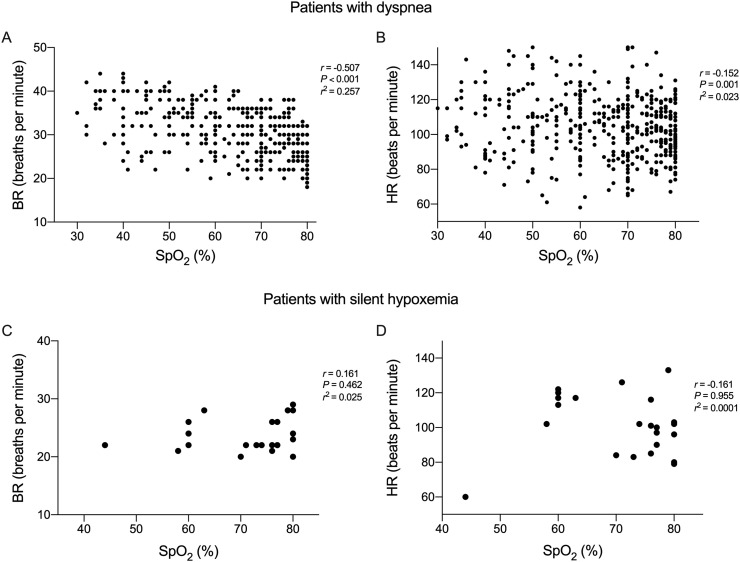
We studied 470 cases (64.4% men; median age 55 years, interquartile range 46-64). There were 447 (95.1%) patients with dyspnea and 23 (4.9%) with silent hypoxemia. The demographic and clinical characteristics, comorbidities, laboratory and imaging findings, disease severity, and outcomes were similar between groups. Higher breathing and heart rates correlated significantly with lower SpO in patients with dyspnea but not in those with silent hypoxemia. Independent predictors of silent hypoxemia were the presence of new-onset headache (OR 2.919, 95% CI 1.101-7.742; P = 0.031) and presenting to the emergency department within the first eight days after symptoms onset (OR 3.183, 95% CI 1.024-9.89; P = 0.045).
Patients with silent hypoxemia sought medical attention earlier and had new-onset headache more often. They were also likely to display lower hemodynamic compensatory responses to hypoxemia, which may underestimate the disease severity.
最近在一些 COVID-19 患者中发现了一个有趣的特征,即“无症状低氧血症”现象,它指的是在缺氧时主观感觉良好与缺氧之间的差异,表现为没有呼吸困难。
描述住院 COVID-19 患者中无症状低氧血症的临床特征和预测因素。
我们进行了一项前瞻性队列研究,纳入了 2020 年 3 月 15 日至 6 月 30 日期间因血氧饱和度(SpO2)≤80%而在急诊室就诊的连续住院成年(≥18 岁)确诊 COVID-19 患者,这些患者在吸入空气时出现低氧血症。我们分析了有呼吸困难和无症状低氧血症(无症状低氧血症)患者的特征、疾病严重程度和住院结局。
我们研究了 470 例病例(64.4%为男性;中位年龄为 55 岁,四分位距为 46-64)。有 447 例(95.1%)患者有呼吸困难,23 例(4.9%)患者有无症状低氧血症。两组患者的人口统计学和临床特征、合并症、实验室和影像学发现、疾病严重程度和结局相似。在有呼吸困难的患者中,呼吸和心率较高与 SpO2 较低显著相关,但在无症状低氧血症患者中则不然。无症状低氧血症的独立预测因素是新发头痛(OR 2.919,95%CI 1.101-7.742;P=0.031)和症状发作后 8 天内就诊于急诊室(OR 3.183,95%CI 1.024-9.89;P=0.045)。
有无症状低氧血症的患者就诊较早,且新发头痛更为常见。他们也可能表现出对低氧血症的较低血流动力学代偿反应,这可能会低估疾病的严重程度。