Indian Institute of Public Health- Hyderabad, Public Health Foundation of India, Hyderabad, India.
Department of Public Health, Environments and Society, Faculty of Public Health and Policy, London School of Hygiene and Tropical Medicine, London, UK.
BMC Psychiatry. 2021 Jul 22;21(1):364. doi: 10.1186/s12888-021-03350-8.
Educational interventions engage youth using visual, literary and performing arts to combat stigma associated with mental health problems. However, it remains unknown whether arts interventions are effective in reducing mental-health-related stigma among youth and if so, then which specific art forms, duration and stigma-related components in content are successful.
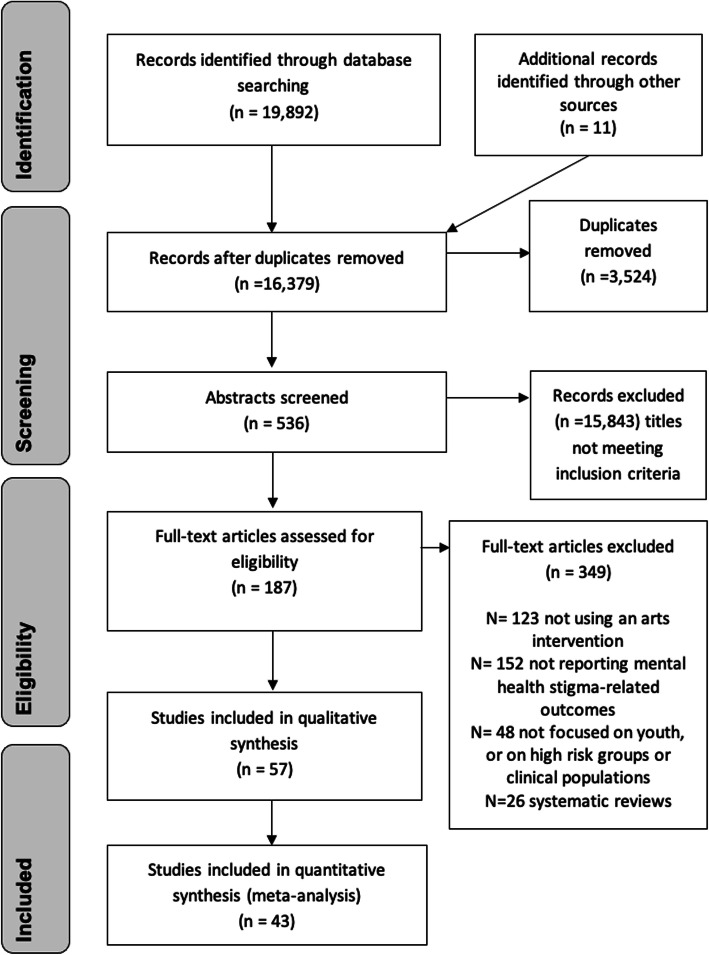
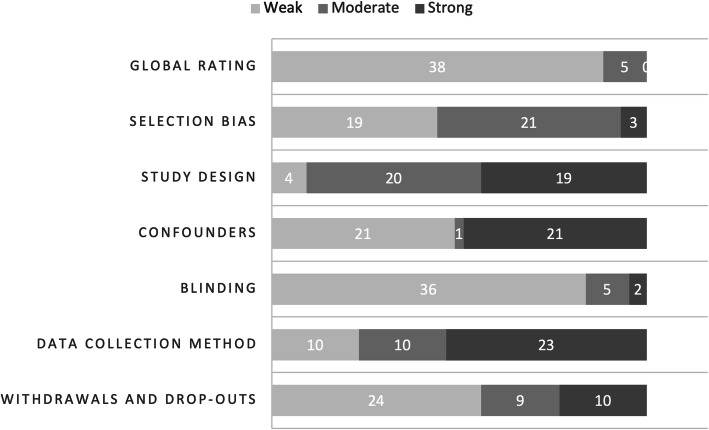
We searched 13 databases, including PubMed, Medline, Global Health, EMBASE, ADOLEC, Social Policy and Practice, Database of Promoting Health Effectiveness Reviews (DoPHER), Trials Register of Promoting Health Interventions (TRoPHI), EPPI-Centre database of health promotion research (Bibliomap), Web of Science, PsycINFO, Cochrane and Scopus for studies involving arts interventions aimed at reducing any or all components of mental-health-related stigma among youth (10-24-year-olds). Risk of bias was assessed using the Effective Public Health Practice Project (EPHPP) Quality Assessment Tool for Quantitative Studies. Data were extracted into tables and analysed using RevMan 5.3.5.
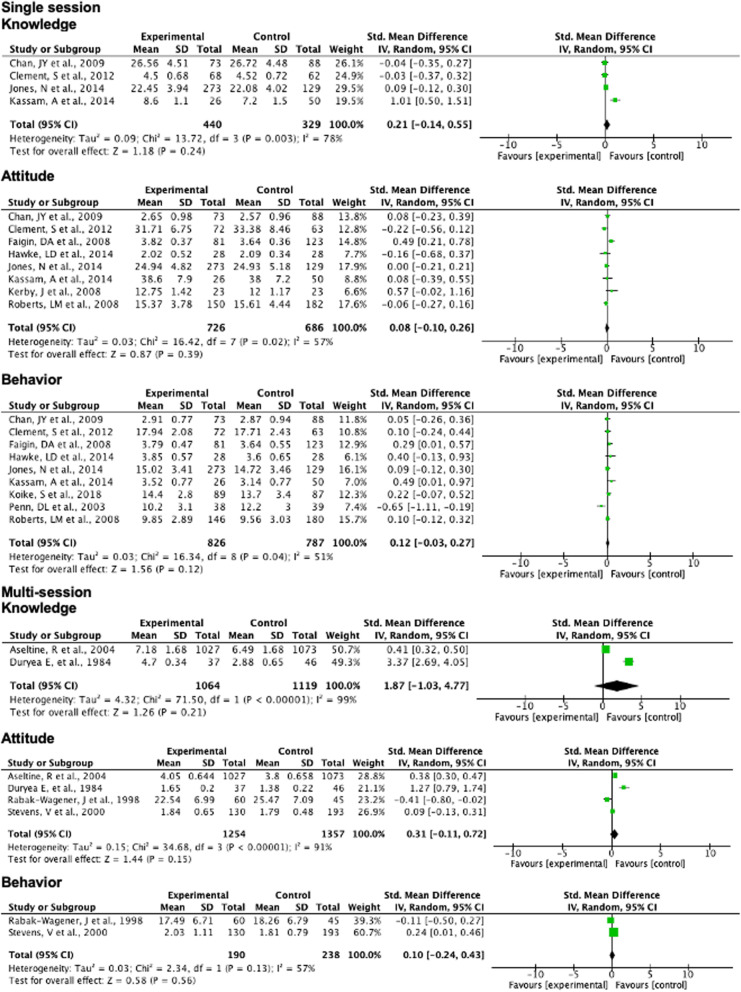
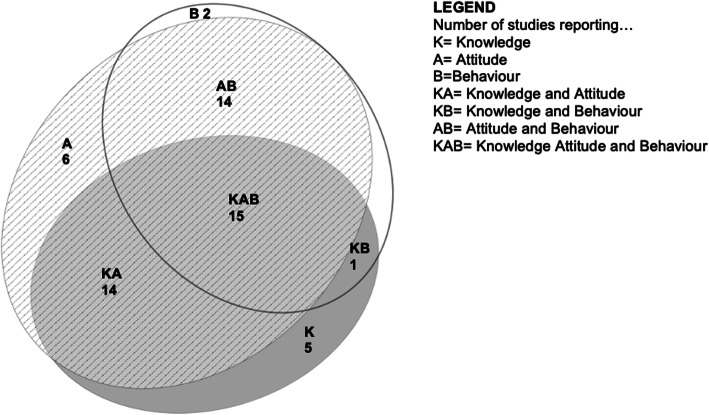
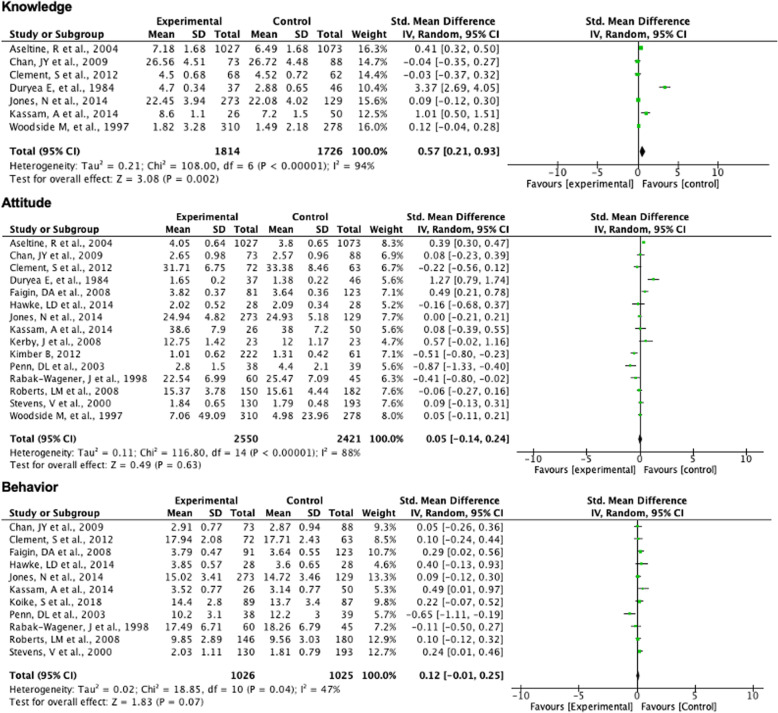
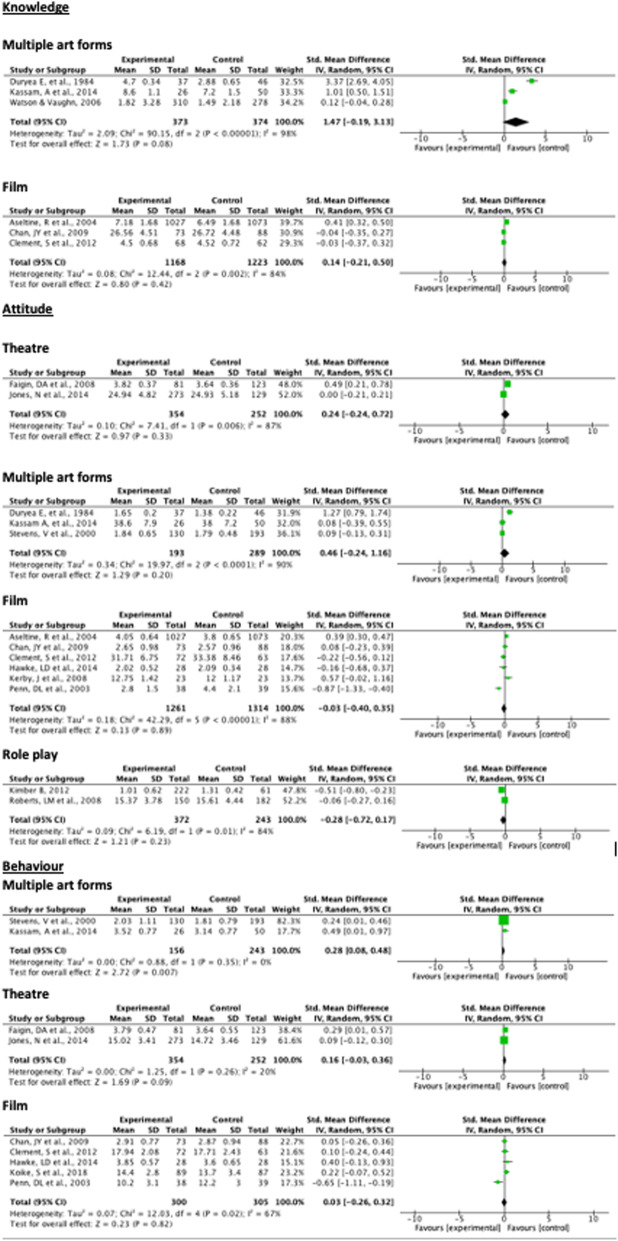
Fifty-seven studies met our inclusion criteria (n = 41,621). Interventions using multiple art forms are effective in improving behaviour towards people with mental health problems to a small effect (effect size = 0.28, 95%CI 0.08-0.48; p = 0.007) No studies reported negative outcomes or unintended harms. Among studies using specific art forms, we observed high heterogeneity among intervention studies using theatre, multiple art forms, film and role play. Data in this review are inconclusive about the use of single versus multiple sessions and whether including all stigma components of knowledge, attitude and behaviour as intervention content are more effective relative to studies focused on these stigma components, individually. Common challenges faced by school-based arts interventions included lack of buy-in from school administrators and low engagement. No studies were reported from low- and middle-income countries.
Arts interventions are effective in reducing mental-health-related stigma to a small effect. Interventions that employ multiple art forms together compared to studies employing film, theatre or role play are likely more effective in reducing mental-health-related stigma.
教育干预措施利用视觉、文学和表演艺术吸引年轻人,以消除与心理健康问题相关的污名。然而,目前尚不清楚艺术干预措施是否能有效减少年轻人的心理健康相关污名,如果是,那么哪种特定的艺术形式、时长以及内容中的哪些与污名相关的组成部分是成功的。
我们搜索了 13 个数据库,包括 PubMed、Medline、全球卫生、EMBASE、ADOLEC、社会政策和实践、促进健康效果评估数据库(DoPHER)、促进健康干预措施的试验登记处(TRoPHI)、健康促进研究的 EPPI 中心数据库(Bibliomap)、Web of Science、PsycINFO、Cochrane 和 Scopus,以获取针对年轻人(10-24 岁)的旨在减少任何或所有心理健康相关污名组成部分的艺术干预措施的研究。使用有效公共卫生实践项目(EPHPP)质量评估工具对定量研究进行了偏倚风险评估。将数据提取到表格中,并使用 RevMan 5.3.5 进行分析。
57 项研究符合纳入标准(n=41621)。使用多种艺术形式的干预措施在改善对心理健康问题患者的行为方面有效,效果较小(效应量=0.28,95%CI 0.08-0.48;p=0.007)。没有研究报告负面结果或意外危害。在使用特定艺术形式的研究中,我们观察到使用戏剧、多种艺术形式、电影和角色扮演的干预研究之间存在高度异质性。本综述中的数据对于单次与多次治疗以及将知识、态度和行为的所有污名组成部分作为干预内容是否比专注于这些污名组成部分的研究更有效,尚无定论。基于学校的艺术干预措施面临的常见挑战包括学校管理人员缺乏支持和参与度低。没有来自低收入和中等收入国家的研究报告。
艺术干预措施在减少心理健康相关污名方面有效,效果较小。与使用电影、戏剧或角色扮演的研究相比,使用多种艺术形式的干预措施可能更有效地减少心理健康相关污名。