Multiple Sclerosis Center (SD-A, AG, AA), Sheba Medical Center, Ramat Gan, Israel; Faculty of Medicine (SD-A), Hebrew University, Jerusalem, Israel; and Sackler Faculty of Medicine (AA), Tel-Aviv University, Tel Aviv, Israel.
J Neuroophthalmol. 2022 Mar 1;42(1):e14-e21. doi: 10.1097/WNO.0000000000001326. Epub 2021 Jul 21.
Optical coherence tomography (OCT) is a sensitive method for quantifying retinal neuronal and axonal structures. Reductions in retinal nerve fiber layer (RNFL) and ganglion cell inner plexiform layer (GCIPL) thicknesses have a reported association with white and grey matter atrophy in multiple sclerosis (MS). We hypothesized that the thinning of intraretinal layer measurements associates with cognitive decline in MS patients with no prior event of optic neuritis (ON).
OCT and NeuroTrax computerized cognitive assessments were performed in 204 relapsing remitting MS patients with no history of ON or other conditions affecting the eye. Data were collected between 2010 and 2020 and retrospectively analyzed. Correlations were examined between cognitive performance and a lower RNFL or GCIPL thickness. A multilinear regression model was generated to assess the significance of these correlations regarding the disability score and disease duration.
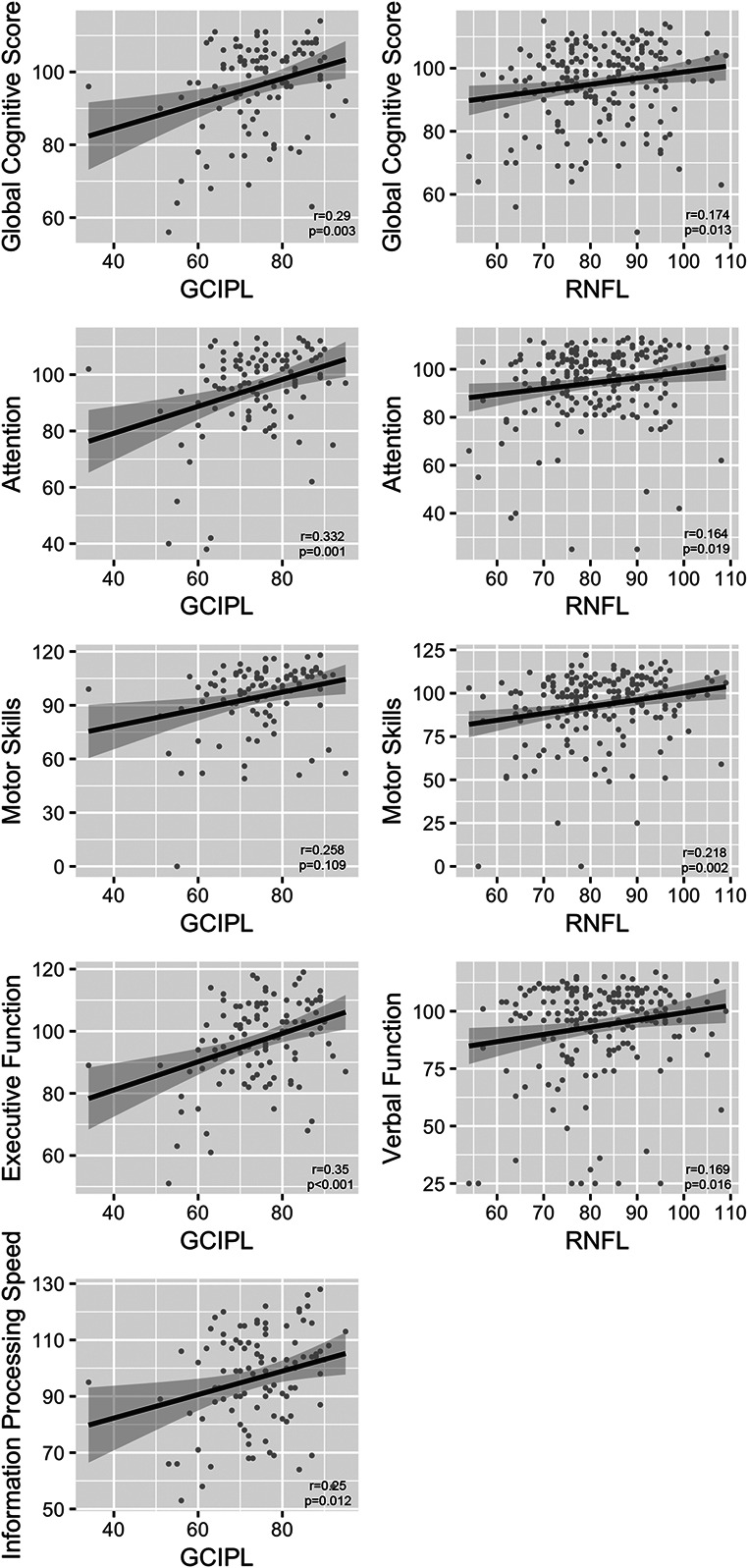
The 204 study participants had a mean age of 40.52 ± 11.8 years (mean ± SD) and disease duration of 9.80 ± 9.40 years. The mean RNFL thickness in this whole cohort was 82.22 ± 10.85 μm and the global cognitive score was 95.32 ± 12.32. The mean GCIPL thickness measured in a subgroup of 104 patients was 74.27 ± 10.37 μm. The RNFL and GCIPL both correlated with the global cognitive score (r = 0.174, P = 0.013 and r = 0.29, P = 0.03, respectively), and with various cognitive domains. However, the GCIPL showed stronger correlations than RNFL, particularly with executive function (r = 0.29, P = 0.003), attention (r = 0.332, P = 0.001), and the information processing speed (r = 0.25, P = 0.012). These correlations remained significant after correcting for confounders.
OCT measurements correlate with cognitive performance in MS patients. OCT can thus be used to evaluate central nervous system neurodegeneration in MS, as reflected by cognitive decline.
光学相干断层扫描(OCT)是一种用于量化视网膜神经元和轴突结构的敏感方法。视网膜神经纤维层(RNFL)和神经节细胞内丛状层(GCIPL)厚度的减少与多发性硬化症(MS)中的白质和灰质萎缩有关。我们假设,在没有视神经炎(ON)病史的 MS 患者中,视网膜内各层测量值的变薄与认知能力下降有关。
对 204 例无 ON 或其他影响眼部疾病病史的复发缓解型 MS 患者进行 OCT 和 NeuroTrax 计算机认知评估。数据于 2010 年至 2020 年期间收集,并进行回顾性分析。检查认知表现与较低的 RNFL 或 GCIPL 厚度之间的相关性。生成一个多线性回归模型,以评估这些相关性与残疾评分和疾病持续时间的显著性。
204 名研究参与者的平均年龄为 40.52±11.8 岁(均值±标准差),疾病持续时间为 9.80±9.40 年。整个队列的平均 RNFL 厚度为 82.22±10.85μm,全球认知评分(global cognitive score)为 95.32±12.32。104 例患者亚组测量的平均 GCIPL 厚度为 74.27±10.37μm。RNFL 和 GCIPL 均与全球认知评分相关(r=0.174,P=0.013 和 r=0.29,P=0.03),与各种认知域也相关。然而,GCIPL 与 RNFL 相比显示出更强的相关性,尤其是与执行功能(r=0.29,P=0.003)、注意力(r=0.332,P=0.001)和信息处理速度(r=0.25,P=0.012)。在纠正混杂因素后,这些相关性仍然显著。
OCT 测量值与 MS 患者的认知表现相关。因此,OCT 可用于评估 MS 患者中枢神经系统神经退行性变,反映为认知能力下降。