Akbari Hamed, Kazerooni Anahita Fathi, Ware Jeffrey B, Mamourian Elizabeth, Anderson Hannah, Guiry Samantha, Sako Chiharu, Raymond Catalina, Yao Jingwen, Brem Steven, O'Rourke Donald M, Desai Arati S, Bagley Stephen J, Ellingson Benjamin M, Davatzikos Christos, Nabavizadeh Ali
Department of Radiology, Perelman School of Medicine, Hospital of University of Pennsylvania, University of Pennsylvania, Philadelphia, PA, USA.
Center for Biomedical Image Computing and Analytics, Perelman School of Medicine, University of Pennsylvania, Philadelphia, PA, USA.
Sci Rep. 2021 Jul 22;11(1):15011. doi: 10.1038/s41598-021-94560-3.
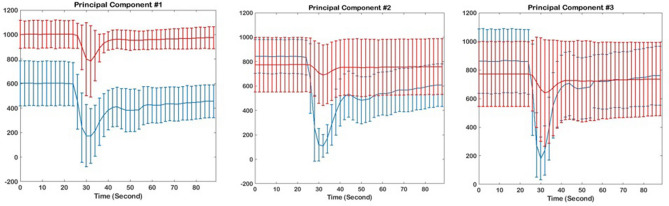
Glioblastoma (GBM) has high metabolic demands, which can lead to acidification of the tumor microenvironment. We hypothesize that a machine learning model built on temporal principal component analysis (PCA) of dynamic susceptibility contrast-enhanced (DSC) perfusion MRI can be used to estimate tumor acidity in GBM, as estimated by pH-sensitive amine chemical exchange saturation transfer echo-planar imaging (CEST-EPI). We analyzed 78 MRI scans in 32 treatment naïve and post-treatment GBM patients. All patients were imaged with DSC-MRI, and pH-weighting that was quantified from CEST-EPI estimation of the magnetization transfer ratio asymmetry (MTR) at 3 ppm. Enhancing tumor (ET), non-enhancing core (NC), and peritumoral T2 hyperintensity (namely, edema, ED) were used to extract principal components (PCs) and to build support vector machines regression (SVR) models to predict MTR values using PCs. Our predicted map correlated with MTR values with Spearman's r equal to 0.66, 0.47, 0.67, 0.71, in NC, ET, ED, and overall, respectively (p < 0.006). The results of this study demonstrates that PCA analysis of DSC imaging data can provide information about tumor pH in GBM patients, with the strongest association within the peritumoral regions.
胶质母细胞瘤(GBM)具有高代谢需求,这会导致肿瘤微环境酸化。我们假设,基于动态磁敏感对比增强(DSC)灌注磁共振成像(MRI)的时间主成分分析(PCA)构建的机器学习模型,可用于估计GBM中的肿瘤酸度,如通过pH敏感胺化学交换饱和转移回波平面成像(CEST-EPI)所估计的那样。我们分析了32例未经治疗和接受过治疗的GBM患者的78次MRI扫描。所有患者均接受DSC-MRI成像,并通过CEST-EPI对3 ppm处的磁化传递率不对称性(MTR)进行估计来量化pH加权。使用强化肿瘤(ET)、非强化核心(NC)和瘤周T2高信号(即水肿,ED)来提取主成分(PC),并构建支持向量机回归(SVR)模型,以使用PC预测MTR值。我们的预测图与MTR值的Spearman相关系数分别在NC、ET、ED和总体中为0.66、0.47、0.67、0.71(p < 0.006)。本研究结果表明,DSC成像数据的PCA分析可以提供GBM患者肿瘤pH的信息,在瘤周区域的相关性最强。