Departamento de Fisiología, Biología Molecular y Celular, Facultad de Ciencias Exactas y Naturales, Universidad de Buenos Aires and Instituto de Fisiología, Biología Molecular y Neurociencias (IFIBYNE), CONICET-Universidad de Buenos Aires, Ciudad Universitaria, Buenos Aires, Argentina.
Wellcome-Medical Research Council Cambridge Stem Cell Institute and Department of Surgery, University of Cambridge, Cambridge, United Kingdom.
Front Endocrinol (Lausanne). 2021 Jul 6;12:692596. doi: 10.3389/fendo.2021.692596. eCollection 2021.
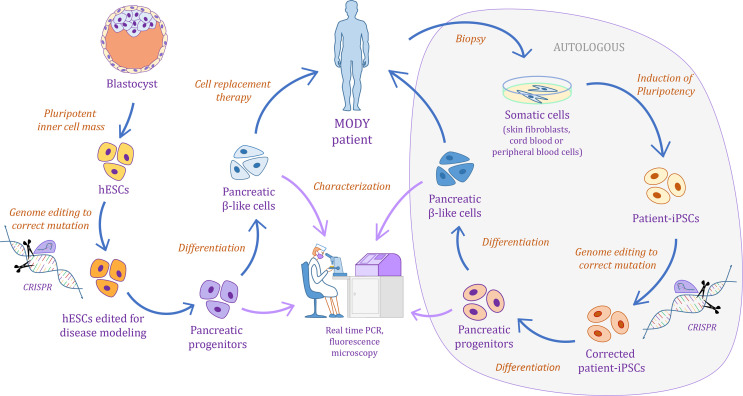
The occurrence of diabetes mellitus is characterized by pancreatic cell loss and chronic hyperglycemia. While Type 1 and Type 2 diabetes are the most common types, rarer forms involve mutations affecting a single gene. This characteristic has made monogenic diabetes an interesting disease group to model using human pluripotent stem cells (hPSCs). By altering the genotype of the original hPSCs or by deriving human induced pluripotent stem cells (hiPSCs) from patients with monogenic diabetes, changes in the outcome of the differentiation protocol can be analyzed in detail to infer the regulatory mechanisms affected by the disease-associated genes. This approach has been so far applied to a diversity of genes/diseases and uncovered new mechanisms. The focus of the present review is to discuss the latest findings obtained by modeling monogenic diabetes using hPSC-derived pancreatic cells generated . We will specifically focus on the interpretation of these studies, the advantages and limitations of the models used, and the future perspectives for improvement.
糖尿病的发生特征为胰岛细胞丧失和慢性高血糖。1 型和 2 型糖尿病最为常见,但罕见形式涉及影响单个基因的突变。这种特征使得单基因糖尿病成为使用人类多能干细胞 (hPSC) 进行建模的有趣疾病群体。通过改变原始 hPSC 的基因型或从单基因糖尿病患者中衍生出人类诱导多能干细胞 (hiPSC),可以详细分析分化方案的结果变化,以推断受疾病相关基因影响的调节机制。迄今为止,这种方法已应用于多种基因/疾病,并揭示了新的机制。本综述的重点是讨论使用 hPSC 衍生的胰腺细胞建模单基因糖尿病获得的最新发现。我们将特别关注对这些研究的解释、所使用模型的优缺点,以及改进的未来展望。