Li Yan, Sun Xian-Li, Ma Chun-Ling, Li Chao, Zhan Ying, Li Wen-Ting, Li Can, Wang Yi-Hao
Department of Obstetrics and Gynaecology, The Affiliated Hospital of Qingdao University, Qingdao University, Qingdao, China.
Department of Obstetrics and Gynecology, Qingdao Women and Children's Hospital, Qingdao University, Qingdao, China.
Front Cell Dev Biol. 2021 Jul 6;9:615973. doi: 10.3389/fcell.2021.615973. eCollection 2021.
Abnormal trophoblast behaviors during pregnancy contribute to the development of preeclampsia (PE). Syntaxin2 (STX2) has been shown to be a crucial epithelial mediator in numerous diseases. However, the functions of STX2 and the mechanisms underlying its role in PE remain largely unknown. The aim of this study was to explore the role of STX2 on trophoblast biology and unravel the molecular mechanisms that contribute to the development and progression of PE.
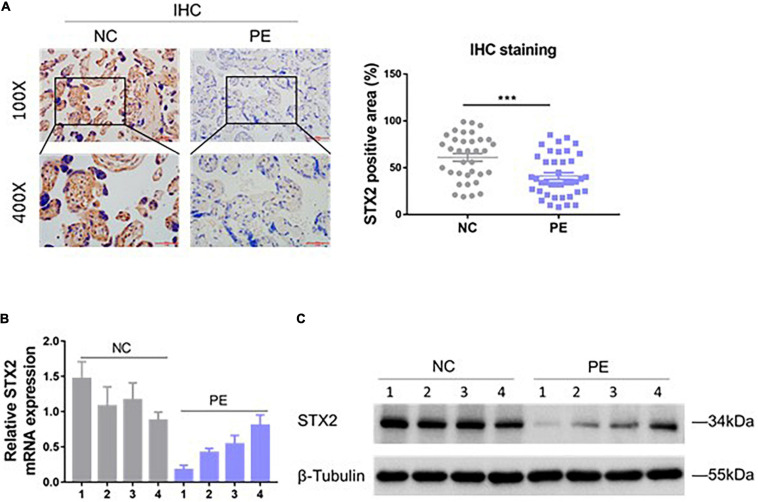
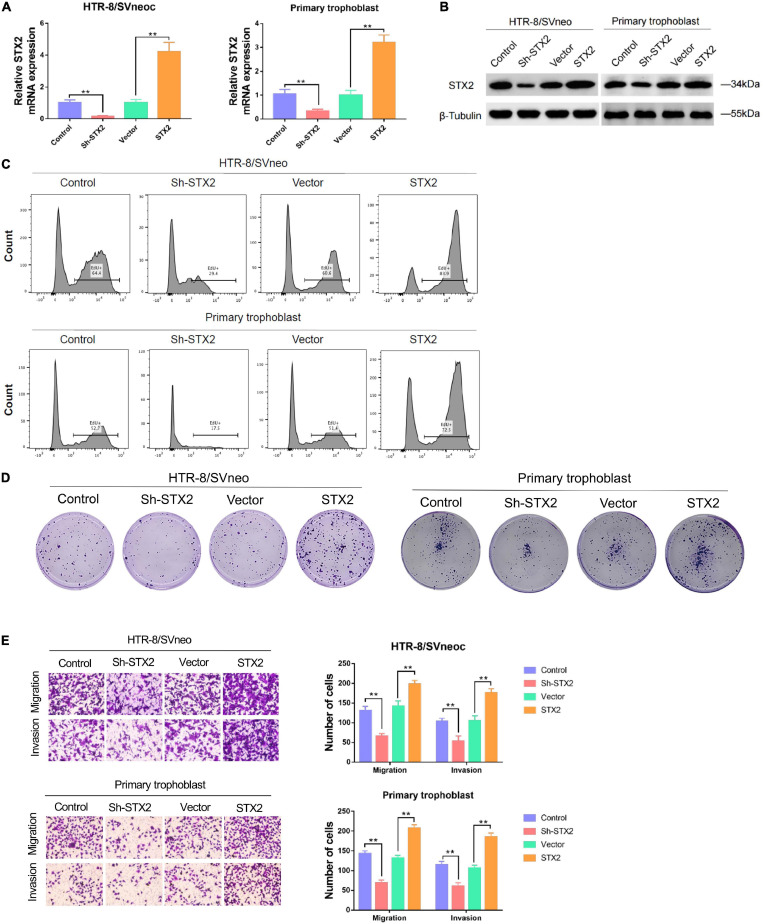
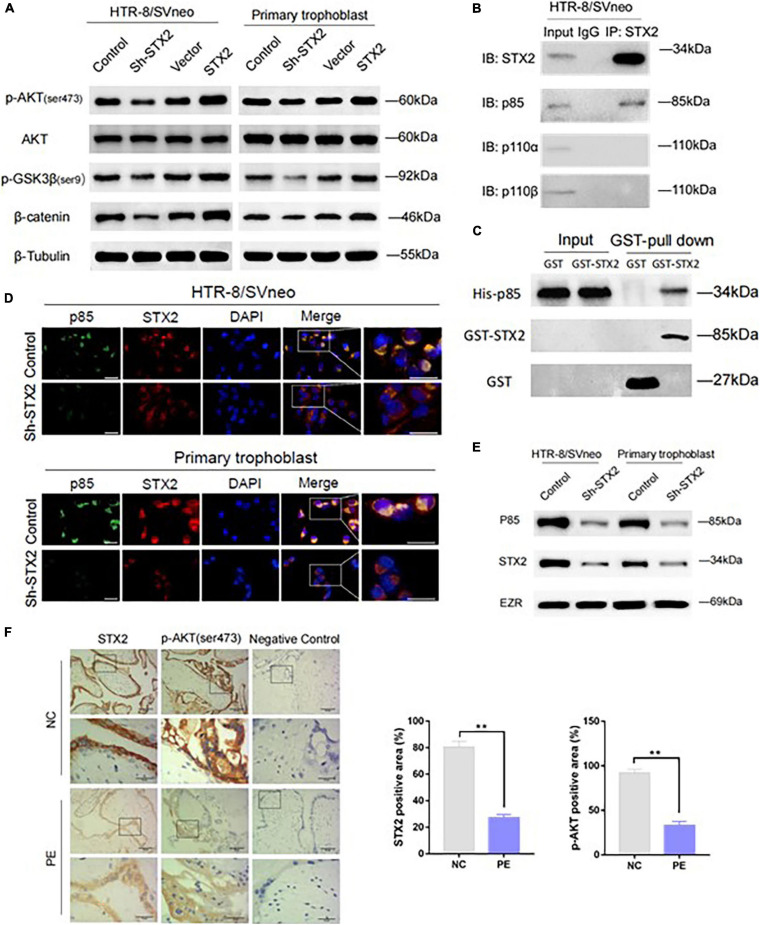
We first compared the expression of STX2 in placental tissues from women with PE and women with normal pregnancies. Then, we investigated the role of STX2 on trophoblast proliferation, migration and invasion in HTR-8/SVneo and primary human trophoblast cells by loss or gain of function experiments. In addition, co-immunoprecipitation, pulldown and immunofluorescence assays were performed to investigate the co-localization of STX2 with other proteins, and to help clarify the mechanisms underlying STX2-mediated functions on trophoblasts.
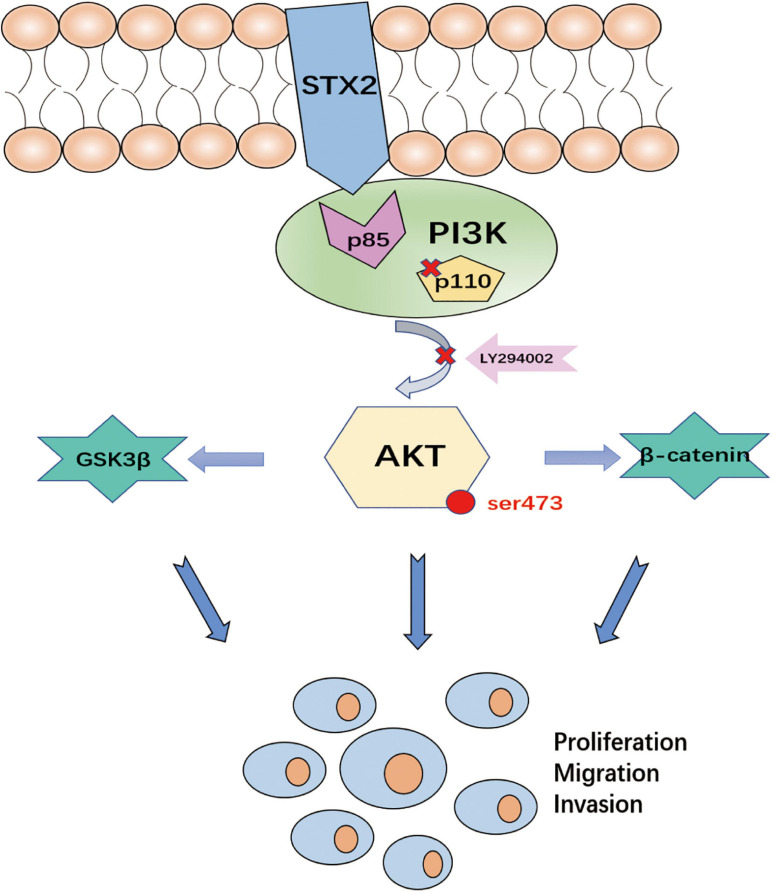
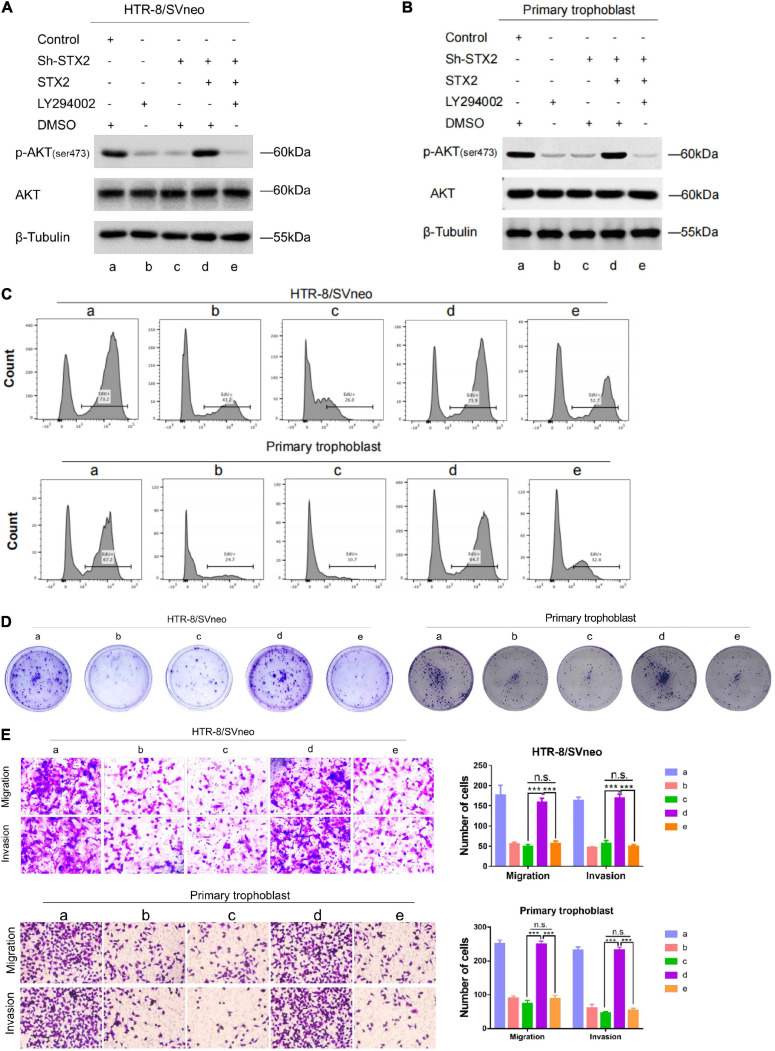
We demonstrated that STX2 expression was downregulated in placental tissues of women with PE compared with those from normal pregnancies. Loss and gain of function experiments further confirmed a role for STX2 in cell proliferation, migration and invasion in trophoblasts. By co-immunoprecipitation, pulldown and immunofluorescence co-localization assays, we revealed that STX2 selectively interacted with p85, a subunit of PI3K, and directly recruited p85 to the cytomembrane, thereby activating the AKT signaling pathway. We further demonstrated that the AKT activation was abolished by the use of a PI3K inhibitor (LY294002), which negatively affected STX2-mediated functions on trophoblasts.
All together, our findings point to a crucial role for STX2 in PE progression. Our new insights also suggest that STX2 may be a potential diagnostic tool and a novel therapeutic target for treating PE.
孕期滋养层细胞行为异常会导致子痫前期(PE)的发生。Syntaxin2(STX2)已被证明是多种疾病中的关键上皮介质。然而,STX2在PE中的功能及其作用机制仍不清楚。本研究旨在探讨STX2在滋养层细胞生物学中的作用,并揭示其在PE发生发展过程中的分子机制。
我们首先比较了PE患者与正常妊娠女性胎盘组织中STX2的表达。然后,通过功能缺失或获得实验,研究了STX2对HTR-8/SVneo细胞和原代人滋养层细胞增殖、迁移和侵袭的作用。此外,还进行了免疫共沉淀、下拉和免疫荧光分析,以研究STX2与其他蛋白质的共定位,并有助于阐明STX2介导的滋养层细胞功能的潜在机制。
我们发现,与正常妊娠女性相比,PE患者胎盘组织中STX2的表达下调。功能缺失和获得实验进一步证实了STX2在滋养层细胞增殖、迁移和侵袭中的作用。通过免疫共沉淀、下拉和免疫荧光共定位分析,我们发现STX2与PI3K的一个亚基p85选择性相互作用,并直接将p85募集到细胞膜上,从而激活AKT信号通路。我们进一步证明,使用PI3K抑制剂(LY294002)可消除AKT的激活,这对STX2介导的滋养层细胞功能产生负面影响。
综上所述,我们的研究结果表明STX2在PE进展中起关键作用。我们的新见解还表明,STX2可能是一种潜在的诊断工具和治疗PE的新靶点。