Alhowail Ahmad H, Pinky Priyanka D, Eggert Matthew, Bloemer Jenna, Woodie Lauren N, Buabeid Manal A, Bhattacharya Subhrajit, Jasper Shanese L, Bhattacharya Dwipayan, Dhanasekaran Muralikrishnan, Escobar Martha, Arnold Robert D, Suppiramaniam Vishnu
Department of Pharmacology and Toxicology, Qassim University, Buraydah, Saudi Arabia.
Department of Drug Discovery and Development, Auburn University, Auburn, Alabama, USA.
Heliyon. 2021 Jul 1;7(7):e07456. doi: 10.1016/j.heliyon.2021.e07456. eCollection 2021 Jul.
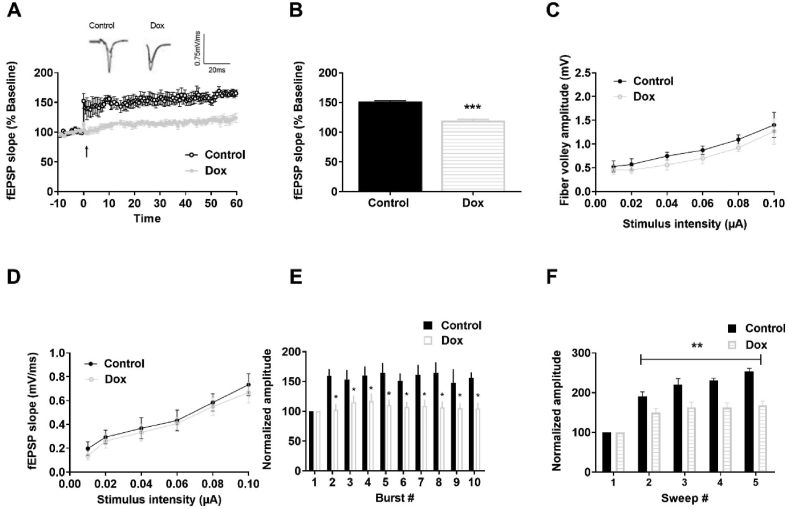
Doxorubicin (Dox) is a chemotherapeutic agent used widely to treat a variety of malignant cancers. However, Dox chemotherapy is associated with several adverse effects, including "chemobrain," the observation that cancer patients exhibit through learning and memory difficulties extending even beyond treatment. This study investigated the effect of Dox treatment on learning and memory as well as hippocampal synaptic plasticity. Dox-treated mice (5 mg/kg weekly x 5) demonstrated impaired performance in the Y-maze spatial memory task and a significant reduction in hippocampal long-term potentiation. The deficit in synaptic plasticity was mirrored by deficits in the functionality of synaptic `α-amino-3- hydroxy-5-methyl-4-isoxazolepropionic acid receptor (AMPAR) channels, including reduced probability of opening, decreased dwell open time, and increased closed times. Furthermore, a reduction in the AMPAR subunit GluA1 level, its downstream signaling molecule Ca+/calmodulin-dependent protein kinase (CaMKII), and brain-derived neurotrophic factor (BDNF) were observed. This was also accompanied by an increase in extracellular signal regulated kinase (ERK) and protein kinase B (AKT) activation. Together these data suggest that Dox-induced cognitive impairments are at least partially due to alterations in the expression and functionality of the glutamatergic AMPAR system.
阿霉素(Dox)是一种广泛用于治疗多种恶性肿瘤的化疗药物。然而,阿霉素化疗会带来多种不良反应,包括“化疗脑”,即癌症患者出现学习和记忆困难,甚至在治疗结束后仍持续存在。本研究调查了阿霉素治疗对学习、记忆以及海马体突触可塑性的影响。接受阿霉素治疗的小鼠(每周5毫克/千克,共5周)在Y迷宫空间记忆任务中的表现受损,海马体长时程增强显著降低。突触可塑性的缺陷反映在突触α-氨基-3-羟基-5-甲基-4-异恶唑丙酸受体(AMPAR)通道功能的缺陷上,包括开放概率降低、开放停留时间缩短和关闭时间增加。此外,还观察到AMPAR亚基GluA1水平、其下游信号分子钙/钙调蛋白依赖性蛋白激酶(CaMKII)和脑源性神经营养因子(BDNF)减少。同时,细胞外信号调节激酶(ERK)和蛋白激酶B(AKT)的激活增加。这些数据共同表明,阿霉素诱导的认知障碍至少部分归因于谷氨酸能AMPAR系统表达和功能的改变。