
丁烯二酸酸二甲酯通过诱导自噬和调节 Nrf-2/HO-1 信号通路抑制 LPS 诱导的小胶质细胞炎症和炎性体介导热激细胞死亡。
Dimethyl itaconate inhibits LPS‑induced microglia inflammation and inflammasome‑mediated pyroptosis via inducing autophagy and regulating the Nrf‑2/HO‑1 signaling pathway.
机构信息
Zhejiang Provincial Key Laboratory of Aging and Neurological Disorder Research, Department of Neurosurgery, The First Affiliated Hospital of Wenzhou Medical University, Wenzhou, Zhejiang 325000, P.R. China.
Department of Operation Room, The First Affiliated Hospital of Wenzhou Medical University, Wenzhou, Zhejiang 325000, P.R. China.
出版信息
Mol Med Rep. 2021 Sep;24(3). doi: 10.3892/mmr.2021.12311. Epub 2021 Jul 23.
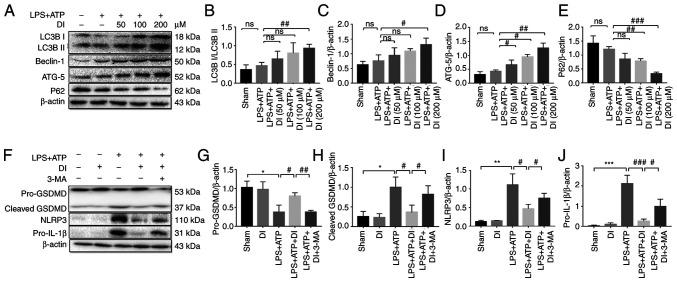
The endogenous metabolite itaconate and its cell‑permeable derivative dimethyl itaconate (DI) have been identified as anti‑inflammatory regulators of macrophages; however, their contribution to inflammasome‑mediated pyroptosis remains unknown. The present study examined the molecular mechanism of DI on NLR family pyrin domain‑containing 3 (NLRP3) inflammasome assembly and NLRP3 inflammasome‑dependent pyroptosis in microglia. Lipopolysaccharide (LPS) and ATP were used to induce microglia pyroptosis ; this process was confirmed by TUNEL assay, lactate dehydrogenase (LDH) detection and gasdermin D (GSDMD) expression analysis. The regulation of microglia polarization and inflammatory cytokine expression was assessed by immunofluorescence assays and ELISA. To investigate the associated mechanism of action, the expression levels of the nuclear factor erythroid 2‑related factor 2 (Nrf‑2)/heme oxygenase‑1 (HO‑1) pathway proteins were analyzed by western blotting. Finally, the regulatory effect of DI on autophagy and its association with inflammation was determined by western blotting. The present study demonstrated that DI administration inhibited NLRP3 assembly, LDH release and GSDMD cleavage. Cotreatment of DI with LPS and ATP facilitated the transition from M1 to M2, reduced inflammatory mediator expression and impeded NF‑κB phosphorylation. In addition, DI effectively reduced reactive oxygen species production through the Nrf‑2/HO‑1 pathway. Moreover, DI induced cellular autophagy, whereas inhibition of autophagy with 3‑methyladenine markedly reversed its inhibitory effect on NLRP3‑dependent pyroptosis. Taken together, the present study suggested that DI participated in the Nrf‑2/HO‑1 pathway and served a key role in microglia inflammation and NLRP3 inflammasome‑mediated pyroptosis via induction of autophagy.
内源性代谢物衣康酸及其可渗透细胞的衍生物二甲基衣康酸(DI)已被鉴定为巨噬细胞的抗炎调节剂;然而,它们对炎性体介导热激原性细胞焦亡的贡献仍不清楚。本研究探讨了 DI 对 NLR 家族吡啶结构域包含 3(NLRP3)炎性体组装和 NLRP3 炎性体依赖性细胞焦亡的分子机制。使用脂多糖(LPS)和三磷酸腺苷(ATP)诱导小胶质细胞细胞焦亡;通过 TUNEL 测定、乳酸脱氢酶(LDH)检测和 Gasdermin D(GSDMD)表达分析来证实这一过程。通过免疫荧光测定和 ELISA 评估小胶质细胞极化和炎症细胞因子表达的调节。为了研究相关的作用机制,通过蛋白质印迹法分析了核因子红细胞 2 相关因子 2(Nrf-2)/血红素加氧酶-1(HO-1)途径蛋白的表达水平。最后,通过蛋白质印迹法确定了 DI 对自噬的调节作用及其与炎症的关联。本研究表明,DI 给药抑制 NLRP3 组装、LDH 释放和 GSDMD 切割。DI 与 LPS 和 ATP 共同处理促进了从 M1 向 M2 的转变,减少了炎症介质的表达,并阻碍了 NF-κB 的磷酸化。此外,DI 通过 Nrf-2/HO-1 途径有效减少活性氧的产生。此外,DI 诱导细胞自噬,而用 3-甲基腺嘌呤抑制自噬则显著逆转其对 NLRP3 依赖性细胞焦亡的抑制作用。综上所述,本研究表明,DI 通过诱导自噬参与 Nrf-2/HO-1 途径,并在小胶质细胞炎症和 NLRP3 炎性体介导热激原性细胞焦亡中发挥关键作用。


 Zotero 插件