Department of Trauma, Hand and Reconstructive Surgery, Goethe University, Theodor-Stern-Kai 7, 60590, Frankfurt, Germany.
Department of Orthopaedic Sports Medicine, Technical University of Munich, Munich, Germany.
Arch Orthop Trauma Surg. 2022 Oct;142(10):2711-2718. doi: 10.1007/s00402-021-04079-5. Epub 2021 Jul 22.
Current classifications of complete knee dislocations do not capture the extent of the complex concomitant ligamentous and bony injuries, which may have an impact on future outcomes. The purpose of this retrospective study was to evaluate the epidemiology of complete knee dislocations as well as to present an updated classification system based on the author's experience at a Level-I trauma center.
Only patients with complete loss of contact of the articulating bones and ≥ 18 years of age who admitted in our level-I trauma center between 2002 and 2019 were included. Patients were identified using a retrospective systematical query in the Hospital Information System (HIS) using the International Statistical Classification of Diseases and Related Health Problems Version10 (ICD-10) codes of the German Diagnosis Related Groups (G-DRG).
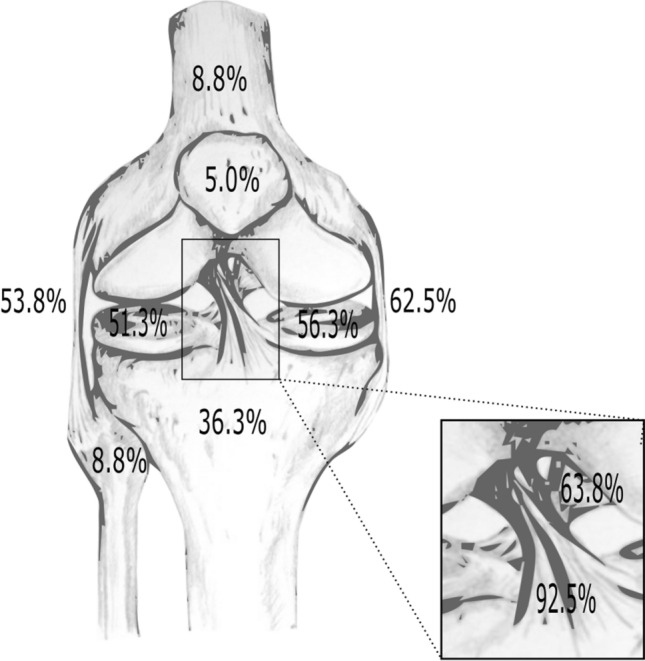
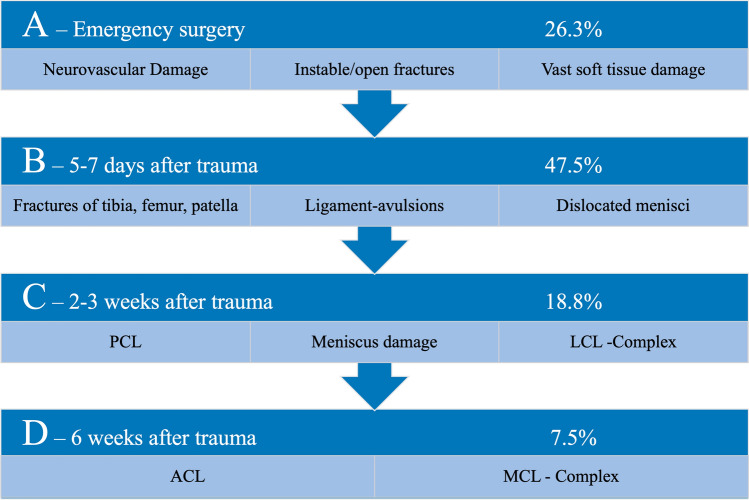
Final data included 80 patients, with the majority of patients being male (n = 64; 80.0%). Mean age was 34.9 years (range: 18-70 years). External protective fixation was applied in 32 patients (40.0%). Reconstruction of the posterior cruciate ligament and the anterior cruciate ligament were performed in 56.3% (n = 45) and 55.0% (n = 44) of cases, respectively. The lateral collateral ligament complex was surgically addressed in 47.5% (n = 38), while the medial collateral ligament complex was reconstructed in 40% (n = 32). Surgery of the lateral meniscus and the medial meniscus was needed in 31.1% (n = 25) and 30.0% (n = 24). Neurovascular surgery occurred in 13.8% (n = 11). From the characteristic injury-patterns the authors of this study present a new classification system that ranks the injuries from Grade-A to Grade-D according to their severity.
This retrospective study demonstrates that the historically used classification systems for dislocations of the knee are insufficient for these severe injuries. Concomitant ligamentous, neurovascular, bony, and meniscal injuries were frequent, and required several staged procedures. Consequently, an updated classification system is proposed.
目前的全膝关节脱位分类方法无法准确描述复杂的伴随韧带和骨损伤,这可能会对未来的结果产生影响。本回顾性研究的目的是评估全膝关节脱位的流行病学,并根据作者在一级创伤中心的经验提出一种新的分类系统。
仅纳入 2002 年至 2019 年期间在我们的一级创伤中心就诊的完全失去关节骨接触且年龄≥18 岁的患者。使用医院信息系统(HIS)中的回顾性系统查询,使用德国诊断相关组(G-DRG)的国际疾病分类第十版(ICD-10)代码在 HIS 中对患者进行识别。
最终数据纳入 80 例患者,其中大多数为男性(n=64;80.0%)。平均年龄为 34.9 岁(范围:18-70 岁)。32 例患者(40.0%)采用外部保护性固定。56.3%(n=45)和 55.0%(n=44)的患者分别进行了后交叉韧带和前交叉韧带重建。47.5%(n=38)的患者进行了外侧副韧带复合体手术治疗,40.0%(n=32)的患者进行了内侧副韧带复合体重建。31.1%(n=25)和 30.0%(n=24)的患者需要进行外侧半月板和内侧半月板手术。13.8%(n=11)的患者需要进行神经血管手术。根据作者提出的新分类系统,根据损伤的严重程度,将损伤从 A 级到 D 级进行分级,该系统从特征性损伤模式中得出。
本回顾性研究表明,膝关节脱位的历史分类系统不足以处理这些严重损伤。常见的伴随韧带、神经血管、骨和半月板损伤,需要进行多次分期手术。因此,提出了一种新的分类系统。