Multiphase Chemistry Department, Max Planck Institute for Chemistry, 55128 Mainz, Germany.
Division 1.5 Protein Analysis, Federal Institute for Materials Research and Testing (BAM), 12489 Berlin, Germany.
Int J Mol Sci. 2021 Jul 16;22(14):7616. doi: 10.3390/ijms22147616.
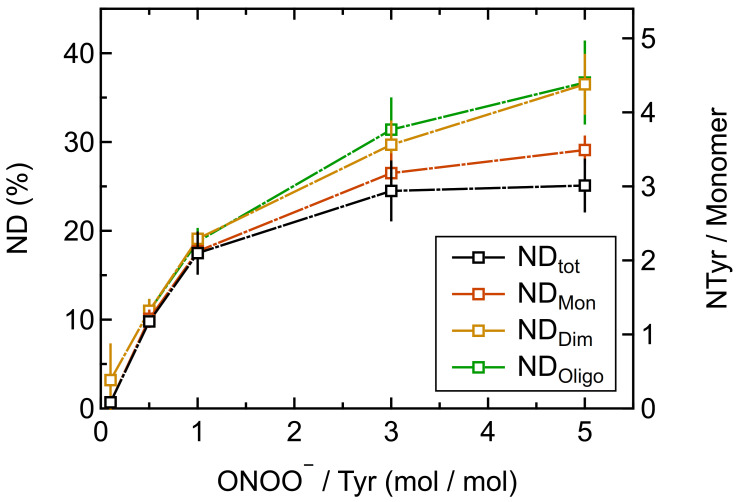
The allergenic and inflammatory potential of proteins can be enhanced by chemical modification upon exposure to atmospheric or physiological oxidants. The molecular mechanisms and kinetics of such modifications, however, have not yet been fully resolved. We investigated the oligomerization and nitration of the grass pollen allergen Phl p 5 by ozone (O), nitrogen dioxide (NO), and peroxynitrite (ONOO). Within several hours of exposure to atmospherically relevant concentration levels of O and NO, up to 50% of Phl p 5 were converted into protein oligomers, likely by formation of dityrosine cross-links. Assuming that tyrosine residues are the preferential site of nitration, up to 10% of the 12 tyrosine residues per protein monomer were nitrated. For the reaction with peroxynitrite, the largest oligomer mass fractions (up to 50%) were found for equimolar concentrations of peroxynitrite over tyrosine residues. With excess peroxynitrite, the nitration degrees increased up to 40% whereas the oligomer mass fractions decreased to 20%. Our results suggest that protein oligomerization and nitration are competing processes, which is consistent with a two-step mechanism involving a reactive oxygen intermediate (ROI), as observed for other proteins. The modified proteins can promote pro-inflammatory cellular signaling that may contribute to chronic inflammation and allergies in response to air pollution.
蛋白质在暴露于大气或生理氧化剂时会发生化学修饰,从而增强其变应原性和炎症潜能。然而,这些修饰的分子机制和动力学尚未完全阐明。我们研究了臭氧(O)、二氧化氮(NO)和过氧亚硝酸盐(ONOO)对草花粉过敏原 Phl p 5 的寡聚化和硝化作用。在暴露于大气相关浓度水平的 O 和 NO 的几个小时内,多达 50%的 Phl p 5 被转化为蛋白质寡聚物,可能是通过形成二酪氨酸交联。假设酪氨酸残基是硝化的优先位点,那么每个蛋白质单体中多达 10%的 12 个酪氨酸残基被硝化。对于与过氧亚硝酸盐的反应,在酪氨酸残基的等摩尔浓度下,发现最大的寡聚物质量分数(高达 50%)。当存在过氧亚硝酸盐过量时,硝化程度增加到 40%,而寡聚物质量分数降低到 20%。我们的结果表明,蛋白质寡聚化和硝化是竞争过程,这与其他蛋白质观察到的涉及活性氧中间体(ROI)的两步机制一致。修饰后的蛋白质可以促进促炎细胞信号转导,这可能导致慢性炎症和过敏反应对空气污染的反应。