• 文献检索
  • 文档翻译
  • 深度研究
  • 学术资讯
  • Suppr Zotero 插件Zotero 插件
  • 邀请有礼
  • 套餐&价格
  • 历史记录
应用&插件
Suppr Zotero 插件Zotero 插件浏览器插件Mac 客户端Windows 客户端微信小程序
定价
高级版会员购买积分包购买API积分包
服务
文献检索文档翻译深度研究API 文档MCP 服务
关于我们
关于 Suppr公司介绍联系我们用户协议隐私条款
关注我们

Suppr 超能文献

核心技术专利:CN118964589B侵权必究
粤ICP备2023148730 号-1Suppr @ 2026

文献检索

告别复杂PubMed语法,用中文像聊天一样搜索,搜遍4000万医学文献。AI智能推荐,让科研检索更轻松。

立即免费搜索

文件翻译

保留排版,准确专业,支持PDF/Word/PPT等文件格式,支持 12+语言互译。

免费翻译文档

深度研究

AI帮你快速写综述,25分钟生成高质量综述,智能提取关键信息,辅助科研写作。

立即免费体验

挑战肺部生理极限——深度屏气潜水。

Going to Extremes of Lung Physiology-Deep Breath-Hold Diving.

作者信息

Tetzlaff Kay, Lemaitre Frederic, Burgstahler Christof, Luetkens Julian A, Eichhorn Lars

机构信息

Department of Sports Medicine, University Hospital of Tübingen, Tübingen, Germany.

Faculte des Sciences du Sport et de l'Education Physique, Universite de Rouen, Rouen, France.

出版信息

Front Physiol. 2021 Jul 9;12:710429. doi: 10.3389/fphys.2021.710429. eCollection 2021.

DOI:10.3389/fphys.2021.710429
PMID:34305657
原文链接:https://pmc.ncbi.nlm.nih.gov/articles/PMC8299524/
Abstract

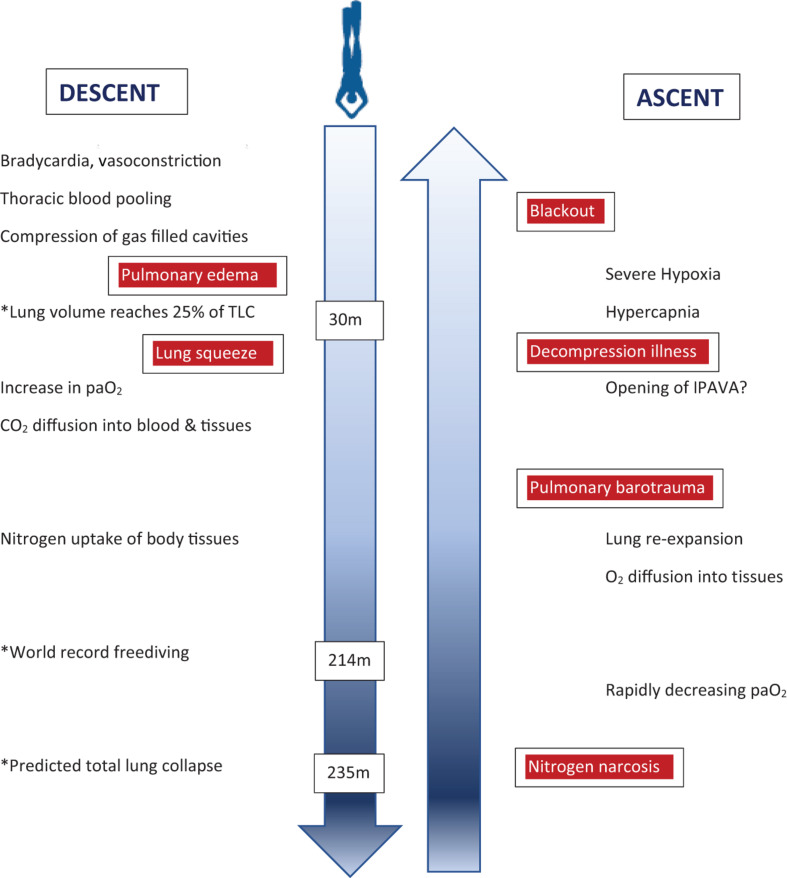
Breath-hold diving involves environmental challenges, such as water immersion, hydrostatic pressure, and asphyxia, that put the respiratory system under stress. While training and inherent individual factors may increase tolerance to these challenges, the limits of human respiratory physiology will be reached quickly during deep breath-hold dives. Nonetheless, world records in deep breath-hold diving of more than 214 m of seawater have considerably exceeded predictions from human physiology. Investigations of elite breath-hold divers and their achievements revised our understanding of possible physiological adaptations in humans and revealed techniques such as glossopharyngeal breathing as being essential to achieve extremes in breath-hold diving performance. These techniques allow elite athletes to increase total lung capacity and minimize residual volume, thereby reducing thoracic squeeze. However, the inability of human lungs to collapse early during descent enables respiratory gas exchange to continue at greater depths, forcing nitrogen (N) out of the alveolar space to dissolve in body tissues. This will increase risk of N narcosis and decompression stress. Clinical cases of stroke-like syndromes after single deep breath-hold dives point to possible mechanisms of decompression stress, caused by N entering the vasculature upon ascent from these deep dives. Mechanisms of neurological injury and inert gas narcosis during deep breath-hold dives are still incompletely understood. This review addresses possible hypotheses and elucidates factors that may contribute to pathophysiology of deep freediving accidents. Awareness of the unique challenges to pulmonary physiology at depth is paramount to assess medical risks of deep breath-hold diving.

摘要

屏气潜水会带来一些环境挑战,比如水浸、静水压力和窒息,这些会给呼吸系统造成压力。虽然训练和个体的内在因素可能会增加对这些挑战的耐受性,但在深度屏气潜水中,人体呼吸生理的极限会很快被突破。尽管如此,超过214米海水深度的屏气潜水世界纪录已大大超出了人体生理学的预测。对精英屏气潜水员及其成就的研究修正了我们对人类可能的生理适应的理解,并揭示了诸如舌咽呼吸等技术对于在屏气潜水表现中达到极致至关重要。这些技术使精英运动员能够增加肺总容量并最小化残气量,从而减少胸廓挤压。然而,人类肺部在下降过程中不能过早塌陷,这使得呼吸气体交换在更深的深度仍能继续,迫使氮气从肺泡空间排出并溶解在身体组织中。这将增加氮麻醉和减压应激的风险。单次深度屏气潜水后出现类似中风综合征的临床病例指出了减压应激的可能机制,这是由氮气在从这些深度潜水上升时进入血管系统所导致的。深度屏气潜水中神经损伤和惰性气体麻醉的机制仍未完全被理解。这篇综述探讨了可能的假说,并阐明了可能导致深度自由潜水事故病理生理学的因素。认识到深度对肺生理的独特挑战对于评估深度屏气潜水的医疗风险至关重要。
https://cdn.ncbi.nlm.nih.gov/pmc/blobs/5adb/8299524/414100d6285b/fphys-12-710429-g003.jpg
https://cdn.ncbi.nlm.nih.gov/pmc/blobs/5adb/8299524/98e1d8f23853/fphys-12-710429-g001.jpg
https://cdn.ncbi.nlm.nih.gov/pmc/blobs/5adb/8299524/898ca5052641/fphys-12-710429-g002.jpg
https://cdn.ncbi.nlm.nih.gov/pmc/blobs/5adb/8299524/414100d6285b/fphys-12-710429-g003.jpg
https://cdn.ncbi.nlm.nih.gov/pmc/blobs/5adb/8299524/98e1d8f23853/fphys-12-710429-g001.jpg
https://cdn.ncbi.nlm.nih.gov/pmc/blobs/5adb/8299524/898ca5052641/fphys-12-710429-g002.jpg
https://cdn.ncbi.nlm.nih.gov/pmc/blobs/5adb/8299524/414100d6285b/fphys-12-710429-g003.jpg

相似文献

1
Going to Extremes of Lung Physiology-Deep Breath-Hold Diving.挑战肺部生理极限——深度屏气潜水。
Front Physiol. 2021 Jul 9;12:710429. doi: 10.3389/fphys.2021.710429. eCollection 2021.
2
Case Studies in Physiology: Breath-hold diving beyond 100 meters-cardiopulmonary responses in world-champion divers.生理学案例研究:100 米以上闭气潜水——世界冠军潜水员的心肺反应。
J Appl Physiol (1985). 2021 May 1;130(5):1345-1350. doi: 10.1152/japplphysiol.00877.2020. Epub 2021 Feb 18.
3
Temporal changes in pulmonary gas exchange efficiency when breath-hold diving below residual volume.当屏气潜水至残气量以下时肺气体交换效率的时间变化。
Exp Physiol. 2021 Apr;106(4):1120-1133. doi: 10.1113/EP089176. Epub 2021 Mar 12.
4
Breath-Hold Diving - The Physiology of Diving Deep and Returning.屏气潜水——深度潜水与返回的生理学
Front Physiol. 2021 May 21;12:639377. doi: 10.3389/fphys.2021.639377. eCollection 2021.
5
The physiology and pathophysiology of human breath-hold diving.人类屏气潜水的生理学与病理生理学
J Appl Physiol (1985). 2009 Jan;106(1):284-92. doi: 10.1152/japplphysiol.90991.2008. Epub 2008 Oct 30.
6
Breath-Hold Diving.屏气潜水。
Compr Physiol. 2018 Mar 25;8(2):585-630. doi: 10.1002/cphy.c160008.
7
Impact of breath holding on cardiovascular respiratory and cerebrovascular health.屏气对心血管、呼吸和脑血管健康的影响。
Sports Med. 2012 Jun 1;42(6):459-72. doi: 10.2165/11599260-000000000-00000.
8
Risk of Neurological Insult in Competitive Deep Breath-Hold Diving.竞技性深潜时发生神经损伤的风险
Int J Sports Physiol Perform. 2017 Feb;12(2):268-271. doi: 10.1123/ijspp.2016-0042. Epub 2016 Aug 24.
9
Arterial blood gas measurements during deep open-water breath-hold dives.深潜闭气过程中的动脉血气测量。
J Appl Physiol (1985). 2021 May 1;130(5):1490-1495. doi: 10.1152/japplphysiol.00111.2021. Epub 2021 Apr 8.
10
Decompression sickness in breath-hold diving, and its probable connection to the growth and dissolution of small arterial gas emboli.屏气潜水时的减压病及其与小动脉气体栓子生长和溶解的可能联系。
Math Biosci. 2015 Apr;262:1-9. doi: 10.1016/j.mbs.2015.01.001. Epub 2015 Jan 15.

引用本文的文献

1
Respiratory anatomy and physiology in diving penguins.潜水企鹅的呼吸解剖学与生理学
Philos Trans R Soc Lond B Biol Sci. 2025 Feb 27;380(1920):20230422. doi: 10.1098/rstb.2023.0422.
2
Body Positions and Physical Activity Levels Modulate the Ratio of Abdominal to Thoracic Breathing and Respiratory Rate in Young Individuals.身体姿势和身体活动水平调节年轻人腹部呼吸与胸部呼吸的比例以及呼吸频率。
J Clin Med. 2024 Dec 21;13(24):7825. doi: 10.3390/jcm13247825.
3
Occurrence and resolution of freediving-induced pulmonary syndrome in breath-hold divers: an online survey of lung squeeze incidents.

本文引用的文献

1
Arterial blood gas measurements during deep open-water breath-hold dives.深潜闭气过程中的动脉血气测量。
J Appl Physiol (1985). 2021 May 1;130(5):1490-1495. doi: 10.1152/japplphysiol.00111.2021. Epub 2021 Apr 8.
2
Physiology, pathophysiology and (mal)adaptations to chronic apnoeic training: a state-of-the-art review.慢性睡眠呼吸暂停训练的生理学、病理生理学和(适应性)变化:最新综述。
Eur J Appl Physiol. 2021 Jun;121(6):1543-1566. doi: 10.1007/s00421-021-04664-x. Epub 2021 Mar 31.
3
Breath-hold diving strategies to avoid loss of consciousness: speed is the key factor.
屏气潜水员中自由潜水诱发的肺部综合征的发生与解决:一项关于肺挤压事件的在线调查
Diving Hyperb Med. 2024 Dec 20;54(4):281-286. doi: 10.28920/dhm54.4.281-286.
4
Skill building in freediving as an example of embodied culture.自由潜水技能培养作为具身文化的一个例子。
Philos Trans R Soc Lond B Biol Sci. 2024 Oct 7;379(1911):20230150. doi: 10.1098/rstb.2023.0150. Epub 2024 Aug 19.
5
Molecular Mechanisms of Neuroprotection after the Intermittent Exposures of Hypercapnic Hypoxia.间歇性高碳酸缺氧后神经保护的分子机制。
Int J Mol Sci. 2024 Mar 25;25(7):3665. doi: 10.3390/ijms25073665.
6
Breathing patterns and associated cardiovascular changes in intermittently breathing animals: (Partially) correcting a semantic quagmire.间歇性呼吸动物的呼吸模式和相关心血管变化:(部分)纠正语义混乱。
Exp Physiol. 2024 Jul;109(7):1051-1065. doi: 10.1113/EP091784. Epub 2024 Mar 19.
7
Dopamine/BDNF loss underscores narcosis cognitive impairment in divers: a proof of concept in a dry condition.多巴胺/脑源性神经营养因子缺失强调潜水员麻醉认知障碍:干条件下的概念验证。
Eur J Appl Physiol. 2023 Jan;123(1):143-158. doi: 10.1007/s00421-022-05055-6. Epub 2022 Oct 10.
屏气潜水策略避免失去意识:速度是关键因素。
Sports Biomech. 2024 Jan;23(1):44-57. doi: 10.1080/14763141.2020.1820073. Epub 2020 Dec 3.
4
Autonomic regulation of the heart and arrhythmogenesis in trained breath-hold divers.训练有素的闭气潜水员的心脏自主调节与心律失常发生。
Eur J Sport Sci. 2021 Mar;21(3):439-449. doi: 10.1080/17461391.2020.1749313. Epub 2020 Apr 26.
5
Oxidative stress assessment in breath-hold diving.屏气潜水时的氧化应激评估。
Eur J Appl Physiol. 2019 Dec;119(11-12):2449-2456. doi: 10.1007/s00421-019-04224-4. Epub 2019 Sep 13.
6
Lung volumes and ventilatory responses to high CO2 and low O2 in the ama.阿马人对高二氧化碳和低氧的肺容量及通气反应。
J Appl Physiol (1985). 1963 May 1;18(3):466-470. doi: 10.1152/jappl.1963.18.3.466.
7
Impaired dynamic cerebral autoregulation in trained breath-hold divers.经过训练的屏气潜水员大脑动态自动调节功能受损。
J Appl Physiol (1985). 2019 Jun 1;126(6):1694-1700. doi: 10.1152/japplphysiol.00210.2019. Epub 2019 May 9.
8
Effects of Breath-Hold Deep Diving on the Pulmonary System.屏气深潜对呼吸系统的影响。
Respiration. 2019;97(5):476-483. doi: 10.1159/000495757. Epub 2019 Feb 15.
9
Arterial Blood Gas Analysis in Breath-Hold Divers at Depth.深度屏气潜水者的动脉血气分析
Front Physiol. 2018 Nov 5;9:1558. doi: 10.3389/fphys.2018.01558. eCollection 2018.
10
Inert gas narcosis in scuba diving, different gases different reactions.在水肺潜水的惰性气体麻醉中,不同的气体有不同的反应。
Eur J Appl Physiol. 2019 Jan;119(1):247-255. doi: 10.1007/s00421-018-4020-y. Epub 2018 Oct 22.