Zhao Ningning, Zhang Jiajie, Zhao Lili, Fu Xiaoni, Zhao Qian, Chao Min, Cao Haiyan, Jiao Yang, Hu Yaqin, Chen Chao, Wang Liang, Wang Huijuan
College of Life Sciences, Northwest University, Xian, China.
Department of Neurosurgery, Tangdu Hospital of Air Force Medical University, Xian, China.
Front Oncol. 2021 Jul 8;11:636632. doi: 10.3389/fonc.2021.636632. eCollection 2021.
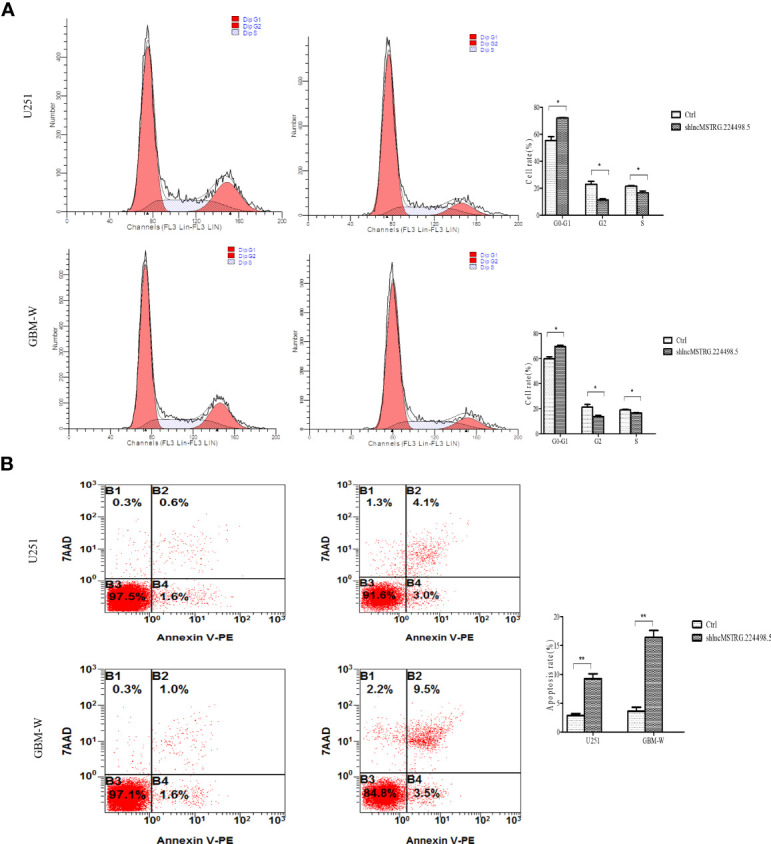
Glioblastoma multiforme (GBM) is the most common brain malignancy and major cause of high mortality in patients with GBM, and its high recurrence rate is its most prominent feature. However, the pathobiological mechanisms involved in recurrent GBM remain largely unknown. Here, whole-transcriptome sequencing (RNA-sequencing, RNA-Seq) was used in characterizing the expression profile of recurrent GBM, and the aim was to identify crucial biomarkers that contribute to GBM relapse. Differentially expressed RNAs in three recurrent GBM tissues compared with three primary GBM tissues were identified through RNA-Seq. The function and mechanism of a candidate long noncoding RNA (lncRNA) in the progression and recurrence of GBM were elucidated by performing comprehensive bioinformatics analyses, such as functional enrichment analysis, protein-protein interaction prediction, and lncRNA-miRNA-mRNA regulatory network construction, and a series of assays. As the most significantly upregulated gene identified in recurrent GBM, HSPA1A is mainly related to antigen presentation and the MAPK signaling pathway, as indicated by functional enrichment analysis. HSPA1A was predicted as the target gene of the lncRNA NONHSAT079852.2. qRT-PCR revealed that NONHSAT079852.2 was significantly elevated in recurrent GBM relative to that in primary GBM, and high NONHSAT079852.2 expression was associated with the poor overall survival rates of patients with GBM. The knockdown of NONHSAT079852.2 successfully induced tumor cell apoptosis, inhibited the proliferation, migration, invasion and the expression level of HSPA1A in glioma cells. NONHSAT079852.2 was identified to be a sponge for hsa-miR-10401-3p through luciferase reporter assay. Moreover, HSPA1A was targeted and regulated by hsa-miR-10401-3p. Collectively, the results suggested that NONHSAT079852.2 acts as a sponge of hsa-mir-10401-3p and thereby enhances HSPA1A expression, promotes tumor cell proliferation and invasion, and leads to the progression and recurrence of GBM. This study will provide new insight into the regulatory mechanisms of NONHSAT079852.2-mediated competing endogenous RNA in the pathogenesis of recurrent GBM and evidence of the potential of lncRNAs as diagnostic biomarkers or potential therapeutic targets.
多形性胶质母细胞瘤(GBM)是最常见的脑恶性肿瘤,也是GBM患者高死亡率的主要原因,其高复发率是其最突出的特征。然而,复发性GBM所涉及的病理生物学机制仍 largely未知。在此,全转录组测序(RNA测序,RNA-Seq)被用于表征复发性GBM的表达谱,目的是识别导致GBM复发的关键生物标志物。通过RNA-Seq鉴定了三个复发性GBM组织与三个原发性GBM组织中差异表达的RNA。通过进行全面的生物信息学分析,如功能富集分析、蛋白质-蛋白质相互作用预测和lncRNA-miRNA-mRNA调控网络构建以及一系列实验,阐明了一种候选长链非编码RNA(lncRNA)在GBM进展和复发中的功能和机制。作为在复发性GBM中鉴定出的上调最显著的基因,HSPA1A主要与抗原呈递和MAPK信号通路相关,功能富集分析表明。HSPA1A被预测为lncRNA NONHSAT079852.2的靶基因。qRT-PCR显示,NONHSAT079852.2在复发性GBM中相对于原发性GBM显著升高,且NONHSAT079852.2高表达与GBM患者较差的总生存率相关。敲低NONHSAT079852.2成功诱导肿瘤细胞凋亡,抑制胶质瘤细胞的增殖、迁移、侵袭以及HSPA1A的表达水平。通过荧光素酶报告基因实验确定NONHSAT079852.2是hsa-miR-10401-3p的海绵。此外,HSPA1A被hsa-miR-10401-3p靶向调控。总体而言,结果表明NONHSAT079852.2作为hsa-mir-10401-3p的海绵,从而增强HSPA1A表达,促进肿瘤细胞增殖和侵袭,并导致GBM的进展和复发。本研究将为NONHSAT079852.2介导的竞争性内源性RNA在复发性GBM发病机制中的调控机制提供新的见解,并为lncRNAs作为诊断生物标志物或潜在治疗靶点的潜力提供证据。