Department of Pathology, Cancer Center Amsterdam (CCA), Amsterdam University Medical Centers (Amsterdam UMC), Vrije Universiteit Amsterdam, Amsterdam, The Netherlands.
Department of Internal Medicine, Division of Infectious Diseases, Amsterdam Institute for Infection and Immunity (AII), Amsterdam UMC, University of Amsterdam, Amsterdam, The Netherlands.
Int J Cancer. 2021 Nov 15;149(10):1833-1844. doi: 10.1002/ijc.33748. Epub 2021 Aug 4.
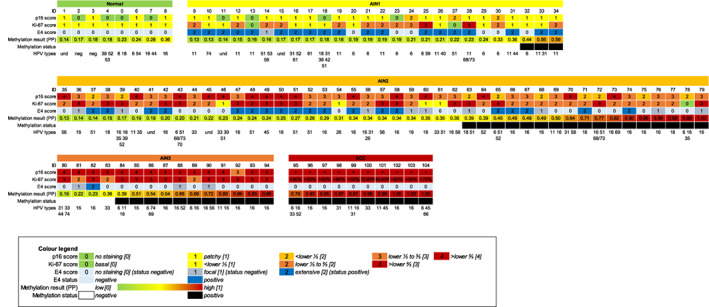
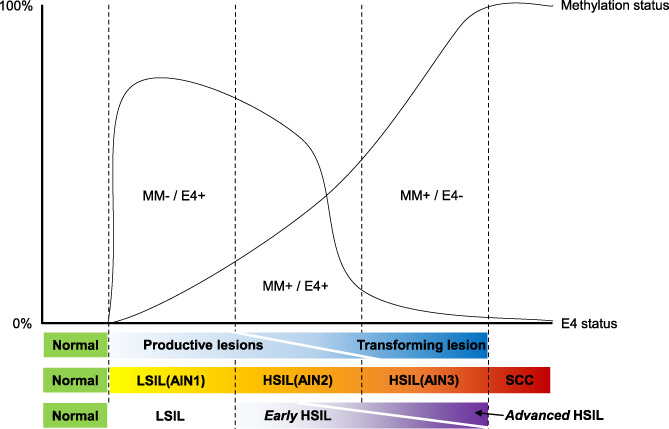
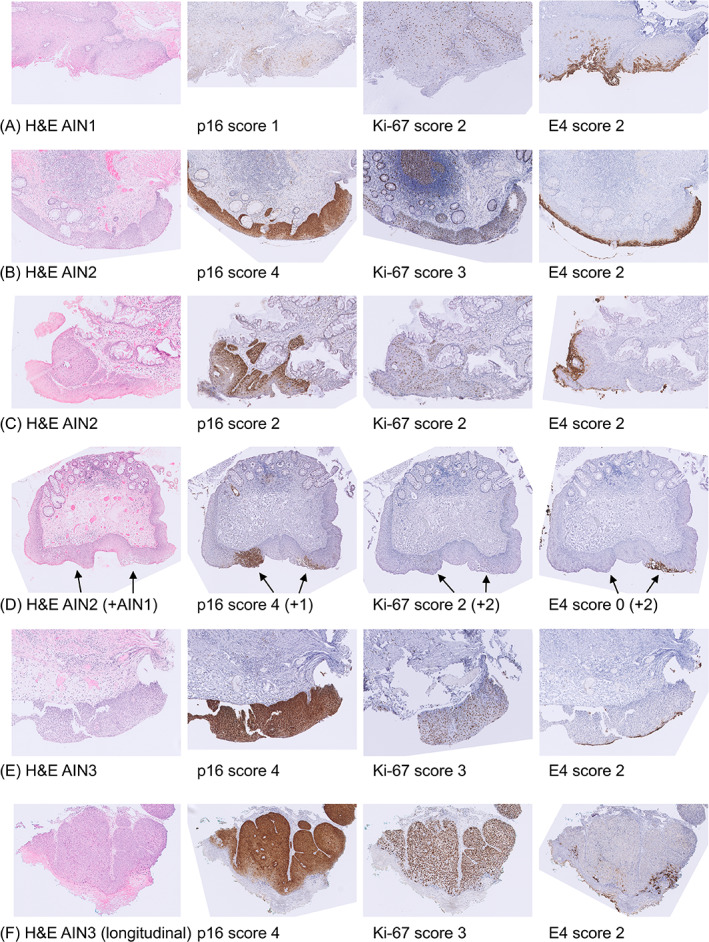
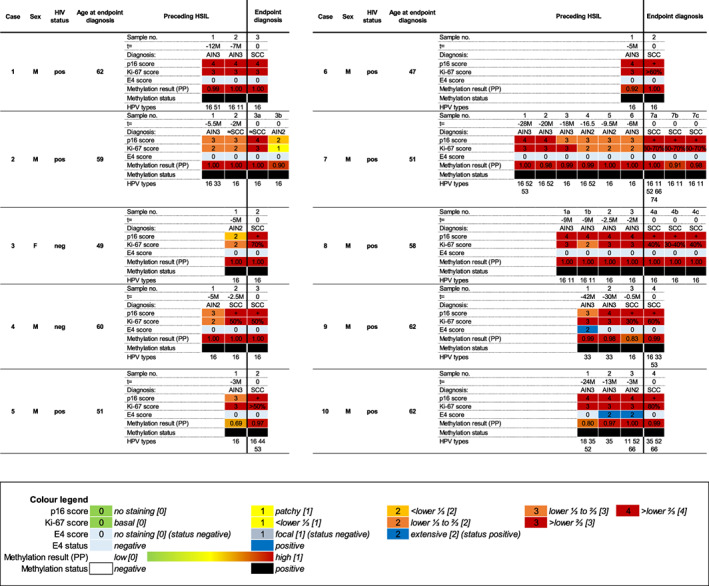
Human papillomavirus (HPV)-induced anal intraepithelial neoplasia (AIN, graded 1-3) is highly prevalent in HIV-positive (HIV+) men who have sex with men (MSM), but only a minority of lesions progresses to cancer. Our study aimed to characterise comprehensively anal tissue samples from a cross-sectional series (n = 104) of HIV+ MSM and longitudinal series (n = 40) of AIN2/3 progressing to cancer using different biomarkers. The cross-sectional series consisted of 8 normal, 26 AIN1, 45 AIN2, 15 AIN3 and 10 anal squamous cell carcinoma. Tissue sections were immunohistochemically (IHC) stained for p16 (viral transformation marker), Ki-67 (cellular proliferation marker) and HPV-E4 (viral production marker). We evaluated the expression of IHC markers and compared it with DNA methylation, a marker for malignant transformation. E4 positivity decreased, whereas p16 and Ki-67 scores and methylation marker positivity increased (P values < .001) with increasing severity of anal lesions. Within AIN2, a heterogeneous biomarker pattern was observed concerning E4, p16 and methylation status, reflecting the biological heterogeneity of these lesions. In the longitudinal series, all AIN2/3 and carcinomas showed high p16 and Ki-67 expression, strong methylation positivity and occasional E4 positivity. We earlier showed that high methylation levels are associated with progression to cancer. The observed E4 expression in some AIN2/3 during the course of progression to cancer and absence of E4 in a considerable number of AIN1 lesions make the potential clinical significance of E4 expression difficult to interpret. Our data show that IHC biomarkers can help to characterise AIN; however, their prognostic value for cancer risk stratification, next to objective methylation analysis, appears to be limited.
人乳头瘤病毒(HPV)引起的肛门上皮内瘤变(AIN,1-3 级)在 HIV 阳性(HIV+)的男男性行为者(MSM)中非常普遍,但只有少数病变进展为癌症。我们的研究旨在使用不同的生物标志物全面描述 HIV+MSM 的横断面系列(n=104)和进展为癌症的 AIN2/3 的纵向系列(n=40)的肛门组织样本。横断面系列包括 8 例正常、26 例 AIN1、45 例 AIN2、15 例 AIN3 和 10 例肛门鳞状细胞癌。组织切片用免疫组化(IHC)染色 p16(病毒转化标志物)、Ki-67(细胞增殖标志物)和 HPV-E4(病毒产生标志物)。我们评估了 IHC 标志物的表达,并将其与 DNA 甲基化(恶性转化的标志物)进行了比较。随着肛门病变严重程度的增加,E4 的阳性率降低,而 p16 和 Ki-67 评分和甲基化标志物的阳性率增加(P 值<.001)。在 AIN2 中,E4、p16 和甲基化状态的异质性生物标志物模式观察到,反映了这些病变的生物学异质性。在纵向系列中,所有 AIN2/3 和癌都表现出高 p16 和 Ki-67 表达、强甲基化阳性和偶尔的 E4 阳性。我们之前表明,高甲基化水平与癌症进展有关。在进展为癌症的过程中,一些 AIN2/3 中观察到的 E4 表达和相当数量的 AIN1 病变中缺乏 E4,使得 E4 表达的潜在临床意义难以解释。我们的数据表明,IHC 生物标志物可帮助表征 AIN;然而,它们在癌症风险分层方面的预后价值,除了客观的甲基化分析之外,似乎是有限的。