
与输入性疟疾相关的心力衰竭:一项全国性丹麦队列研究。
Heart failure associated with imported malaria: a nationwide Danish cohort study.
机构信息
Department of Cardiology, Herlev and Gentofte Hospital, Herlev, Denmark.
Department of Cardiology, Federal University of Acre, Câmpus Floresta, Cruzeiro do Sul, Brazil.
出版信息
ESC Heart Fail. 2021 Oct;8(5):3521-3529. doi: 10.1002/ehf2.13441. Epub 2021 Jul 27.
AIMS
Despite adequate treatment, recent studies have hypothesized that malaria may affect long-term cardiovascular function. We aimed to investigate the long-term risk of cardiovascular events and death in individuals with a history of imported malaria in Denmark.
METHODS
Using nationwide Danish registries, we followed individuals with a history of malaria for the risk of incident heart failure (HF), myocardial infarction (MI), cardiovascular death and all-cause death (1 January 1994 to 1 January 2017). The population was age- and sex-matched with individuals without a history of malaria from the Danish population (ratio 1:9). We excluded patients with known HF and ischaemic heart disease at inclusion.
RESULTS
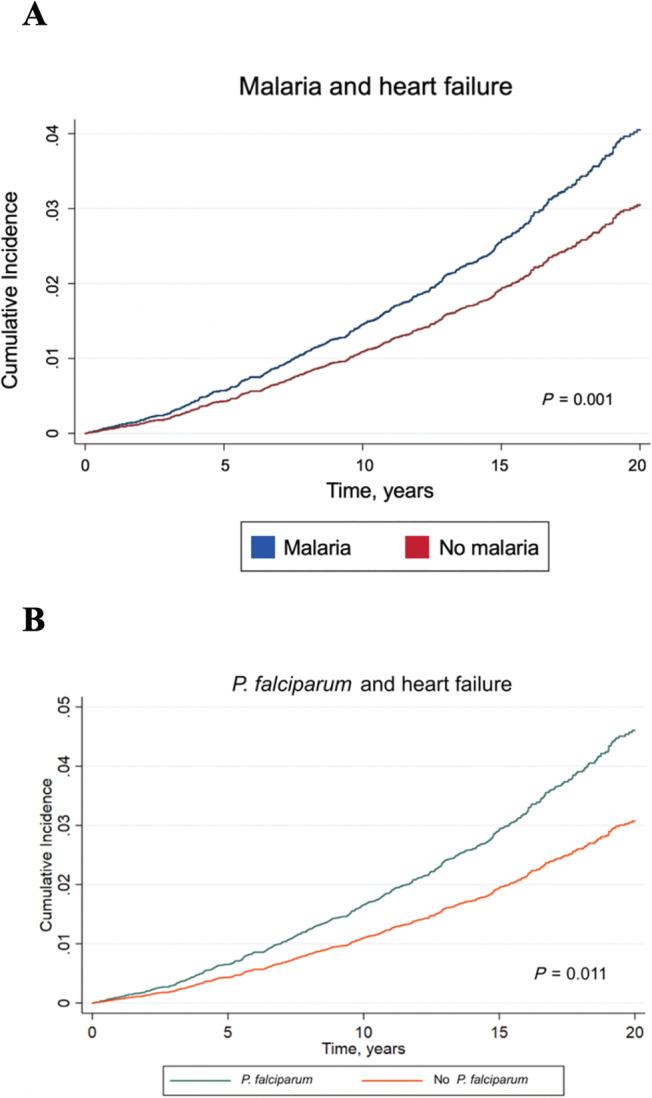
We identified 3912 cases with a history of malaria (mean age 33 ± 17 years, 57% male, 41% Plasmodium falciparum infections). The median follow-up was 9.8 years (interquartile range 3.9-16.4 years). Event rates per 1000 person-years for individuals with a history vs. no history of malaria were HF: 1.84 vs. 1.32; MI: 1.28 vs. 1.30; cardiovascular death: 1.40 vs. 1.77; and all-cause death: 5.04 vs. 5.28. In Cox proportional hazards models adjusted for cardiovascular risk factors, concomitant pharmacotherapy, region of origin, household income and educational level, malaria was associated with HF (HR: 1.59 [1.21-2.09], P = 0.001), but not MI (HR: 1.00 [0.72-1.39], P = 1.00), cardiovascular death (HR: 1.00 [0.74-1.35], P = 0.98) or all-cause death (HR 1.11 [0.94-1.30], P = 0.21). Specifically, P. falciparum infection was associated with increased risk of HF (HR: 1.64 [1.14-2.36], P = 0.008).
CONCLUSION
Individuals with a history of imported malaria, specifically P. falciparum, may have an increased risk of incident HF.
目的
尽管治疗得当,最近的研究假设疟疾可能会影响长期心血管功能。我们旨在研究丹麦有过输入性疟疾病史的个体发生心血管事件和死亡的长期风险。
方法
利用全国性的丹麦登记处,我们对有疟疾病史的个体进行随访,以确定心力衰竭(HF)、心肌梗死(MI)、心血管死亡和全因死亡的发病风险(1994 年 1 月 1 日至 2017 年 1 月 1 日)。根据年龄和性别与丹麦人群中无疟疾病史的个体进行匹配(比例为 1:9)。我们排除了纳入时已知有心力衰竭和缺血性心脏病的患者。
结果
我们确定了 3912 例有疟疾病史的病例(平均年龄 33±17 岁,57%为男性,41%为恶性疟原虫感染)。中位随访时间为 9.8 年(四分位间距 3.9-16.4 年)。有疟疾病史和无疟疾病史个体的每 1000 人年事件发生率分别为 HF:1.84 比 1.32;MI:1.28 比 1.30;心血管死亡:1.40 比 1.77;全因死亡:5.04 比 5.28。在调整了心血管危险因素、伴随药物治疗、原籍地、家庭收入和教育水平后,在 Cox 比例风险模型中,疟疾与 HF 相关(HR:1.59[1.21-2.09],P=0.001),但与 MI(HR:1.00[0.72-1.39],P=1.00)、心血管死亡(HR:1.00[0.74-1.35],P=0.98)或全因死亡(HR 1.11[0.94-1.30],P=0.21)无关。具体而言,恶性疟原虫感染与 HF 发病风险增加相关(HR:1.64[1.14-2.36],P=0.008)。
结论
有输入性疟疾病史的个体,特别是恶性疟原虫感染,可能有更高的 HF 发病风险。


 Zotero 插件