Gallego-Delgado Julio, Walther Thomas, Rodriguez Ana
From the Department of Microbiology, New York University School of Medicine (J.G.-D., A.R.); and Department of Pharmacology and Therapeutics, School of Medicine and School of Pharmacy, University College Cork (UCC), Ireland (T.W.).
Circ Res. 2016 Oct 28;119(10):1071-1075. doi: 10.1161/CIRCRESAHA.116.309602. Epub 2016 Sep 22.
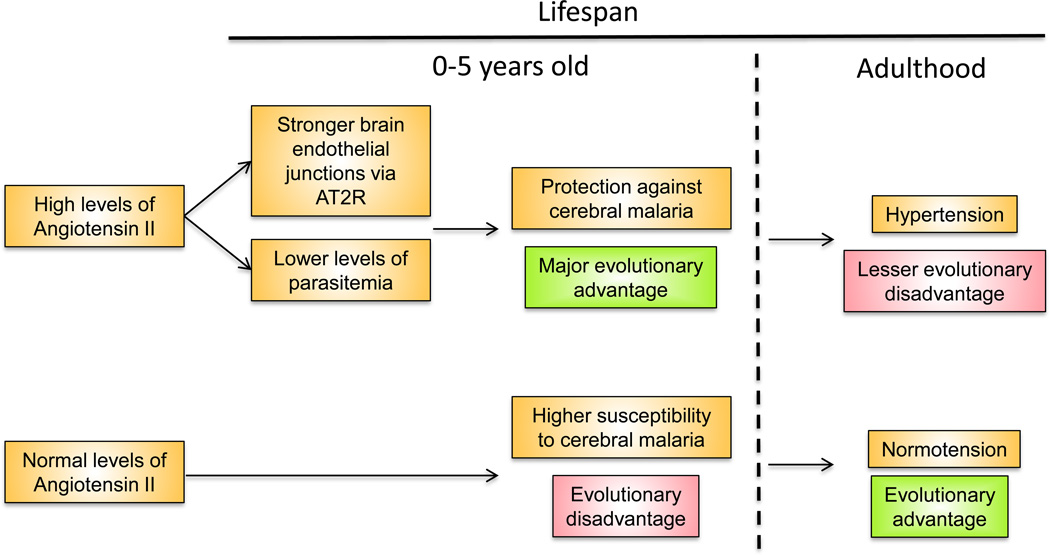
A recently proposed hypothesis states that malaria may contribute to hypertension in endemic areas, but the role of angiotensin II (Ang II), a major regulator of blood pressure, was not considered. Elevated levels of Ang II may confer protection against malaria morbidity and mortality, providing an alternative explanation for hypertension in malaria endemic areas.
To discuss a possible alternative cause for hypertension in populations who have been under the selective pressure of malaria.
We reviewed published scientific literature for studies that could establish a link between Ang II and malaria. Both genetic and functional studies suggested that high levels of Ang II may confer protection against cerebral malaria by strengthening the integrity of the endothelial brain barrier. We also describe strong experimental evidence supporting our hypothesis through genetic, functional, and interventional studies.
A causal association between high levels of Ang II and protection from malaria pathogenesis can provide a likely explanation for the increased prevalence in hypertension observed in populations of African and South Asian origin. Furthermore, this potential causative connection might also direct unique approaches for the effective treatment of cerebral malaria.
最近提出的一个假说认为,疟疾可能是流行地区高血压的一个成因,但血压的主要调节因子血管紧张素II(Ang II)的作用并未得到考虑。Ang II水平升高可能对疟疾的发病和死亡具有保护作用,这为疟疾流行地区的高血压现象提供了另一种解释。
探讨在遭受疟疾选择压力的人群中,高血压可能的另一个成因。
我们查阅了已发表的科学文献,以寻找能够建立Ang II与疟疾之间联系的研究。遗传和功能研究均表明,高水平的Ang II可能通过加强脑内皮屏障的完整性来预防脑型疟疾。我们还通过遗传、功能和干预性研究描述了支持我们假说的有力实验证据。
高水平的Ang II与预防疟疾发病机制之间的因果关联,可能是非洲和南亚裔人群中高血压患病率增加的一个合理解释。此外,这种潜在的因果联系也可能为有效治疗脑型疟疾带来独特的方法。