Venkatakrishnan A J, Pawlowski Colin, Zemmour David, Hughes Travis, Anand Akash, Berner Gabriela, Kayal Nikhil, Puranik Arjun, Conrad Ian, Bade Sairam, Barve Rakesh, Sinha Purushottam, O'Horo John C, Badley Andrew D, Halamka John, Soundararajan Venky
nference, Cambridge, MA, USA.
nference Labs, Bangalore, India.
NPJ Digit Med. 2021 Jul 27;4(1):117. doi: 10.1038/s41746-021-00484-7.
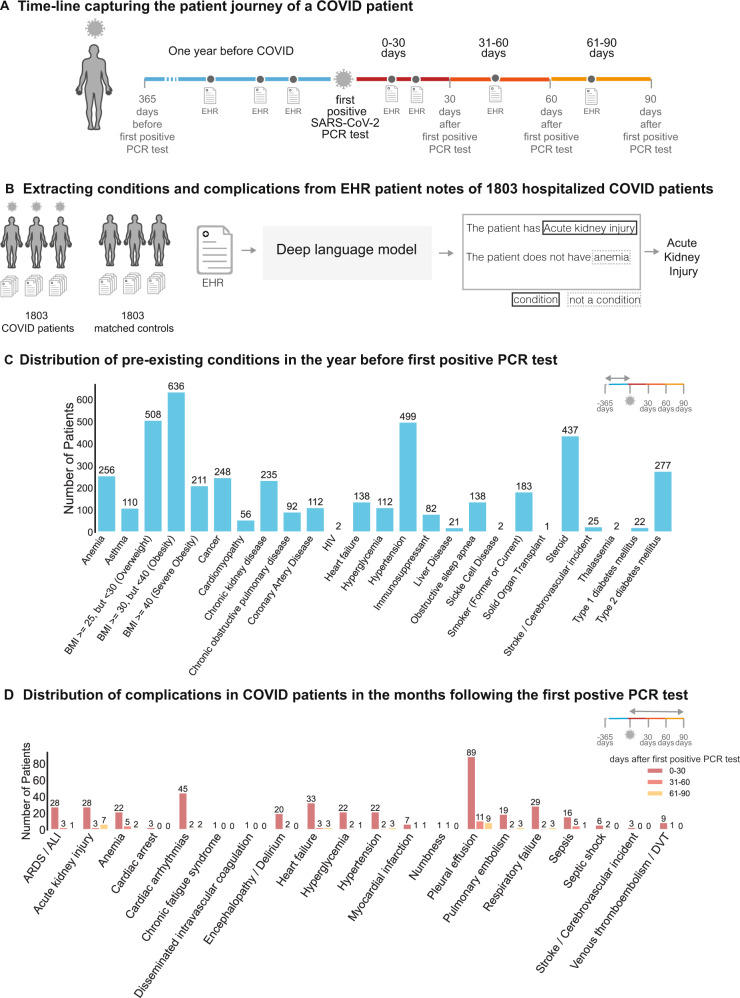
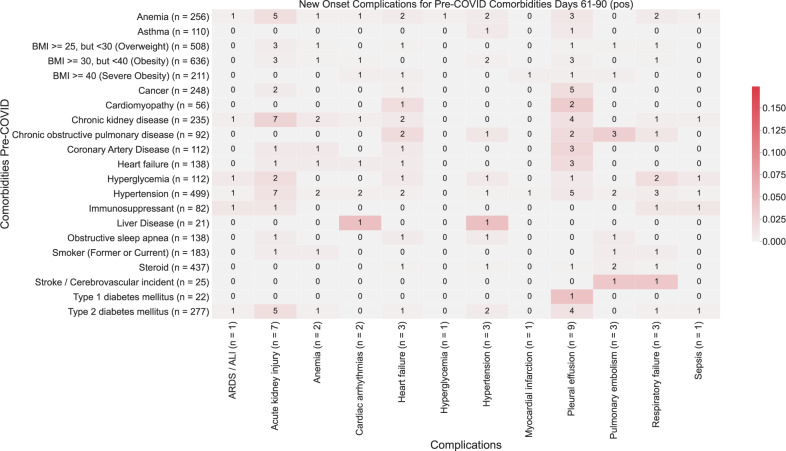
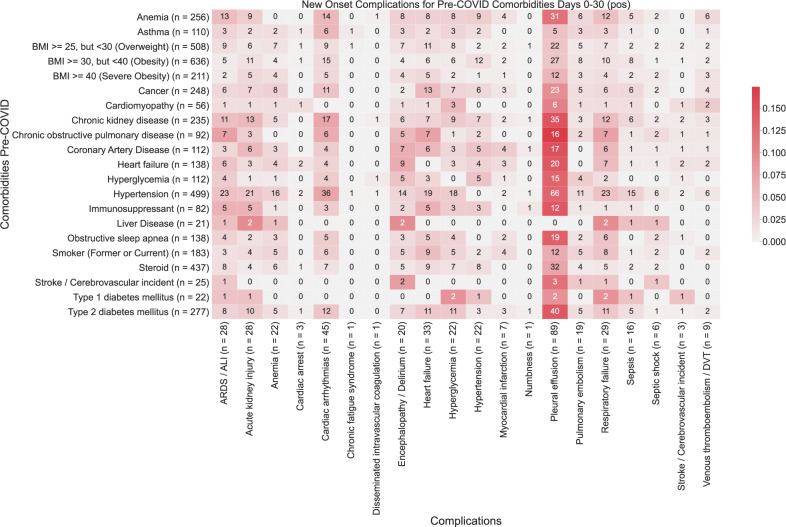
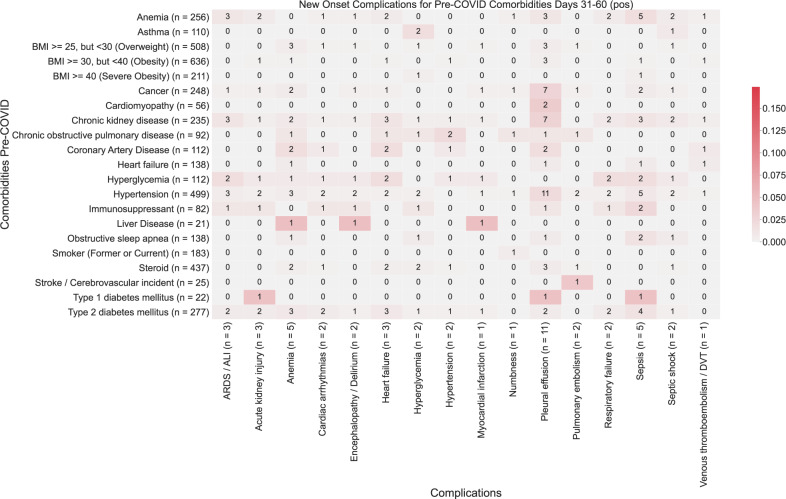
Understanding the relationships between pre-existing conditions and complications of COVID-19 infection is critical to identifying which patients will develop severe disease. Here, we leverage ~1.1 million clinical notes from 1803 hospitalized COVID-19 patients and deep neural network models to characterize associations between 21 pre-existing conditions and the development of 20 complications (e.g. respiratory, cardiovascular, renal, and hematologic) of COVID-19 infection throughout the course of infection (i.e. 0-30 days, 31-60 days, and 61-90 days). Pleural effusion was the most frequent complication of early COVID-19 infection (89/1803 patients, 4.9%) followed by cardiac arrhythmia (45/1803 patients, 2.5%). Notably, hypertension was the most significant risk factor associated with 10 different complications including acute respiratory distress syndrome, cardiac arrhythmia, and anemia. The onset of new complications after 30 days is rare and most commonly involves pleural effusion (31-60 days: 11 patients, 61-90 days: 9 patients). Lastly, comparing the rates of complications with a propensity-matched COVID-negative hospitalized population confirmed the importance of hypertension as a risk factor for early-onset complications. Overall, the associations between pre-COVID conditions and COVID-associated complications presented here may form the basis for the development of risk assessment scores to guide clinical care pathways.
了解新冠病毒感染的基础疾病与并发症之间的关系对于确定哪些患者会发展为重症疾病至关重要。在此,我们利用来自1803名住院新冠患者的约110万份临床记录和深度神经网络模型,来描述21种基础疾病与新冠病毒感染在整个感染过程(即0 - 30天、31 - 60天和61 - 90天)中出现的20种并发症(如呼吸系统、心血管系统、肾脏和血液系统并发症)之间的关联。胸腔积液是新冠病毒早期感染最常见的并发症(89/1803例患者,4.9%),其次是心律失常(45/1803例患者,2.5%)。值得注意的是,高血压是与包括急性呼吸窘迫综合征、心律失常和贫血在内的10种不同并发症相关的最显著风险因素。30天后出现新并发症的情况很少见,最常见的是胸腔积液(31 - 60天:11例患者,61 - 90天:9例患者)。最后,将并发症发生率与倾向匹配的新冠病毒阴性住院人群进行比较,证实了高血压作为早期并发症风险因素的重要性。总体而言,本文所呈现的新冠病毒感染前状况与新冠病毒相关并发症之间的关联可能为开发风险评估评分以指导临床护理路径奠定基础。