Tao Wuhai, Li Hehui, Li Xin, Huang Rong, Shao Wen, Guan Qing, Zhang Zhanjun
Center for Brain Disorders and Cognitive Science, Shenzhen University, Shenzhen, China.
Shenzhen-Hong Kong Institute of Brain Science-Shenzhen Fundamental Research Institutions, Shenzhen, China.
Front Aging Neurosci. 2021 Jul 12;13:687530. doi: 10.3389/fnagi.2021.687530. eCollection 2021.
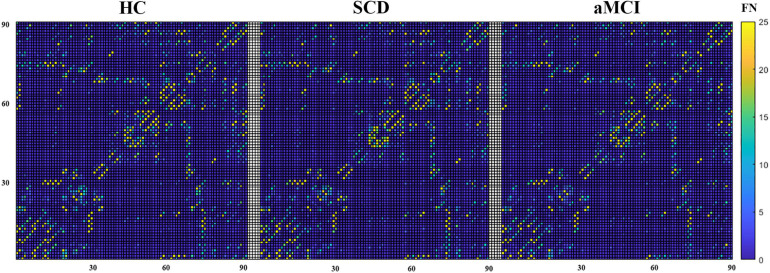
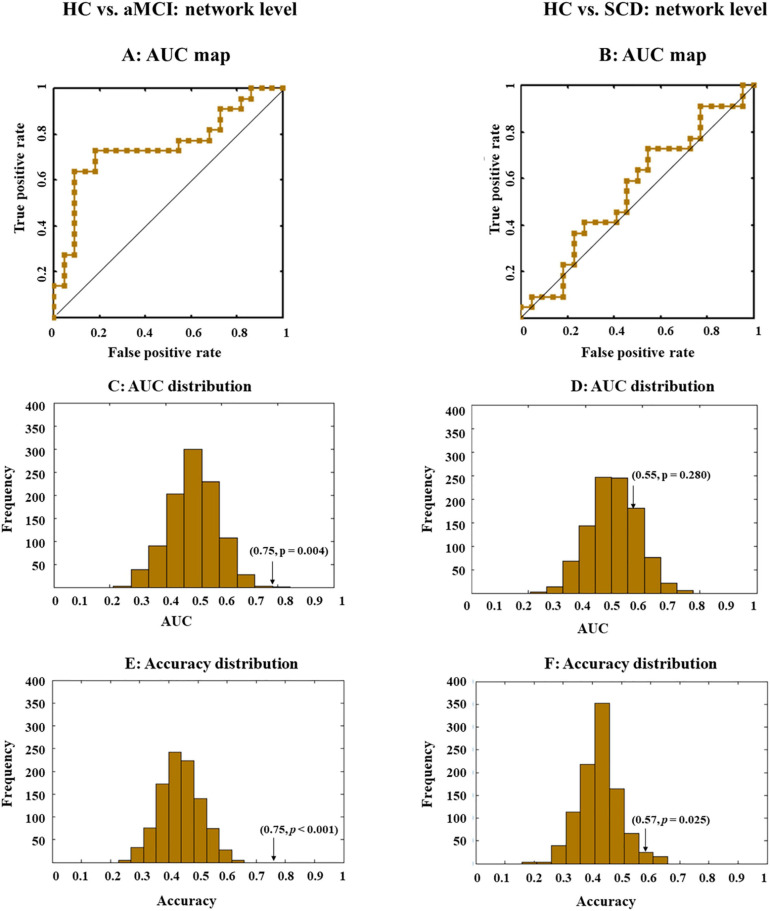
People with subjective cognitive decline (SCD) and amnestic mild cognitive impairment (aMCI) are both at high risk for Alzheimer's disease (AD). Behaviorally, both SCD and aMCI have subjective reports of cognitive decline, but the latter suffers a more severe objective cognitive impairment than the former. However, it remains unclear how the brain develops from SCD to aMCI. In the current study, we aimed to investigate the topological characteristics of the white matter (WM) network that can successfully identify individuals with SCD or aMCI from healthy control (HC) and to describe the relationship of pathological changes between these two stages. To this end, three groups were recruited, including 22 SCD, 22 aMCI, and 22 healthy control (HC) subjects. We constructed WM network for each subject and compared large-scale topological organization between groups at both network and nodal levels. At the network level, the combined network indexes had the best performance in discriminating aMCI from HC. However, no indexes at the network level can significantly identify SCD from HC. These results suggested that aMCI but not SCD was associated with anatomical impairments at the network level. At the nodal level, we found that the short-path length can best differentiate between aMCI and HC subjects, whereas the global efficiency has the best performance in differentiating between SCD and HC subjects, suggesting that both SCD and aMCI had significant functional integration alteration compared to HC subjects. These results converged on the idea that the neural degeneration from SCD to aMCI follows a gradual process, from abnormalities at the nodal level to those at both nodal and network levels.
主观认知下降(SCD)和遗忘型轻度认知障碍(aMCI)患者均处于患阿尔茨海默病(AD)的高风险中。在行为方面,SCD和aMCI均有认知下降的主观报告,但后者的客观认知障碍比前者更严重。然而,目前尚不清楚大脑是如何从SCD发展到aMCI的。在本研究中,我们旨在探究白质(WM)网络的拓扑特征,该特征能够成功地从健康对照(HC)中识别出SCD或aMCI个体,并描述这两个阶段之间病理变化的关系。为此,我们招募了三组人群,包括22名SCD患者、22名aMCI患者和22名健康对照(HC)受试者。我们为每个受试者构建了WM网络,并在网络和节点层面比较了各组之间的大规模拓扑组织。在网络层面,综合网络指标在区分aMCI和HC方面表现最佳。然而,在网络层面没有指标能够显著地将SCD与HC区分开来。这些结果表明,aMCI而非SCD与网络层面的解剖学损伤有关。在节点层面,我们发现最短路径长度能够最好地区分aMCI和HC受试者,而全局效率在区分SCD和HC受试者方面表现最佳,这表明与HC受试者相比,SCD和aMCI均有显著的功能整合改变。这些结果都表明,从SCD到aMCI的神经退行性变是一个渐进的过程,从节点层面的异常发展到节点和网络层面的异常。