Cash Rebecca E, Anderson Sarah E, Lancaster Kathryn E, Lu Bo, Rivard Madison K, Camargo Carlos A, Panchal Ashish R
National Registry of Emergency Medical Technicians Columbus Ohio USA.
Division of Epidemiology The Ohio State University College of Public Health Columbus Ohio USA.
J Am Coll Emerg Physicians Open. 2021 Jul 21;2(4):e12516. doi: 10.1002/emp2.12516. eCollection 2021 Aug.
Our objective was to quantify the associations between sleep duration and perceived and chronic stress with ideal cardiovascular health (CVH) among emergency medical services (EMS) personnel from county-based EMS agencies.
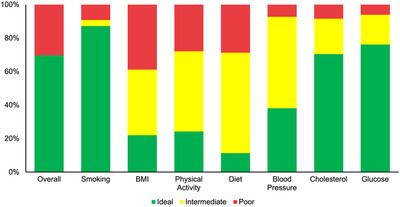
We conducted a cross-sectional survey of cardiovascular disease (CVD)-free EMS personnel from 4 US EMS agencies. The questionnaire consisted of the Pittsburgh Sleep Quality Index (PSQI), Perceived Stress Scale (PSS), Chronic Burden Scale, and the CVH components (smoking, body mass index, physical activity, diet, blood glucose, blood pressure, cholesterol, each scored 0-2 points). The components were summed and ideal CVH considered 11-14 points. Mixed effects logistic regression models with a random intercept for agency were used to estimate the odds of ideal CVH for good sleep quality (PSQI < 5 points), recommended sleep duration (7 to < 9h), low perceived stress (PSS < 26 points), and low chronic stress (0 recent stressful events).
We received 379 responses (response rate = 32%). There was low prevalence of good sleep quality (23%) and recommended sleep duration (25%), but 95% reported low perceived stress, and 33% had low chronic stress. Ideal CVH was reported by 30%. No significant associations between ideal CVH and sleep quality, perceived stress, or chronic stress were found. There was a nearly 2-fold increase in the odds of ideal CVH with recommended sleep duration (odds ratio: 1.83, 95% confidence interval: 1.08-3.10).
In this sample of EMS personnel, only recommended sleep duration was associated with ideal CVH. Future longitudinal studies are needed to understand the relationship between sleep, stress, and CVD in this understudied occupational group.
我们的目的是量化县级紧急医疗服务(EMS)机构的EMS人员的睡眠时间、感知压力和慢性压力与理想心血管健康(CVH)之间的关联。
我们对来自4家美国EMS机构的无心血管疾病(CVD)的EMS人员进行了横断面调查。问卷包括匹兹堡睡眠质量指数(PSQI)、感知压力量表(PSS)、慢性负担量表以及CVH的组成部分(吸烟、体重指数、身体活动、饮食、血糖、血压、胆固醇,每项得分0 - 2分)。将这些组成部分相加,理想的CVH为11 - 14分。使用带有机构随机截距的混合效应逻辑回归模型来估计良好睡眠质量(PSQI < 5分)、推荐睡眠时间(7至< 9小时)、低感知压力(PSS < 26分)和低慢性压力(近期无压力事件)下理想CVH的几率。
我们收到了379份回复(回复率 = 32%)。良好睡眠质量(23%)和推荐睡眠时间(25%)的患病率较低,但95%的人报告感知压力较低,33%的人慢性压力较低。30%的人报告有理想的CVH。未发现理想CVH与睡眠质量、感知压力或慢性压力之间存在显著关联。推荐睡眠时间使理想CVH的几率增加了近2倍(优势比:1.83,95%置信区间:1.08 - 3.10)。
在这个EMS人员样本中,只有推荐睡眠时间与理想CVH相关。未来需要进行纵向研究,以了解这个研究较少的职业群体中睡眠、压力和心血管疾病之间的关系。