• 文献检索
  • 文档翻译
  • 深度研究
  • 学术资讯
  • Suppr Zotero 插件Zotero 插件
  • 邀请有礼
  • 套餐&价格
  • 历史记录
应用&插件
Suppr Zotero 插件Zotero 插件浏览器插件Mac 客户端Windows 客户端微信小程序
定价
高级版会员购买积分包购买API积分包
服务
文献检索文档翻译深度研究API 文档MCP 服务
关于我们
关于 Suppr公司介绍联系我们用户协议隐私条款
关注我们

Suppr 超能文献

核心技术专利:CN118964589B侵权必究
粤ICP备2023148730 号-1Suppr @ 2026

文献检索

告别复杂PubMed语法,用中文像聊天一样搜索,搜遍4000万医学文献。AI智能推荐,让科研检索更轻松。

立即免费搜索

文件翻译

保留排版,准确专业,支持PDF/Word/PPT等文件格式,支持 12+语言互译。

免费翻译文档

深度研究

AI帮你快速写综述,25分钟生成高质量综述,智能提取关键信息,辅助科研写作。

立即免费体验

心脏不停跳体外循环下心内直视术后婴儿癫痫风险评估。

Evaluation of Seizure Risk in Infants After Cardiopulmonary Bypass in the Absence of Deep Hypothermic Cardiac Arrest.

机构信息

Division of Child Neurology, Lucile Packard Children's Hospital at Stanford University, Dr Levy 750 Welch Road Suite 317, Palo Alto, CA, USA.

Division of Medical Genetics, Lucile Packard Children's Hospital at Stanford University, Palo Alto, CA, USA.

出版信息

Neurocrit Care. 2022 Feb;36(1):30-38. doi: 10.1007/s12028-021-01313-1. Epub 2021 Jul 28.

DOI:10.1007/s12028-021-01313-1
PMID:34322828
原文链接:https://pmc.ncbi.nlm.nih.gov/articles/PMC8318326/
Abstract

BACKGROUND

Guidelines recommend evaluation for electrographic seizures in neonates and children at risk, including after cardiopulmonary bypass (CPB). Although initial research using screening electroencephalograms (EEGs) in infants after CPB found a 21% seizure incidence, more recent work reports seizure incidences ranging 3-12%. Deep hypothermic cardiac arrest was associated with increased seizure risk in prior reports but is uncommon at our institution and less widely used in contemporary practice. This study seeks to establish the incidence of seizures among infants following CPB in the absence of deep hypothermic cardiac arrest and to identify additional risk factors for seizures via a prediction model.

METHODS

A retrospective chart review was completed of all consecutive infants ≤ 3 months who received screening EEG following CPB at a single center within a 2-year period during 2017-2019. Clinical and laboratory data were collected from the perioperative period. A prediction model for seizure risk was fit using a random forest algorithm, and receiver operator characteristics were assessed to classify predictions. Fisher's exact test and the logrank test were used to evaluate associations between clinical outcomes and EEG seizures.

RESULTS

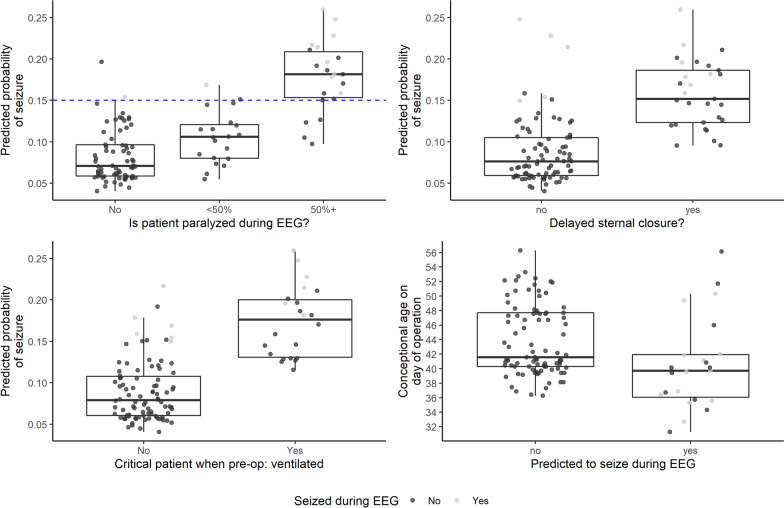
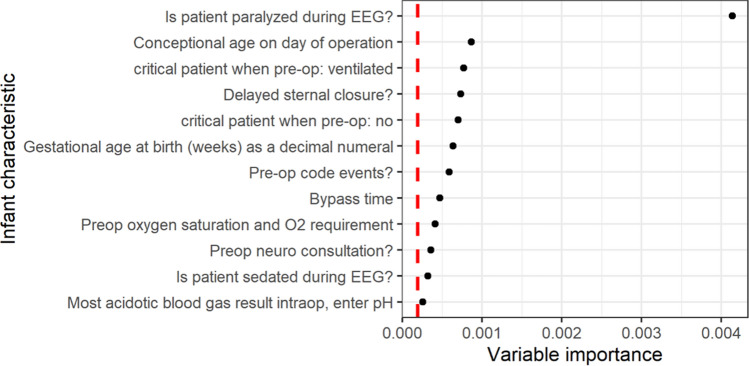
A total of 112 infants were included. Seizure incidence was 10.7%. Median time to first seizure was 28.1 h (interquartile range 18.9-32.2 h). The most important factors in predicting seizure risk from the random forest analysis included postoperative neuromuscular blockade, prematurity, delayed sternal closure, bypass time, and critical illness preoperatively. When variables captured during the EEG recording were included, abnormal postoperative neuroimaging and peak lactate were also highly predictive. Overall model accuracy was 90.2%; accounting for class imbalance, the model had excellent sensitivity and specificity (1.00 and 0.89, respectively).

CONCLUSIONS

Seizure incidence was similar to recent estimates even in the absence of deep hypothermic cardiac arrest. By employing random forest analysis, we were able to identify novel risk factors for postoperative seizure in this population and generate a robust model of seizure risk. Further work to validate our model in an external population is needed.

摘要

背景

指南建议对电癫痫发作进行评估,包括新生儿和有风险的儿童,包括体外循环(CPB)后。尽管最初的研究使用 CPB 后婴儿的筛查脑电图(EEG)发现癫痫发作发生率为 21%,但最近的研究报告癫痫发作发生率为 3-12%。在之前的报告中,深低温心脏停搏与癫痫发作风险增加相关,但在我们的机构中并不常见,在当代实践中也较少使用。本研究旨在确定无深低温心脏停搏的 CPB 后婴儿癫痫发作的发生率,并通过预测模型确定其他癫痫发作的危险因素。

方法

对 2017 年至 2019 年期间在单一中心接受 CPB 后接受筛查脑电图的所有连续婴儿(≤3 个月)进行回顾性图表审查。收集围手术期的临床和实验室数据。使用随机森林算法拟合癫痫发作风险预测模型,并评估接收者操作特征以分类预测。Fisher 精确检验和对数秩检验用于评估临床结果与 EEG 癫痫发作之间的关联。

结果

共纳入 112 例婴儿。癫痫发作发生率为 10.7%。首次癫痫发作的中位时间为 28.1 小时(四分位距 18.9-32.2 小时)。随机森林分析中预测癫痫发作风险最重要的因素包括术后神经肌肉阻滞、早产、延迟胸骨闭合、体外循环时间和术前危重病。当包括脑电图记录期间捕获的变量时,异常术后神经影像学和峰值乳酸也具有高度预测性。总体模型准确性为 90.2%;考虑到类别不平衡,该模型具有出色的敏感性和特异性(分别为 1.00 和 0.89)。

结论

即使没有深低温心脏停搏,癫痫发作的发生率也与最近的估计相似。通过采用随机森林分析,我们能够确定该人群术后癫痫发作的新危险因素,并生成癫痫发作风险的强大模型。需要进一步的工作来在外部人群中验证我们的模型。

https://cdn.ncbi.nlm.nih.gov/pmc/blobs/b31f/8318326/a2c17349773f/12028_2021_1313_Fig3_HTML.jpg
https://cdn.ncbi.nlm.nih.gov/pmc/blobs/b31f/8318326/ade6e0b69681/12028_2021_1313_Fig1_HTML.jpg
https://cdn.ncbi.nlm.nih.gov/pmc/blobs/b31f/8318326/4c70b305ce9e/12028_2021_1313_Fig2_HTML.jpg
https://cdn.ncbi.nlm.nih.gov/pmc/blobs/b31f/8318326/a2c17349773f/12028_2021_1313_Fig3_HTML.jpg
https://cdn.ncbi.nlm.nih.gov/pmc/blobs/b31f/8318326/ade6e0b69681/12028_2021_1313_Fig1_HTML.jpg
https://cdn.ncbi.nlm.nih.gov/pmc/blobs/b31f/8318326/4c70b305ce9e/12028_2021_1313_Fig2_HTML.jpg
https://cdn.ncbi.nlm.nih.gov/pmc/blobs/b31f/8318326/a2c17349773f/12028_2021_1313_Fig3_HTML.jpg

相似文献

1
Evaluation of Seizure Risk in Infants After Cardiopulmonary Bypass in the Absence of Deep Hypothermic Cardiac Arrest.心脏不停跳体外循环下心内直视术后婴儿癫痫风险评估。
Neurocrit Care. 2022 Feb;36(1):30-38. doi: 10.1007/s12028-021-01313-1. Epub 2021 Jul 28.
2
Increasing duration of deep hypothermic circulatory arrest is associated with an increased incidence of postoperative electroencephalographic seizures.深度低温循环停止时间的延长与术后脑电图癫痫发作的发生率增加有关。
J Thorac Cardiovasc Surg. 2005 Nov;130(5):1278-86. doi: 10.1016/j.jtcvs.2005.02.065. Epub 2005 Oct 13.
3
Electroencephalographic seizures after neonatal cardiac surgery with high-flow cardiopulmonary bypass.新生儿心脏手术后使用高流量体外循环心肺转流术的脑电图发作。
Anesth Analg. 2010 Jun 1;110(6):1680-5. doi: 10.1213/ANE.0b013e3181dd5a58. Epub 2010 Apr 30.
4
Development and Validation of a Seizure Prediction Model in Neonates After Cardiac Surgery.心脏手术后新生儿癫痫发作预测模型的建立与验证。
Ann Thorac Surg. 2021 Jun;111(6):2041-2048. doi: 10.1016/j.athoracsur.2020.05.157. Epub 2020 Jul 29.
5
Incidence of postoperative seizures in neonates following cardiac surgery with regional cerebral perfusion and deep hypothermic circulatory arrest.采用局部脑灌注和深度低温循环停搏进行心脏手术后新生儿的术后癫痫发病率。
JTCVS Open. 2023 Oct 31;16:771-783. doi: 10.1016/j.xjon.2023.10.026. eCollection 2023 Dec.
6
Deep Hypothermic Circulatory Arrest in the Pediatric Population Undergoing Cardiac Surgery With Electroencephalography Monitoring: A Systematic Review and Meta-Analysis.接受心脏手术的儿科患者在脑电图监测下进行深度低温循环骤停:一项系统评价和荟萃分析
J Cardiothorac Vasc Anesth. 2021 Oct;35(10):2875-2888. doi: 10.1053/j.jvca.2021.01.039. Epub 2021 Jan 29.
7
Subclinical seizures identified by postoperative electroencephalographic monitoring are common after neonatal cardiac surgery.新生儿心脏手术后,通过术后脑电图监测识别出的亚临床癫痫发作很常见。
J Thorac Cardiovasc Surg. 2015 Jul;150(1):169-78; discussion 178-80. doi: 10.1016/j.jtcvs.2015.03.045. Epub 2015 Apr 1.
8
Electrographic neonatal seizures after infant heart surgery.婴儿心脏手术后的新生儿脑电图癫痫发作
Epilepsia. 2005 Jan;46(1):84-90. doi: 10.1111/j.0013-9580.2005.22504.x.
9
The Characterization of Postoperative Mechanical Respiratory Requirement in Neonates and Infants Undergoing Cardiac Surgery on Cardiopulmonary Bypass in a Single Tertiary Institution.单中心体外循环下心内直视术后新生儿和婴儿机械通气呼吸力学特征。
J Cardiothorac Vasc Anesth. 2022 Jan;36(1):215-221. doi: 10.1053/j.jvca.2021.04.023. Epub 2021 Apr 25.
10
A comparison of the perioperative neurologic effects of hypothermic circulatory arrest versus low-flow cardiopulmonary bypass in infant heart surgery.婴儿心脏手术中低温循环停搏与低流量体外循环围手术期神经学效应的比较。
N Engl J Med. 1993 Oct 7;329(15):1057-64. doi: 10.1056/NEJM199310073291501.

引用本文的文献

1
Ketamine Versus Midazolam as the First-Line Continuous Infusion for Status Epilepticus in Children with Cardiac Disease.氯胺酮与咪达唑仑作为心脏病患儿癫痫持续状态一线持续输注药物的比较
Neurocrit Care. 2025 Jan 28. doi: 10.1007/s12028-025-02212-5.
2
Neuromonitoring practices for neonates with congenital heart disease: a scoping review.先天性心脏病新生儿的神经监测实践:一项范围综述
Pediatr Res. 2024 Aug 25. doi: 10.1038/s41390-024-03484-x.
3
Rapid bilateral pulmonary artery banding: A developmentally based proposal for the management of neonates with hypoplastic left heart.

本文引用的文献

1
Central nervous system consequences in infants of cardiac surgery using deep hypothermia and circulatory arrest.
Circulation. 1974 Aug;50(2 Suppl):II60-8.
快速双侧肺动脉环扎术:一种基于发育学的新生儿左心发育不全管理方案。
JTCVS Open. 2023 Apr 3;14:398-406. doi: 10.1016/j.xjon.2023.03.009. eCollection 2023 Jun.
4
Pediatric Stroke and Cardiac Disease: Challenges in Recognition and Management.小儿中风与心脏病:识别与管理中的挑战
Semin Pediatr Neurol. 2022 Oct;43:100992. doi: 10.1016/j.spen.2022.100992. Epub 2022 Aug 31.
5
Continuous EEG for Diagnosis of Electrographic Seizures in the Pediatric Cardiac Critical Care Unit: Using a Precious Resource Wisely.
Neurocrit Care. 2022 Feb;36(1):13-15. doi: 10.1007/s12028-021-01314-0. Epub 2021 Jul 30.