Health Education and Improvement Wales' School of Surgery, Tŷ Dysgu, Cefn Coed, Nantgarw, UK.
University of California, San Francisco, California, USA.
BJS Open. 2021 Jul 6;5(4). doi: 10.1093/bjsopen/zrab054.
Core surgical training programmes are associated with a high risk of burnout. This study aimed to assess the influence of a novel enhanced stress-resilience training (ESRT) course delivered at the start of core surgical training in a single UK statutory education body.
All newly appointed core surgical trainees (CSTs) were invited to participate in a 5-week ESRT course teaching mindfulness-based exercises to develop tools to deal with stress at work and burnout. The primary aim was to assess the feasibility of this course; secondary outcomes were to assess degree of burnout measured using Maslach Burnout Inventory (MBI) scoring.
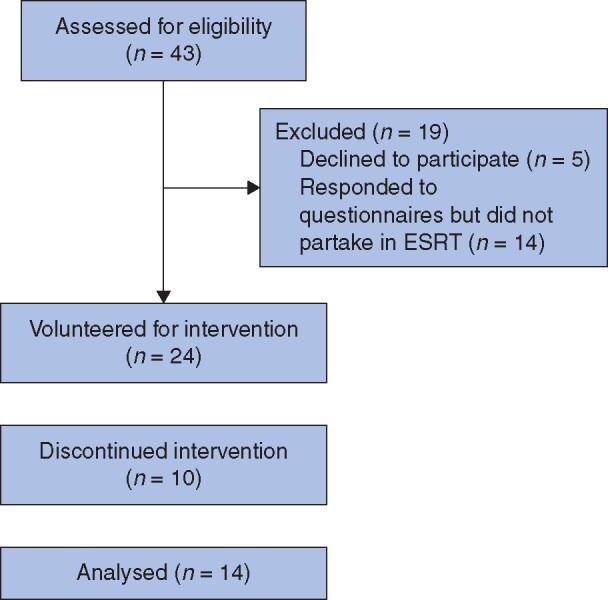
Of 43 boot camp attendees, 38 trainees completed questionnaires, with 24 choosing to participate in ESRT (63.2 per cent; male 13, female 11, median age 28 years). Qualitative data reflected challenges delivering ESRT because of arduous and inflexible clinical on-call rotas, time pressures related to academic curriculum demands and the concurrent COVID-19 pandemic (10 of 24 drop-out). Despite these challenges, 22 (91.7 per cent) considered the course valuable and there was unanimous support for programme development. Of the 14 trainees who completed the ESRT course, nine (64.3 per cent) continued to use the techniques in daily clinical work. Burnout was identified in 23 trainees (60.5 per cent) with no evident difference in baseline MBI scores between participants (median 4 (range 0-11) versus 5 (1-11), P = 0.770). High stress states were significantly less likely, and mindfulness significantly higher in the intervention group (P < 0.010); MBI scores were comparable before and after ESRT in the intervention cohort (P = 0.630, median 4 (range 0-11) versus 4 (1-10)).
Despite arduous emergency COVID rotas ESRT was feasible and, combined with protected time for trainees to engage, deserves further research to determine medium-term efficacy.
核心外科培训计划与倦怠风险高有关。本研究旨在评估在英国单一法定教育机构的核心外科培训开始时提供的新型强化应激弹性培训 (ESRT) 课程对其的影响。
所有新任命的核心外科培训师 (CST) 均被邀请参加为期 5 周的 ESRT 课程,该课程教授正念练习,以开发应对工作压力和倦怠的工具。主要目的是评估该课程的可行性;次要结果是使用 Maslach 倦怠量表 (MBI) 评分评估倦怠程度。
在 43 名参加训练营的学员中,有 38 名学员完成了问卷调查,其中 24 名学员选择参加 ESRT(63.2%;男性 13 名,女性 11 名,中位数年龄 28 岁)。定性数据反映了由于艰苦而灵活的临床值班轮班、与学术课程需求相关的时间压力以及同期 COVID-19 大流行(24 名学员中有 10 名辍学)而难以提供 ESRT。尽管存在这些挑战,22 名学员(91.7%)认为该课程有价值,并且一致支持该课程的开发。在完成 ESRT 课程的 14 名学员中,有 9 名(64.3%)继续将这些技术应用于日常临床工作中。在 23 名学员中发现了倦怠现象,在参与者之间基线 MBI 评分没有明显差异(中位数 4(范围 0-11)与 5(1-11),P=0.770)。干预组中高压力状态明显减少,正念明显增加(P<0.010);干预组中 ESRT 前后 MBI 评分相当(P=0.630,中位数 4(范围 0-11)与 4(1-10))。
尽管 COVID 紧急轮班艰巨,但 ESRT 是可行的,并且结合受训者参与的受保护时间,值得进一步研究以确定其中期疗效。