Department of Medicine and Obstetrics and Gynecology, Center for Global Health, Weill Cornell Medicine, New York, New York, USA.
University of California-San Francisco, San Francisco, California, USA.
Clin Infect Dis. 2022 May 3;74(9):1604-1613. doi: 10.1093/cid/ciab665.
Pregnancy increases the risk of tuberculosis and its complications. A 3-month regimen of weekly isoniazid and rifapentine (3HP) is safe and effective for tuberculosis prevention in adults and children, including those with HIV, but 3HP has not been evaluated in pregnancy.
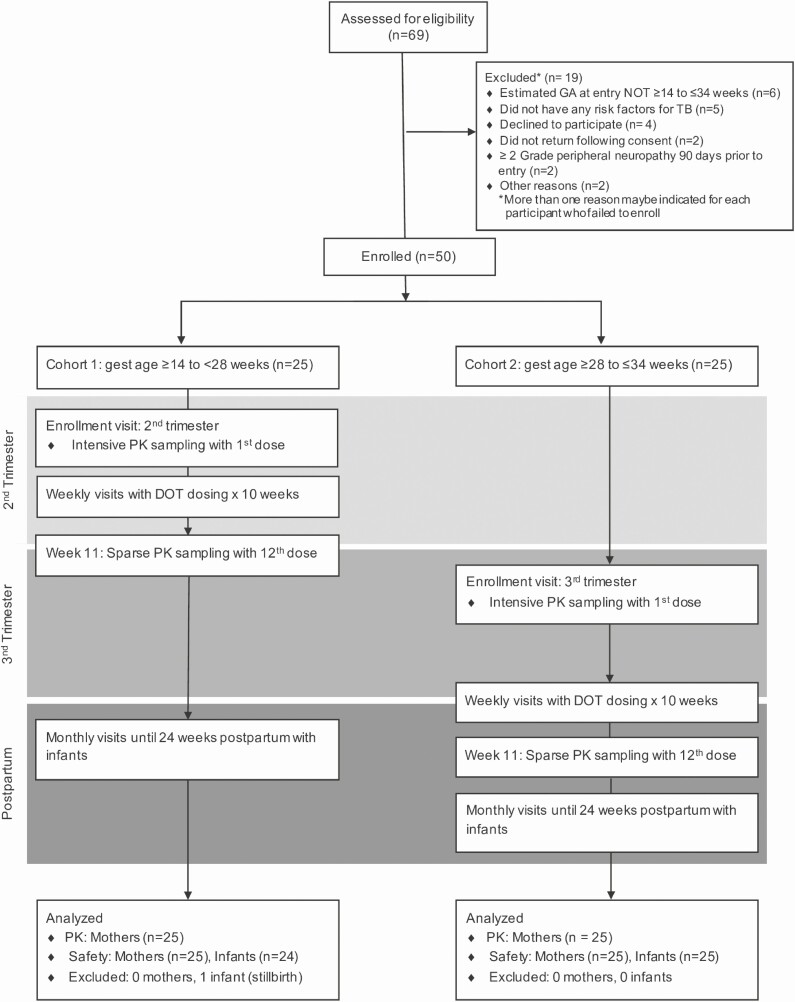
IMPAACT 2001 was a phase I/II trial evaluating the pharmacokinetics and safety of 3HP among pregnant women with indications for tuberculosis preventative therapy in Haiti, Kenya, Malawi, Thailand, and Zimbabwe (NCT02651259). Isoniazid and rifapentine were provided at standard doses (900 mg/week). Pharmacokinetic sampling was performed with the first (second/third trimester) and twelfth (third trimester/postpartum) doses. Nonlinear mixed-effects models were used to estimate drug population pharmacokinetics.
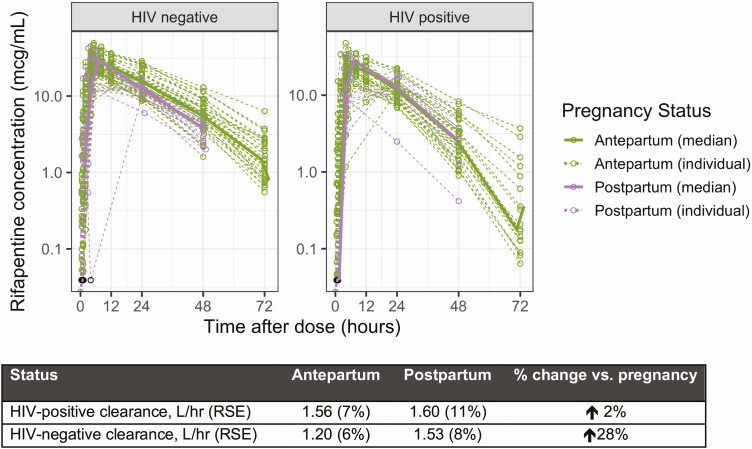
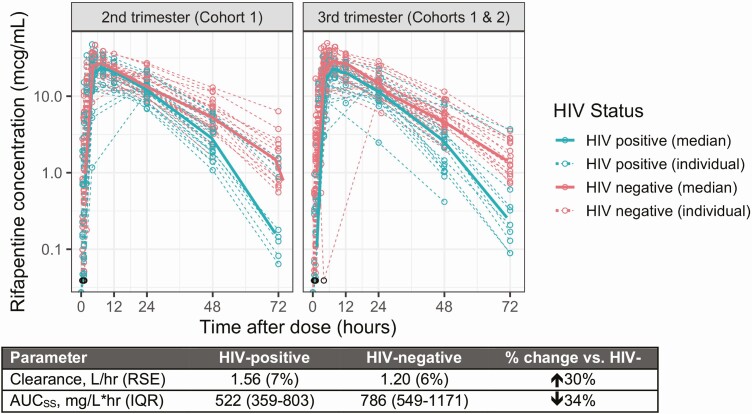
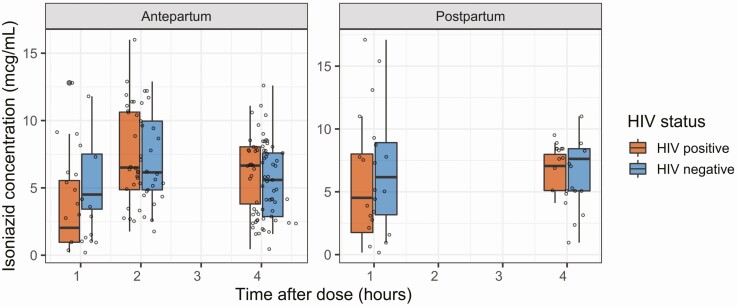
Of 50 participants, 20 had HIV and were taking efavirenz-based antiretroviral therapy. Among women without HIV, clearance of rifapentine was 28% lower during pregnancy than postpartum (1.20 vs 1.53 L/hour, P < .001), with area under the concentration-time curve (AUCSS) of 786 and 673 mg × hour/L, respectively. In pregnant women with HIV, clearance was 30% higher than women without HIV (P < .001), resulting in lower AUCss (522 mg × hour/L); clearance did not change significantly between pregnancy and postpartum. Pregnancy did not impact isoniazid pharmacokinetics. There were no drug-related serious adverse events, treatment discontinuations, or tuberculosis cases in women or infants.
3HP does not require dose adjustment in pregnancy. Rifapentine clearance is higher among women with HIV, but all women achieved exposures of rifapentine and isoniazid associated with successful tuberculosis prevention. The data support proceeding with larger safety-focused studies of 3HP in pregnancy.
ClinicalTrials.gov, NCT02651259.
妊娠会增加罹患结核病及其并发症的风险。为期 3 个月的每周异烟肼和利福喷汀方案(3HP)对成人和儿童(包括 HIV 感染者)的结核病预防是安全且有效的,但尚未在妊娠人群中进行评估。
IMPACT 2001 是一项在海地、肯尼亚、马拉维、泰国和津巴布韦进行的评估有结核病预防治疗指征的妊娠女性中 3HP 的药代动力学和安全性的 I/II 期试验(NCT02651259)。异烟肼和利福喷汀按照标准剂量(900 mg/周)给药。在第一次(第二/第三孕期)和第十二次(第三孕期/产后)给药时进行药代动力学采样。采用非线性混合效应模型来估计药物群体药代动力学。
在 50 名参与者中,有 20 名 HIV 阳性并正在接受基于依非韦伦的抗逆转录病毒治疗。在没有 HIV 的女性中,妊娠时利福喷汀清除率较产后降低 28%(1.20 比 1.53 L/小时,P<0.001),相应的 AUCSS 分别为 786 和 673 mg×小时/L。HIV 阳性的妊娠女性的清除率高于没有 HIV 的女性(P<0.001),导致 AUCSS 更低(522 mg×小时/L);妊娠与产后之间清除率无显著变化。妊娠并未影响异烟肼的药代动力学。在女性和婴儿中,没有药物相关的严重不良事件、治疗中断或结核病病例。
3HP 在妊娠时无需调整剂量。HIV 阳性女性的利福喷汀清除率更高,但所有女性均达到了成功预防结核病所需的利福喷汀和异烟肼暴露量。这些数据支持在妊娠人群中进行更大规模的关注安全性的 3HP 研究。
ClinicalTrials.gov,NCT02651259。