
在 3T 场强下,通过人体全脑离体磁共振成像以 160μm 各向同性分辨率对多发性硬化病变进行成像。
Imaging multiple sclerosis pathology at 160 μm isotropic resolution by human whole-brain ex vivo magnetic resonance imaging at 3 T.
机构信息
Translational Imaging in Neurology (ThINk) Basel, Department of Biomedical Engineering, University Hospital Basel and University of Basel, Gewerbestrasse 14, 4123, Allschwil, Switzerland.
Neurologic Clinic and Policlinic, Departments of Medicine, Clinical Research and Biomedical Engineering, University Hospital Basel and University of Basel, Petersgraben 4, 4031, Basel, Switzerland.
出版信息
Sci Rep. 2021 Jul 29;11(1):15491. doi: 10.1038/s41598-021-94891-1.
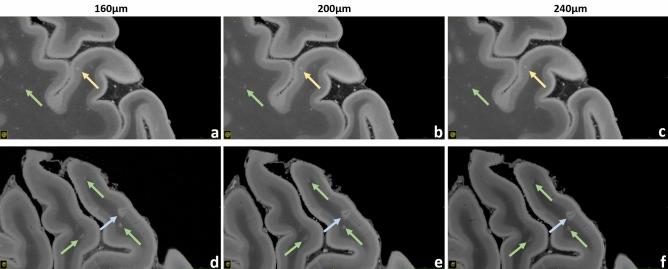
Postmortem magnetic resonance imaging (MRI) of the fixed healthy and diseased human brain facilitates spatial resolutions and image quality that is not achievable with in vivo MRI scans. Though challenging-and almost exclusively performed at 7 T field strength-depicting the tissue architecture of the entire brain in fine detail is invaluable since it enables the study of neuroanatomy and uncovers important pathological features in neurological disorders. The objectives of the present work were (1) to develop a 3D isotropic ultra-high-resolution imaging approach for human whole-brain ex vivo acquisitions working on a standard clinical 3 T MRI system; and (2) to explore the sensitivity and specificity of this concept for specific pathoanatomical features of multiple sclerosis. The reconstructed images demonstrate unprecedented resolution and soft tissue contrast of the diseased human brain at 3 T, thus allowing visualization of sub-millimetric lesions in the different cortical layers and in the cerebellar cortex, as well as unique cortical lesion characteristics such as the presence of incomplete/complete iron rims, and patterns of iron accumulation. Further details such as the subpial molecular layer, the line of Gennari, and some intrathalamic nuclei are also well distinguishable.
对固定的健康和患病人类大脑进行死后磁共振成像(MRI)有助于实现体内 MRI 扫描无法达到的空间分辨率和图像质量。尽管具有挑战性——几乎仅在 7T 场强下进行——但详细描绘整个大脑的组织结构是非常宝贵的,因为它可以使神经解剖学的研究成为可能,并揭示神经疾病中的重要病理特征。本工作的目的是(1)开发一种适用于标准临床 3T MRI 系统的用于人体全脑离体采集的 3D 各向同性超高分辨率成像方法;(2)探索该概念对多发性硬化症多种特定病理解剖特征的敏感性和特异性。重建图像显示了在 3T 下患病人类大脑前所未有的分辨率和软组织对比,从而可以可视化不同皮质层和小脑皮质中的亚毫米病变,以及独特的皮质病变特征,如不完全/完全铁环和铁积累模式。还可以很好地区分其他详细信息,如软脑膜分子层、杰纳里线和一些丘脑核。




 Zotero 插件