Department of Science and Education, Peking University Binhai Hospital, Tianjin, China.
Department of Science and Education, Peking University Binhai Hospital, Tianjin, China.
Breast. 2021 Oct;59:270-278. doi: 10.1016/j.breast.2021.07.016. Epub 2021 Jul 22.
We conducted a systematic review and meta-analysis to compare the screening performance of synthesized mammography (SM) plus digital breast tomosynthesis (DBT) with digital mammography (DM) plus DBT or DM alone.
Medline, Embase, Web of Science, and the Cochrane Library databases were searched from January 2010 to January 2021. Eligible population-based studies on breast cancer screening comparing SM/DBT with DM/DBT or DM in asymptomatic women were included. A random-effect model was used in this meta-analysis. Data were summarized as risk differences (RDs), with 95 % confidence intervals (CIs).
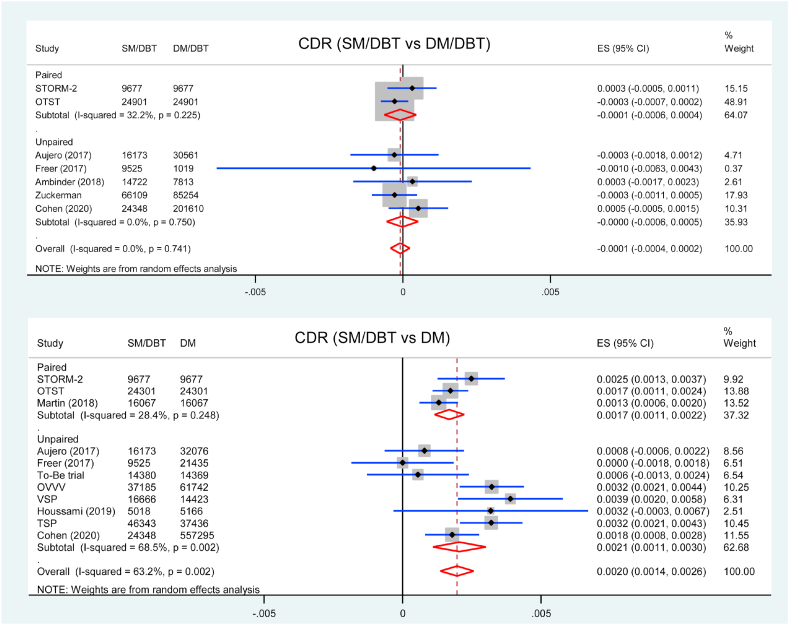
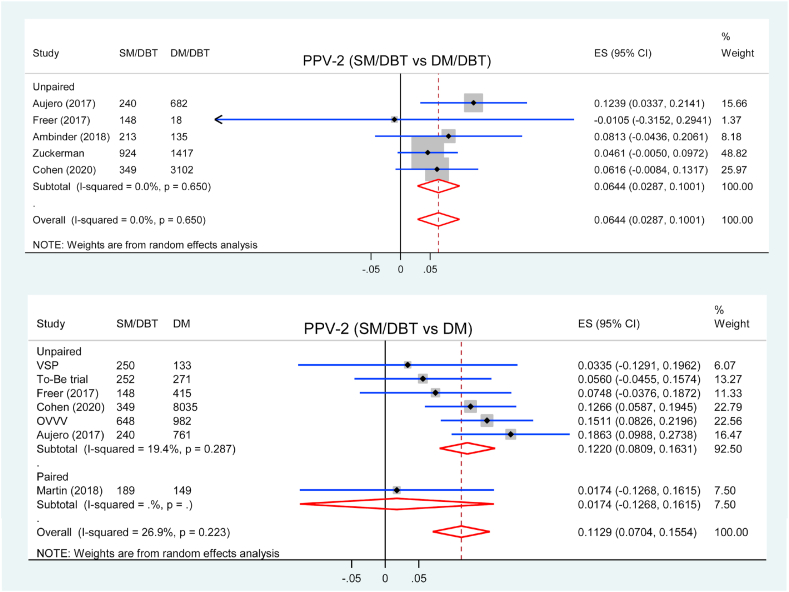
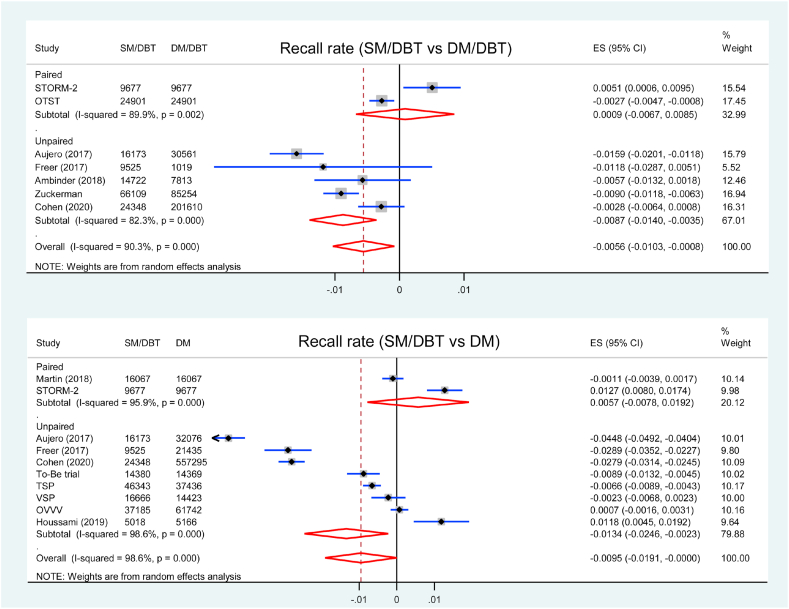
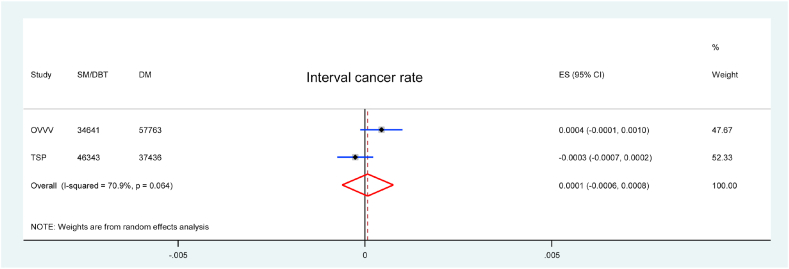
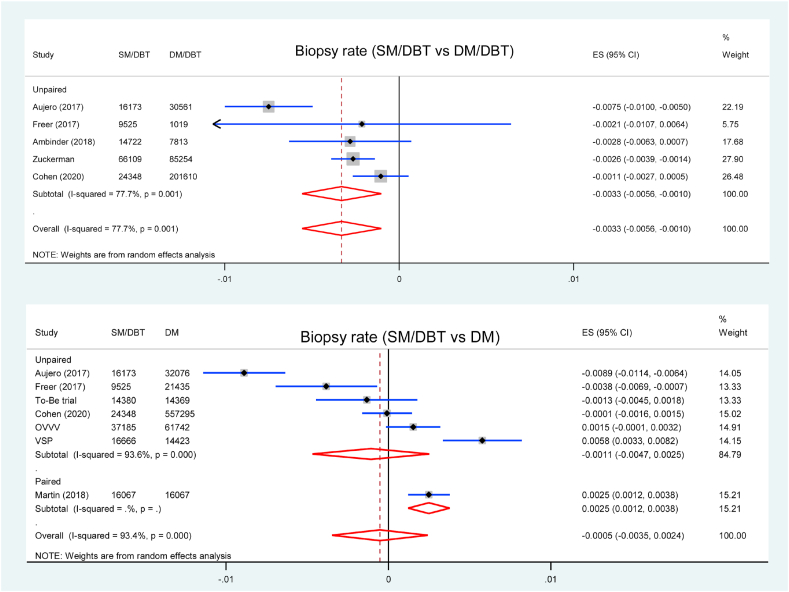
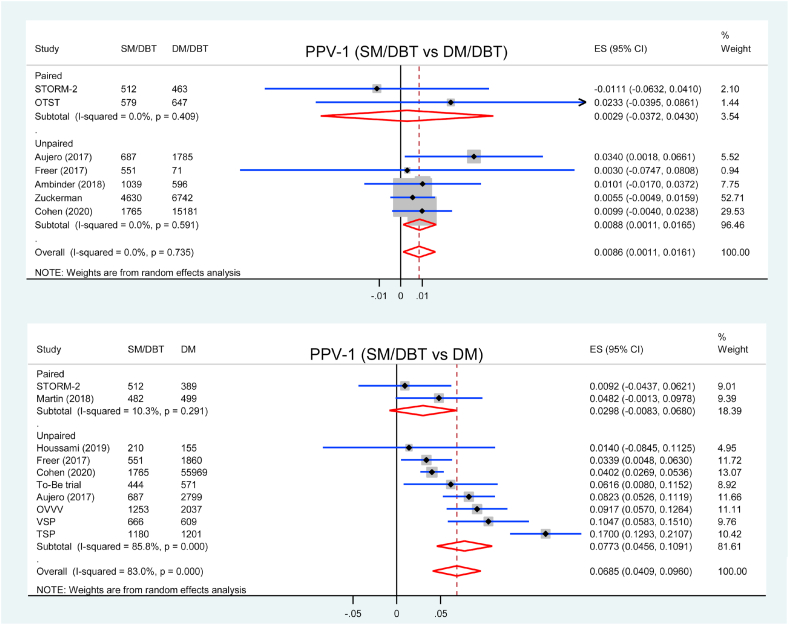
Thirteen studies involving 1,370,670 participants were included. Compared with DM/DBT, screening using SM/DBT had similar breast cancer detection rate (CDR) (RD = -0.1/1000 screens, 95 % CI = -0.4 to 0.2, p = 0.557, I = 0 %), but lower recall rate (RD = -0.56 %, 95 % CI = -1.03 to -0.08, p = 0.022, I = 90 %) and lower biopsy rate (RD = -0.33 %, 95 % CI = -0.56 to -0.10, p = 0.005, I = 78 %). Compared with DM, SM/DBT improved CDR (RD = 2.0/1000 screens, 95 % CI = 1.4 to 2.6, p < 0.001, I = 63 %) and reduced recall rate (RD = -0.95 %, 95 % CI = -1.91 to -0.002, p = 0.049, I = 99 %). However, SM/DBT and DM had similar interval cancer rate (ICR) (RD = 0.1/1000 screens, 95 % CI = -0.6 to 0.8, p = 0.836, I = 71 %) and biopsy rate (RD = -0.05 %, 95 % CI = -0.35 to 0.24, p = 0.727, I = 93 %).
Screening using SM/DBT has similar breast cancer detection but reduces recall and biopsy when compared with DM/DBT. SM/DBT improves CDR when compared with DM, but they have little difference in ICR. SM/DBT could replace DM/DBT in breast cancer screening to reduce radiation dose.
我们进行了一项系统评价和荟萃分析,以比较合成乳房 X 线摄影术(SM)加数字乳腺断层摄影术(DBT)与数字乳腺 X 线摄影术(DM)加 DBT 或 DM 单独用于乳腺癌筛查的筛查性能。
从 2010 年 1 月至 2021 年 1 月,检索了 Medline、Embase、Web of Science 和 Cochrane 图书馆数据库。纳入了基于人群的乳腺癌筛查研究,比较了 SM/DBT 与 DM/DBT 或 DM 在无症状女性中的应用。本荟萃分析采用随机效应模型。数据以风险差异(RD)表示,置信区间(CI)为 95%。
共纳入了 13 项涉及 1370670 名参与者的研究。与 DM/DBT 相比,SM/DBT 筛查的乳腺癌检出率(CDR)相似(RD=-0.1/1000 次筛查,95%CI=-0.4 至 0.2,p=0.557,I=0%),但召回率(RD=-0.56%,95%CI=-1.03 至-0.08,p=0.022,I=90%)和活检率(RD=-0.33%,95%CI=-0.56 至-0.10,p=0.005,I=78%)较低。与 DM 相比,SM/DBT 提高了 CDR(RD=2.0/1000 次筛查,95%CI=1.4 至 2.6,p<0.001,I=63%)和降低了召回率(RD=-0.95%,95%CI=-1.91 至-0.002,p=0.049,I=99%)。然而,SM/DBT 和 DM 的间期癌率(ICR)相似(RD=0.1/1000 次筛查,95%CI=-0.6 至 0.8,p=0.836,I=71%)和活检率(RD=-0.05%,95%CI=-0.35 至 0.24,p=0.727,I=93%)相似。
与 DM/DBT 相比,SM/DBT 筛查具有相似的乳腺癌检出率,但降低了召回率和活检率。与 DM 相比,SM/DBT 提高了 CDR,但在 ICR 方面差异不大。SM/DBT 可替代 DM/DBT 用于乳腺癌筛查,以减少辐射剂量。