Department of Oncology, The Second Affiliated Hospital of Nanchang University, No.1 Minde Street, Nanchang, 330000, Jiangxi Province, People's Republic of China.
Jiangxi Key Laboratory of Clinical Translational Cancer Research, Nanchang, 330000, Jiangxi Province, People's Republic of China.
BMC Cancer. 2021 Jul 30;21(1):873. doi: 10.1186/s12885-021-08581-2.
Leptomeningeal metastasis (LM) is a severe complication of advanced non-small cell lung cancer (NSCLC). This retrospective study aimed to investigate the potential use of osimertinib for preventing LM in patients with advanced epidermal growth factor receptor (EGFR)-mutated NSCLC.
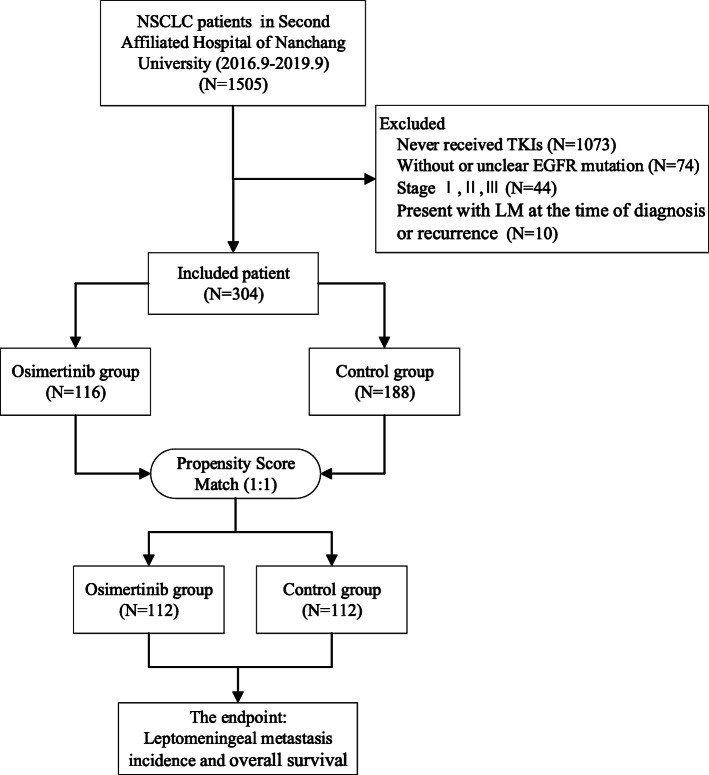
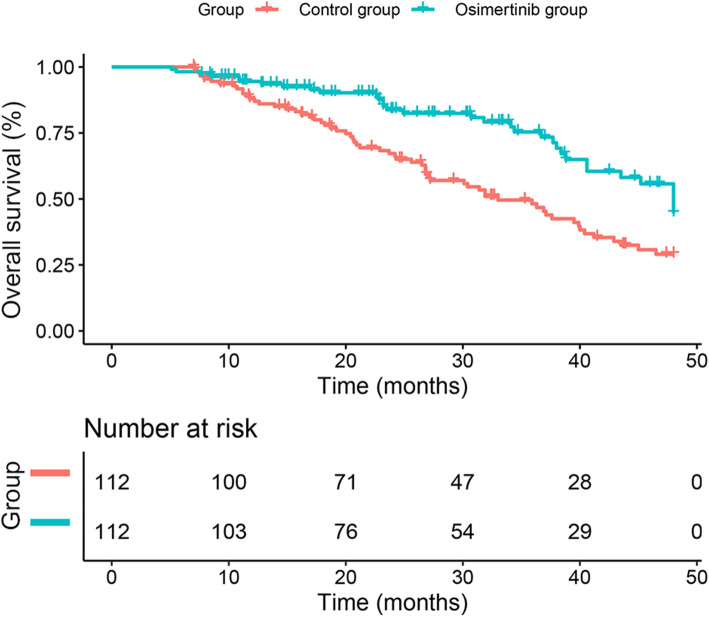
Patients with advanced NSCLC harboring EGFR mutations who underwent tyrosine kinase inhibitors (TKIs) therapy for at least 8 weeks between September 2016 and September 2019 were eligible for this study. All included patients were divided into two groups based on whether they received osimertinib, the osimertinib group (patients treated with osimertinib) and the control group (patients not treated with osimertinib). Propensity score matching (PSM, ratio of 1:1) was used to account for differences in baseline characteristics. The cumulative incidence of LM and the overall survival (OS) were evaluated.
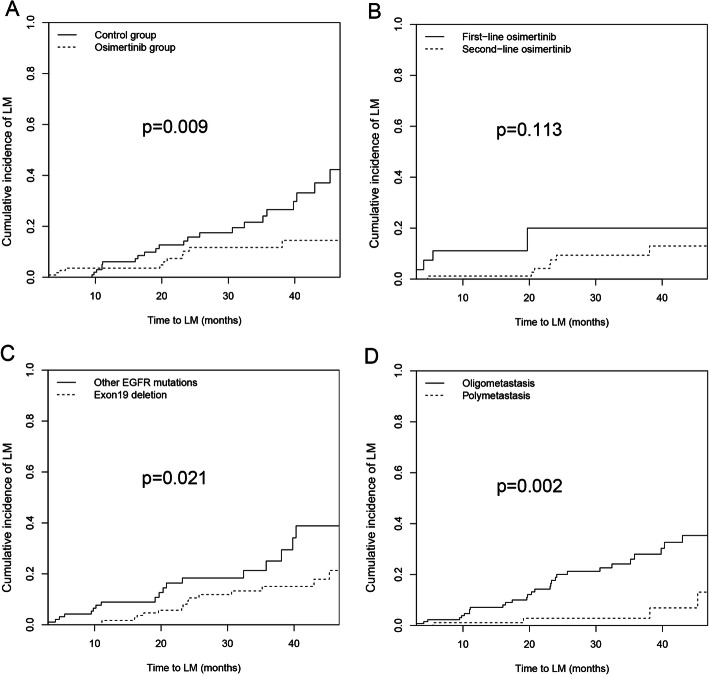
A total of 304 patients were included in the study population. Among them, 116 patients received osimertinib, and 188 did not. A total of 112 patients remained in each group after PSM, and the baseline characteristics were not significantly different between the two cohorts. LM developed in 11 patients (9.82%) in the osimertinib group and 24 patients (21.42%) in the control group (hazard ratio [HR] 0.38, 95% confidence interval [CI] 0.19-0.79, p = 0.009). Multivariate analysis indicated that osimertinib was an independent, statistically significant predictor for determining the risk for LM, with an HR of 0.33 (p = 0.042). At present, the OS rate data are too immature for statistical analysis.
Real-world data demonstrate that osimertinib can significantly reduce the incidence of LM in patients with advanced NSCLC harboring common EGFR mutations. Given this result, osimertinib should be encouraged in clinical practice for specific patient populations.
脑膜转移(LM)是晚期非小细胞肺癌(NSCLC)的严重并发症。本回顾性研究旨在探讨奥希替尼在预防晚期表皮生长因子受体(EGFR)突变型 NSCLC 患者 LM 中的潜在作用。
纳入 2016 年 9 月至 2019 年 9 月期间接受酪氨酸激酶抑制剂(TKI)治疗至少 8 周的晚期 NSCLC 患者。所有纳入的患者均根据是否接受奥希替尼分为两组,奥希替尼组(接受奥希替尼治疗的患者)和对照组(未接受奥希替尼治疗的患者)。采用倾向评分匹配(PSM,1:1 比例)来平衡基线特征差异。评估 LM 的累积发生率和总生存期(OS)。
共纳入 304 例患者。其中,116 例患者接受奥希替尼治疗,188 例患者未接受奥希替尼治疗。PSM 后两组各有 112 例患者,两组基线特征无显著差异。奥希替尼组有 11 例(9.82%)患者发生 LM,对照组有 24 例(21.42%)患者发生 LM(风险比 [HR] 0.38,95%置信区间 [CI] 0.19-0.79,p=0.009)。多因素分析表明,奥希替尼是 LM 风险的独立、有统计学意义的预测因素,HR 为 0.33(p=0.042)。目前,OS 率数据尚不成熟,无法进行统计分析。
真实世界数据表明,奥希替尼可显著降低常见 EGFR 突变型晚期 NSCLC 患者 LM 的发生率。鉴于这一结果,奥希替尼在临床实践中应鼓励用于特定患者人群。