Department of Radiology, Turku University Hospital, Kiinamyllynkatu 4-8, 20521, Turku, Finland.
Department of Otorhinolaryngology-Head and Neck Surgery, University of Turku and Turku University Hospital, Kiinamyllynkatu 4-8, FI-20520, Turku, Finland.
Eur Radiol. 2022 Feb;32(2):1078-1086. doi: 10.1007/s00330-021-08200-5. Epub 2021 Jul 30.
Due to its superior soft-tissue contrast and ability to delineate abscesses, MRI has high diagnostic accuracy in neck infections. Whether MRI findings can predict the clinical course in these patients is unknown. The purpose of this study was to determine the clinical and prognostic significance of various MRI findings in emergency patients with acute neck infections.
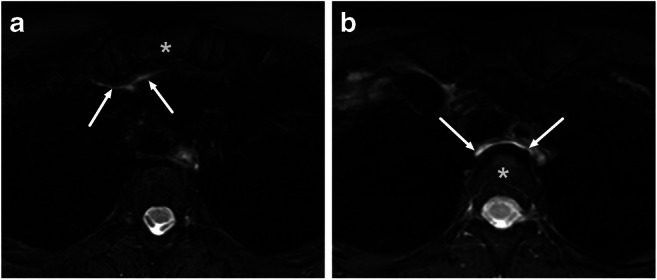
We retrospectively reviewed the 3-T MRI findings of 371 patients with acute neck infections from a 5-year period in a single tertiary emergency radiology department. We correlated various MRI findings, including retropharyngeal (RPE) and mediastinal edema (ME) and abscess diameter, to clinical findings and outcomes, such as the need for intensive care unit (ICU) treatment and length of hospital stay (LOS).
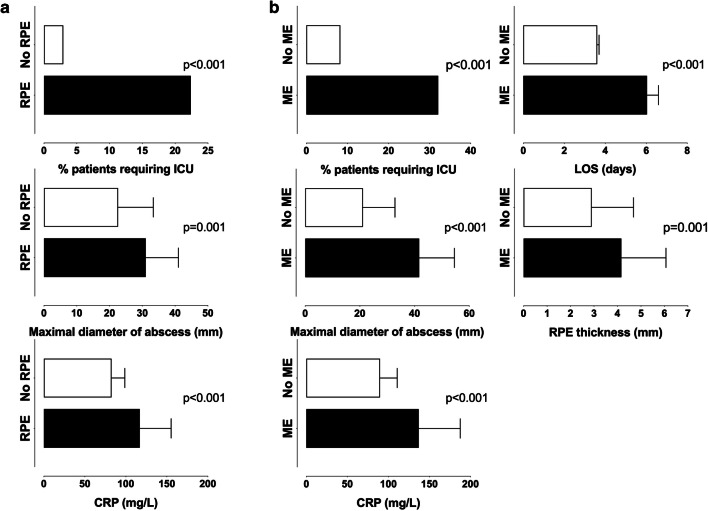
A total of 201 out of 371 patients (54%) with neck infections showed evidence of RPE, and 81 out of 314 patients (26%) had ME. Both RPE (OR = 9.5, p < 0.001) and ME (OR = 5.3, p < 0.001) were more prevalent among the patients who required ICU treatment than among those who did not. In a multivariate analysis, C-reactive protein (CRP) levels, RPE, and maximal abscess diameter were independent predictors of the need for ICU treatment, and CRP, ME, and maximal abscess diameter were independent predictors of LOS.
In patients with an acute neck infection that requires emergency imaging, RPE, ME, and abscess diameter, as shown by MRI, are significant predictors of a more severe illness.
• Two hundred one out of 371 patients (54%) with neck infection showed evidence of retropharyngeal edema (RPE), and 81 out of 314 patients (26%) had mediastinal edema (ME). • Maximal abscess diameter, RPE, and C-reactive protein (CRP) were independent predictors of the need for intensive care unit (ICU) treatment, and maximal abscess diameter, ME, and CRP were independent predictors of length of hospital stay. • Prognostic significance of MRI findings was evident also while controlling for CRP values.
由于 MRI 具有出色的软组织对比度和显示脓肿的能力,因此在颈部感染的诊断中具有很高的准确性。但目前尚不清楚 MRI 结果是否可以预测这些患者的临床病程。本研究旨在确定在急诊患有急性颈部感染的患者中,各种 MRI 表现的临床和预后意义。
我们回顾性分析了一家三级急诊放射科 5 年内 371 例急性颈部感染患者的 3-T MRI 表现。我们将各种 MRI 表现(包括咽后间隙 [RPE] 和纵隔水肿 [ME] 以及脓肿直径)与临床发现和结果(如是否需要重症监护治疗和住院时间 [LOS])相关联。
在 371 例颈部感染患者中,共有 201 例(54%)存在 RPE 证据,在 314 例患者中有 81 例(26%)存在 ME。与未接受 ICU 治疗的患者相比,需要 ICU 治疗的患者中 RPE(OR=9.5,p<0.001)和 ME(OR=5.3,p<0.001)更为常见。多变量分析显示,C 反应蛋白(CRP)水平、RPE 和最大脓肿直径是需要 ICU 治疗的独立预测因素,而 CRP、ME 和最大脓肿直径是 LOS 的独立预测因素。
在需要紧急影像学检查的急性颈部感染患者中,MRI 显示的 RPE、ME 和脓肿直径是疾病更严重的重要预测指标。